
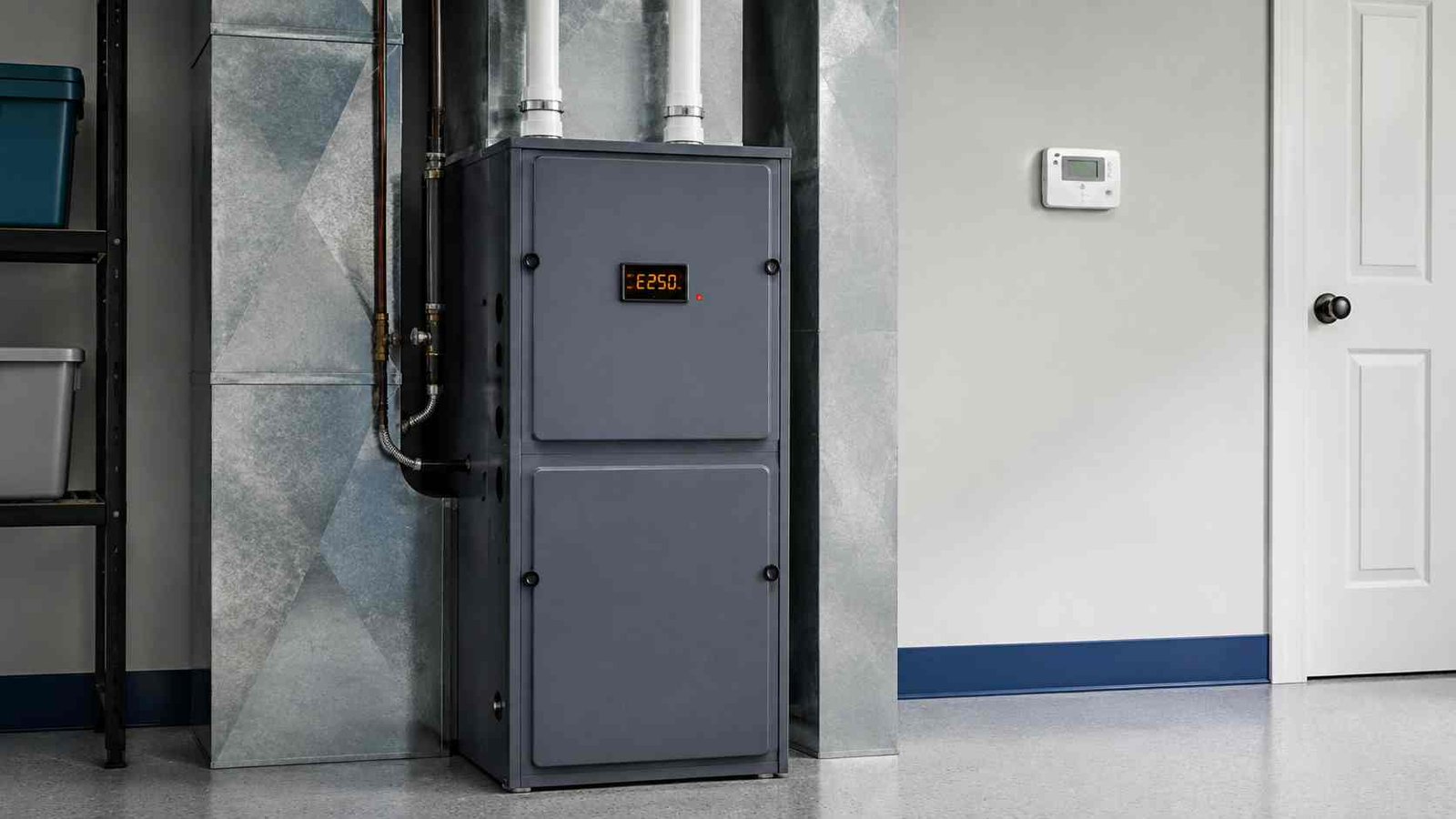
Lennox furnace error codes identify problems involving ignition, flame detection, airflow, pressure switches, electrical power, communication, or safety controls. The exact meaning depends on the furnace model and control board. An older Lennox furnace may flash a red LED a certain number of times, while a newer model may show an E-code such as E250 or place a numbered alert on an iComfort thermostat.
Start by recording the complete code before switching anything off. Then check the furnace model number, filter, thermostat settings, open air vents, and visible outdoor vent terminations. Do not continue troubleshooting if you smell gas, a carbon-monoxide alarm activates, the furnace shows a rollout or out-of-sequence flame fault, or the code returns after one restart. Lennox documentation directs gas-furnace installation and internal service to qualified professionals.
Important: Lennox does not use one universal fault-code table. Always compare the displayed code with the diagnostic chart supplied with your exact furnace.
Lennox Furnace Code
| Item | Details |
|---|---|
| Appliance | Residential gas furnace |
| Brand | Lennox |
| Code formats | Red LED flashes, seven-segment E-codes, or thermostat alerts |
| Common fault areas | Airflow, ignition, flame sensing, pressure switches, blower, voltage, communication |
| Safe first check | Record the code, inspect the filter, and confirm vents are open |
| Can the furnace still run? | Some warnings allow limited operation; lockout and safety faults may stop heating |
| Reset difficulty | Easy externally, but a reset does not repair the underlying fault |
| Professional help | Required for gas, combustion, wiring, pressure-switch, blower, rollout, and repeated ignition faults |
Why Lennox Furnace Codes Differ by Model
Lennox has used several generations of furnace controls. That is why two furnaces carrying the same brand name may display faults differently.
Red LED flash-count controls
Selected older models use a red light that flashes a repeated number of times. The pause between groups separates one code cycle from the next.
On the ML180DFE control documented by Lennox:
- A slow heartbeat indicates normal idle, continuous-fan, or cooling operation.
- A rapid heartbeat can indicate a call for heat or burner operation.
- Numbered flash groups identify specific faults.
- The control stores recent error history.
Seven-segment E-code controls
Newer or more advanced models may have a small diagnostic display on the furnace control board. It can show operating characters, airflow information, menu options, and codes beginning with E.
For example, the SLP99UHV control uses E-codes including E200, E223, E240, E250, E270, and E292.
iComfort thermostat alerts
Compatible Lennox communicating thermostats can display numbered alerts without the E prefix. For example, furnace code E250 may appear as alert 250 through the thermostat notification system.
Lennox classifies some notifications as Service Soon and more serious conditions as Service Urgent. A Service Urgent notification can indicate that heating, cooling, or ventilation is unavailable and that licensed HVAC service is required promptly.
K-series refrigerant detection codes
Some current furnace model numbers ending in K include onboard refrigerant-detection support for compatible systems. Their diagnostic tables may include E150-series sensor and refrigerant alerts that are not found on older furnaces. Lennox explains that K-designated versions include the detection system, while otherwise similar non-K versions do not.
Before Decoding the Light or Display
Complete these steps before using any online error-code table.
1. Record exactly what you see
Write down:
- Every letter and number
- The number of LED flashes
- Whether the light is slow, fast, solid, or completely off
- Any thermostat notification
- What the furnace does before it stops
- Whether the blower continues running
Do this before resetting the furnace. Removing power can clear an active display even though the control may retain the fault in its history.
2. Find the furnace model number
The model and serial numbers are printed on the furnace nameplate. Depending on furnace design and orientation, the label may be near the interior cabinet wall or blower deck.
Access-panel removal may expose electrical and combustion components. Turn the thermostat off first, follow the user manual, and do not touch internal wiring or controls merely to find the label. Lennox provides a product-literature search that can locate documents by model number. (Lennox)
3. Check the furnace’s own diagnostic chart
Many furnaces have a code chart on the inside of a panel or in the installation manual. Treat that model-specific chart as the primary reference.
The tables below provide common Lennox examples, but they should not override your furnace documentation.
Common Lennox Furnace E-Codes
The following codes appear in selected Lennox seven-segment control documentation. Availability and exact recovery behaviour vary by model.
Electrical, communication, and control codes
| Code | Typical meaning | Homeowner action |
|---|---|---|
| E105 | Communication problem between system devices | Record the code and arrange service if it persists |
| E110 | Low incoming line voltage | Check whether the home has a wider power problem; do not test furnace voltage |
| E113 | High incoming line voltage | Turn the system off and contact an HVAC technician or electrician |
| E114 | Power frequency outside the required range | Professional electrical diagnosis required |
| E115 | Low 24-volt control power | Professional diagnosis of transformer, wiring, or connected accessories |
| E124 | Thermostat communication signal missing | Confirm the thermostat has power; service is needed if communication does not return |
| E125 | Control self-check or internal hardware failure | One power cycle may be tried; persistent faults require control diagnosis |
| E126 | Internal communication failure within the control | Professional control-board diagnosis required |
These codes can be caused by power-supply problems, wiring faults, failed controls, loose communication connections, or incompatible configuration. Do not probe live voltage or reconnect internal wiring as a homeowner.
K-series refrigerant detection codes
| Code | Meaning on applicable K-series controls | Recommended response |
|---|---|---|
| E150 | Refrigerant detected near the indoor coil | Stop treating it as a normal furnace fault and arrange HVAC service |
| E151 | Refrigerant detector sensor 1 fault | Sensor or control diagnosis required |
| E152 | Refrigerant detector sensor 2 fault | Sensor or control diagnosis required |
| E154 | Sensor 1 communication or configuration problem | Wiring, connector, sensor, or switch configuration needs professional inspection |
| E155 | Sensor 2 communication lost | Professional inspection required |
| E160 | Sensor 1 type is incorrect | Correct approved sensor must be installed |
| E161 | Sensor 2 type is incorrect | Correct approved sensor must be installed |
| E163 | Furnace control-board failure | Control-board diagnosis may be required |
| E164 | Low-GWP system test mode | Usually a temporary test display rather than a fault |
| E390 | Low-GWP relay stuck | Furnace control may require repair or replacement |
These codes apply only to furnaces and system configurations equipped for refrigerant detection. Do not disable a detection sensor, alter its switches, or bypass the blower response.
Rollout, gas-valve, blower, and igniter codes
| Code | Typical meaning | What to do |
|---|---|---|
| E200 | Rollout circuit open or previously open | Turn the furnace off and call a qualified technician |
| E201 | Indoor blower communication failure | Professional blower and control diagnosis |
| E202 | Blower motor or furnace capacity mismatch | Installer configuration must be checked |
| E203 | Furnace capacity has not been programmed | Installer setup required |
| E204 | Gas valve miswired | Do not operate the furnace; professional service required |
| E205 | Gas-valve relay contact problem | Turn the furnace off and arrange service |
| E207 | Hot-surface igniter circuit sensed open | Igniter and control testing required |
E200 is not a filter-change code. A rollout switch responds to abnormal heat or flame conditions around the burner area. Do not reset, bypass, press, or replace the rollout switch without finding why it opened. Official Lennox instructions classify the condition as a hard lockout requiring the cause to be corrected and furnace operation tested.
Pressure-switch and venting codes
| Code | Typical meaning | Safe homeowner check |
|---|---|---|
| E223 | Low pressure switch failed to open or prove correctly, depending on control wording | Look for an obvious external vent obstruction |
| E224 | Low pressure switch failed closed | Professional diagnosis required |
| E225 | High pressure switch failed open | Check only the visible exterior termination |
| E226 | High pressure switch failed closed | Professional diagnosis required |
| E227 | Pressure switch opened during ignition or operation | Inspect the exterior vent area from ground level |
| E228 | Pressure-switch calibration unsuccessful | Arrange service if the code remains |
A pressure-switch code does not automatically mean the pressure switch itself has failed. Possible causes include restricted intake or exhaust venting, condensate drainage problems on a condensing furnace, damaged tubing, inducer problems, installation issues, or an actual switch fault.
Testing requires pressure measurements and inspection of combustion equipment. Those are technician-level procedures.
Flame and overheating codes
| Code | Typical meaning | Response |
|---|---|---|
| E240 | Low flame current during operation | Professional flame-signal and combustion inspection |
| E241 | Flame sensed out of sequence | Turn off the furnace and gas supply only if you know how to do so safely; call for service |
| E250 | Primary limit-switch circuit open | Check filter and open vents; service if the fault returns |
| E252 | Discharge-air temperature too high | Check filter; airflow and firing rate require professional testing |
E241 is a serious condition because the control is detecting flame when it should not be present. Lennox’s diagnostic guidance calls for shutting off gas and checking for gas-valve leakage. That inspection must be performed by a qualified professional.
Ignition lockout and blower codes
| Code | Typical meaning | Response |
|---|---|---|
| E270 | Maximum ignition attempts exceeded with no flame detected | One restart only if no safety warning is present; service if it returns |
| E271 | Lockout after pressure switch opened during ignition attempts | Professional venting and pressure diagnosis |
| E272 | Repeated pressure-switch opening during operation | Professional diagnosis |
| E273 | Repeated flame loss during heating | Flame sensing, grounding, gas flow, or combustion inspection required |
| E274 | Limit remained open or repeatedly opened | Check filter and vents; do not keep resetting |
| E275 | Out-of-sequence flame fault followed by lockout | Turn the furnace off and arrange urgent service |
| E276 | Pressure-switch calibration repeatedly failed | Professional diagnosis |
| E290 | Igniter circuit fault | Igniter and control testing required |
| E291 | Heating airflow below minimum | Check filter and open vents; blower and duct testing may be needed |
| E292 | Indoor blower cannot start | Turn the system off and arrange service |
| E294 | Inducer motor current too high | Professional inducer diagnosis |
| E295 | Indoor blower motor temperature too high | Turn the system off if the fault persists |
Watchguard is a protective lockout condition. The control stops or limits furnace operation after repeated ignition, flame, pressure, or temperature failures. Waiting for the lockout period or cycling power may allow another attempt, but it does not remove the cause.
Lennox Red-Light Flash Codes
The following flash pattern is documented for selected ML180DFE ignition controls. Other Lennox controls may assign different meanings.
| Red LED pattern | Meaning on the documented ML180DFE control |
|---|---|
| Light off | No control power or possible board fault |
| Solid light | Board fault on selected control version |
| Slow heartbeat | Normal idle, cooling, or continuous-fan operation |
| Fast heartbeat or rapid flash | Call for heat or burner operation |
| 1 flash | Reversed line-voltage polarity |
| 2 flashes | Improper earth ground |
| 3 flashes | Burner failed to light or flame was lost |
| 4 flashes | Low flame signal |
| 5 flashes | Ignition retries or recycles exceeded; Watchguard lockout |
| 6 flashes | Not used |
| 7 flashes | Primary or secondary limit open |
| 8 flashes | Rollout switch open |
| 9 flashes | Pressure switch failed to close or opened during heating |
| 10 flashes | Pressure switch opened repeatedly during one heat demand |
| 11 flashes | Pressure switch stuck closed before inducer activation |
| 12 flashes | Flame sensed without the gas valve being energized |
| 13 flashes | Low line voltage |
A flash code repeats after a pause. Count only the quick flashes within one group. A normal heartbeat is not the same as a one-flash fault.
Which flashing codes are urgent?
Stop using the furnace and call a qualified HVAC contractor for:
- 8 flashes indicating an open rollout switch
- 12 flashes indicating flame without the gas valve being energized
- Repeated breaker trips
- Burning or electrical odours
- Gas odour
- A carbon-monoxide alarm
- Visible scorching, soot, or heat damage
- Any code that immediately returns after a restart
Seven flashes can sometimes be related to restricted airflow, but a repeatedly open limit can also involve blower performance, duct restriction, firing rate, or another overheating cause.
Safe Checks You Can Perform
These checks stay outside gas, electrical, and combustion components.
1. Check the thermostat
Confirm that:
- The thermostat is set to Heat.
- The target temperature is above room temperature.
- The display has power.
- There is no Hold, Away, Schedule, or system-off setting preventing heating.
- Any active notification has been recorded.
On compatible Lennox thermostats, open the notifications area and write down the alert number before restarting the system. (Lennox)
2. Inspect the air filter
A heavily restricted filter can reduce supply airflow and contribute to high-temperature or low-airflow faults such as E250, E252, E274, or E291.
Replace a disposable filter if it is visibly dirty or overdue. Use the correct size and airflow direction. Do not run the furnace without a filter.
Filter replacement frequency depends on the filter type, system use, pets, dust, and indoor conditions. Lennox recommends regular inspection and advises owners to consult the manual or dealer for the correct filter. (Lennox)
3. Open supply and return vents
Make sure:
- Supply registers are open.
- Return grilles are not blocked by furniture, curtains, rugs, or boxes.
- No filter has been installed in the wrong location.
- Multiple filters have not been added unless the system was designed for them.
Closing too many registers does not improve efficiency and may increase system airflow resistance.
4. Look at the exterior vent termination
From ground level, check whether the furnace intake or exhaust is visibly blocked by:
- Snow
- Ice
- Leaves
- Insect nests
- Plastic bags
- Debris
Do not dismantle vent pipes, climb onto a roof, insert tools into the termination, or operate the furnace with venting disconnected.
Lennox user guidance notes that heavy snow, ice, or frozen fog can restrict furnace vent pipes and recommends keeping terminations unobstructed.
5. Check the furnace power switch and breaker
Confirm that the nearby furnace service switch is on and that the circuit breaker has not tripped.
Reset a breaker only once. If it trips again, leave it off and call a technician. A repeated trip can indicate a motor, wiring, or control fault.
6. Confirm the access panels are seated
Many furnaces have a door interlock switch that interrupts power when a panel is not correctly installed. A loose panel after a filter change or inspection may prevent operation.
Do not defeat or hold the switch closed by hand.
How to Reset a Lennox Furnace
A restart may clear a temporary communication interruption or allow the furnace to retry after a soft lockout. It will not repair blocked venting, overheating, flame loss, a failed motor, a gas-valve problem, or a safety-switch activation.
Do not reset the furnace when:
- You smell gas.
- A carbon-monoxide alarm has activated.
- The furnace shows E200, E241, E275, 8 flashes, or 12 flashes.
- The breaker trips repeatedly.
- You see scorching, soot, melted wiring, or water damage.
- The furnace makes a new loud mechanical or electrical noise.
- The unit has been flooded.
Lennox states that a flood-damaged furnace should not be operated until inspected because wet gas controls and electrical parts can create fire or explosion risks.
One external power-cycle attempt
When no immediate safety warning is present:
- Record the code.
- Set the thermostat system mode to Off.
- Allow the blower to stop.
- Turn off the furnace using its external service switch or circuit breaker.
- Wait about 30 seconds.
- Restore power.
- Set the thermostat to Heat.
- Watch one complete heating attempt from a safe distance.
Do not repeat this process several times. If the same code returns, leave the furnace off if it involves gas, flame, rollout, overheating, or electrical failure and arrange service.
Clearing error history is not a repair
Selected older Lennox controls store their ten most recent codes. Modern seven-segment controls may also provide an error-recall menu and an option to clear stored history.
Clearing history removes the record. It does not correct an active condition. Because these controls are usually inside the furnace cabinet, error recall and history clearing are better left to a technician unless the exact homeowner manual clearly authorizes the procedure.
What to Do When the Basic Fix Fails
The filter is clean, but E250 returns
E250 means the primary limit circuit is open on applicable controls. A dirty filter is only one possible cause.
Other possibilities include:
- Blocked or undersized ductwork
- Too many closed registers
- A non-functioning zoning damper
- Weak blower performance
- Incorrect blower setup
- Excessive firing rate
- A limit-control or wiring problem
The technician may need to measure temperature rise, airflow, gas input, and duct static pressure. Do not replace or bypass the limit switch without diagnosing why it opened.
E223 or another pressure-switch code returns
Check the outdoor vent opening for an obvious obstruction. If it is clear, stop there.
Pressure-switch diagnosis may involve:
- Combustion-air inducer testing
- Pressure measurements
- Condensate trap and drain inspection
- Vent sizing and slope checks
- Tubing inspection
- Furnace level checks
- Switch and wiring testing
A new pressure switch should not be installed based on the code alone.
E270 returns after a reset
E270 means the control exceeded its allowed ignition attempts without proving flame on applicable furnaces.
Possible causes include:
- Interrupted gas supply
- A failed hot-surface igniter
- Low flame signal
- Burner contamination
- Flame-sensor or grounding problems
- Condensate or pressure-related problems on a condensing furnace
- Gas-valve or control faults
Gas flow, ignition current, combustion, and valve operation require professional diagnosis.
The burners light and then shut off
A furnace that lights briefly and loses flame may produce E240, E273, three flashes, four flashes, or five flashes, depending on its control.
The cause may involve flame sensing, grounding, burner condition, gas pressure, vent recirculation, or control wiring. Cleaning or replacing a flame sensor is often presented as a simple repair, but the same symptom can have several causes. Repeated flame loss needs a complete diagnosis.
The blower runs but the burners remain off
The blower may continue operating during:
- An open-limit condition
- A rollout fault
- A refrigerant-detection response on compatible K-series systems
- A control or thermostat command
- A blower or communication problem
- A cooling or continuous-fan demand
Do not assume that the blower itself has failed merely because it runs continuously. Record the code and thermostat status.
Parts a Technician May Test
Depending on the code, professional diagnosis may include:
| Component | Related code areas |
|---|---|
| Integrated furnace control | E105–E126, E163, E390 |
| Indoor blower motor or module | E201, E202, E291, E292, E295 |
| Hot-surface igniter | E207, E270, E290 |
| Flame sensor and burner grounding | E240, E270, E273 |
| Pressure switches and tubing | E223–E228, E271, E272, E276 |
| Combustion-air inducer | Pressure-switch faults and E294 |
| Primary limit switch | E250, E274 |
| Rollout switch | E200 |
| Gas valve | E204, E205, E241, E275 |
| Refrigerant detector and wiring | E150–E161 |
| Thermostat communication wiring | E105, E120, E124 |
The code identifies the circuit or condition detected by the control. It does not always identify the failed part.
When to Stop Using the Furnace
Turn the furnace off and seek professional help immediately when:
- You smell gas.
- The carbon-monoxide alarm sounds.
- Anyone develops headache, dizziness, nausea, or unusual fatigue that improves outside the home.
- E200, E241, E275, 8 flashes, or 12 flashes appears.
- The furnace or vent pipe shows soot, rust streaks, scorching, or melting.
- The breaker trips more than once.
- There is a strong electrical or burning smell.
- The furnace has been exposed to flooding.
- Vent pipes are damaged or disconnected.
When gas is smelled, Lennox instructs occupants not to light appliances, touch electrical switches, or use a phone inside the building. Leave immediately, call the gas supplier from outside or a neighbour’s phone, and contact the fire department if the supplier cannot be reached.
When to Call a Lennox Dealer or HVAC Technician
Arrange professional service when:
- The same code returns after one safe restart.
- There is no heat during freezing weather.
- A Service Urgent thermostat alert appears.
- An ignition or flame code repeats.
- A limit code returns with a clean filter and open vents.
- A pressure-switch code remains after confirming the exterior vent is clear.
- The blower will not start.
- The furnace repeatedly short cycles.
- Internal electrical, gas, or combustion testing is required.
- You cannot confirm the code from the model-specific manual.
Provide the technician with the model number, serial number, complete code, thermostat alert, recent maintenance history, and a description of what the furnace does before it stops.
Frequently Asked Questions
What does a blinking red light on a Lennox furnace mean?
It may indicate normal operation or a diagnostic fault. A slow heartbeat is normal on selected ML180DFE controls, while groups of rapid flashes identify faults. Count the flashes and compare them with the chart for your exact model.
Are Lennox furnace error codes the same on every model?
No. Older furnaces may use flash counts, newer models may use E-codes, and communicating systems may display numbered thermostat alerts. Even similar codes can have different wording or recovery rules across controls.
What does Lennox furnace code E250 mean?
On applicable controls, E250 means the primary limit-switch circuit is open. Check the filter and make sure supply and return vents are unobstructed. If the code returns, a technician must check airflow, firing rate, zoning, blower performance, duct restriction, and the limit circuit.
What does Lennox furnace code E270 mean?
E270 indicates that the furnace exceeded the maximum number of ignition attempts without proving flame on applicable controls. It may involve gas flow, the igniter, flame sensing, grounding, pressure conditions, or combustion components. Professional service is required if it returns.
Can I run my Lennox furnace with an error code?
It depends on the code. A normal heartbeat is safe, while some Service Soon alerts may allow temporary operation. Do not continue using the furnace with rollout, out-of-sequence flame, repeated ignition, gas odour, carbon-monoxide, overheating, or electrical faults.
Why does the error return after resetting the furnace?
A reset restarts the control but does not remove a blocked vent, dirty filter, weak blower, flame-signal problem, failed igniter, wiring fault, gas problem, or open safety circuit. A returning code means the original condition is still present or is recurring.
How do I clear stored Lennox furnace codes?
The procedure varies by control. Some flash-code boards store recent faults and use a diagnostic button, while seven-segment controls may have an E error-history menu and a c clear option. Because the control is inside the furnace cabinet, follow the exact model manual or allow a technician to retrieve and clear the history.
Where can I find the correct Lennox furnace manual?
Use the model number from the furnace nameplate and search the official Lennox Product Literature library. Do not choose a manual based only on the appearance of the furnace.
Daniel Brooks is a US-based appliance troubleshooting researcher with 12 years of experience studying washer, dryer, refrigerator, and dishwasher faults. He reviews manufacturer manuals and converts technical error codes into safe, practical guidance for homeowners.