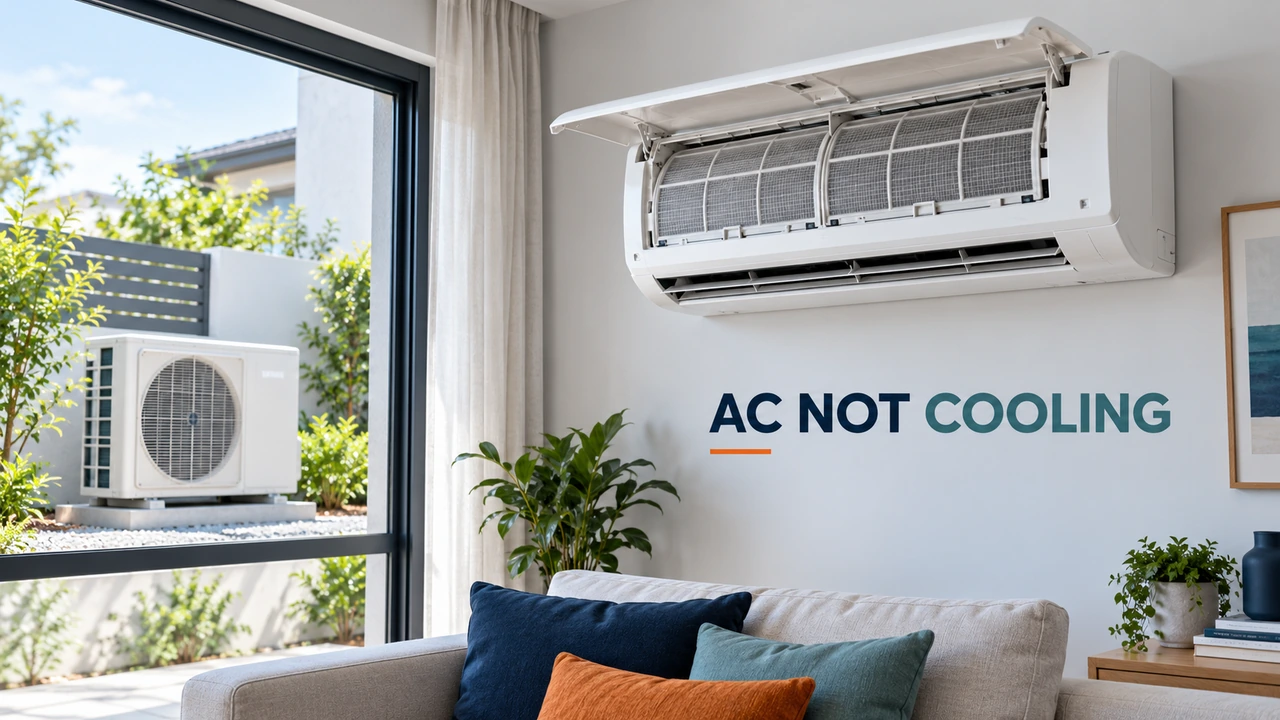
 If your air conditioner is not cooling, check the thermostat setting, air filter and airflow before assuming the compressor has failed. An AC that blows room-temperature air may be running its indoor fan without actively cooling. A clogged filter, blocked outdoor unit or frozen indoor coil can also reduce cooling. These checks apply broadly, but central, ductless mini-split, window and portable air conditioners have different access points and maintenance rules.
Turn cooling off and arrange professional help if you see ice on the refrigerant lines, hear severe electrical noises, smell burning, notice damaged wiring or find water near electrical components. Never open electrical panels, handle capacitors, cut refrigerant tubing or add refrigerant yourself.
First, identify what your AC is doing
The distinction between weak airflow and air that flows normally but is not cold helps narrow the issue. An AC that cannot cool one room may have a different problem from a system that cannot cool the entire home.
| What you notice | Possible explanation | Safe first check |
|---|---|---|
| Fan runs, but air feels warm | Fan-only setting, thermostat problem or outdoor cooling system not operating | Check Cool mode and setpoint |
| Airflow is weak from vents | Dirty filter, blocked return or frozen coil | Inspect user-accessible filters and vents |
| AC runs constantly but room stays warm | High heat load, restricted airflow, dirty outdoor coil or equipment fault | Check shade, windows and outdoor clearance |
| Ice appears on pipes or indoor coil | Airflow restriction or refrigerant-system problem | Switch cooling off and request service |
| Indoor fan runs, outdoor unit stays silent | Normal control delay, power interruption or outdoor equipment fault | Check displayed settings and observe from a safe distance |
| Water appears around indoor unit | Condensate drainage issue or frozen-coil thawing | Stop cooling if leaking and protect nearby electrics |
1. Confirm the thermostat and cooling mode
Set the thermostat or remote to Cool, not Fan, Heat or Dry, and choose a target temperature below the current room temperature. On central systems, the fan setting On may circulate room-temperature air even when the compressor is not cooling; Auto generally runs the blower according to cooling demand. Some systems also have scheduled setbacks or energy-saving modes that change the setpoint.
Give the system time to respond after a setting change. Many units have a built-in compressor restart delay to protect equipment. Avoid repeatedly turning it off and on to force cooling. If the remote or thermostat display is blank, consult its manual for battery and basic power checks.
2. Check the air filter and clear indoor airflow
A dirty air filter reduces airflow across the indoor cooling coil and can eventually contribute to icing. Turn the unit off before removing a filter the manufacturer identifies as user-serviceable. Replace a disposable filter with the correct size and airflow rating, or wash a reusable filter only as the manual permits and let it dry fully before reinstalling.
Make sure return-air grilles and supply vents are not blocked by furniture, curtains or stored items. For a ductless mini-split, inspect the accessible mesh filters in the indoor wall unit using its instructions. Do not open the sealed coil compartment or run the unit without its required filters.
3. Look at the outdoor unit without opening it
On central and ductless split systems, the outdoor condenser needs unobstructed airflow to release heat. From a safe position, look for leaves, packaging, grass clippings or vegetation packed around the cabinet. Remove only loose debris that can be cleared from outside the unit without reaching through the grille. Follow the manufacturer’s clearance guidance, including keeping adequate space around the sides and above the equipment.
If the outdoor fan is not running during an expected cooling cycle, note the observation rather than reaching toward it or trying to start it by hand. A control delay can be normal; a persistent failure may involve power supply, controls, fan motor or compressor-related components and needs qualified service. Do not remove the cabinet or spray the unit with a pressure washer.
4. Check for frozen coils or refrigerant-line ice
Ice on the accessible refrigerant tubing, reduced airflow or a suddenly weak cooling performance can indicate a frozen evaporator coil. A dirty filter or blocked airflow can contribute, but refrigerant problems and other faults are also possible. Switch cooling off and call an HVAC professional. Do not chip ice away, direct heat at tubing or keep running the compressor in hopes that the ice will clear.
Even if visible ice eventually melts, the underlying cause may remain. A technician can check airflow, the indoor coil condition and the sealed refrigerant system using appropriate procedures.
5. Why is the AC running but not blowing cold air?
When air comes through the vents at a normal rate but does not feel cooler than the room, revisit the mode and temperature setting first. On a central system, the indoor blower may run independently of the outdoor cooling equipment. On a window or portable unit, Fan mode likewise moves air without active refrigeration.
If settings are correct and sufficient time has passed, a malfunctioning compressor, capacitor, control board or refrigerant system becomes possible. These components cannot be reliably diagnosed by sound alone, and electrical capacitors can retain dangerous charges after power is disconnected. Stop at external observations and arrange service.
6. Why does the AC cool a little but not the whole room?
Closing windows and doors, reducing direct sunlight and checking whether cooking appliances or other heat sources are adding unusual heat can improve cooling performance. An undersized system, damaged ductwork, poor insulation or extremely hot outdoor conditions may also explain why the thermostat target is not reached, even if the equipment is operating.
On central systems, uneven cooling between rooms may reflect duct restrictions, airflow balancing or building heat gain rather than a failed compressor. Avoid closing many supply registers as a quick fix; doing so can upset airflow on some systems. If a properly maintained unit cannot keep up under typical conditions, an HVAC professional can assess capacity and distribution.
7. Window, portable and mini-split ACs need different checks
| AC type | Useful homeowner checks | Model-specific limitation |
|---|---|---|
| Central ducted system | Thermostat, return filter, vents, outdoor-unit clearance | Internal coils, wiring, capacitors and refrigerant are service work |
| Ductless mini-split | Remote mode, indoor mesh filters, unobstructed indoor and outdoor airflow | Multi-zone systems may follow special operating modes |
| Window air conditioner | Cool rather than Fan mode, accessible filter, unobstructed indoor and outdoor grilles | Do not remove the unit or open the cabinet without safe installation and manufacturer guidance |
| Portable air conditioner | Exhaust-hose routing, filter, window seal and water-container alert where applicable | Single- and dual-hose designs and drainage rules differ |
For a portable AC, ensure its exhaust hose is fitted and routed according to the manual. A crushed, detached or excessively long hose may reduce performance. Some portable units stop cooling when a condensate container is full; follow the approved draining procedure rather than improvising an outlet.
8. Could low refrigerant be the reason?
Yes, inadequate refrigerant charge can reduce cooling, but it is not something that can be established from warm air alone. Refrigerant does not normally get consumed during operation. If the charge is low, a leak or improper charging may be involved. A qualified professional should locate the cause, determine whether repair is appropriate and perform any legally required refrigerant handling.
Avoid offers to simply top up refrigerant without investigating the underlying problem. Do not puncture lines, apply leak-sealing products or attempt to measure refrigerant pressure as a homeowner troubleshooting step.
9. What if the AC stops cooling after running for a while?
If cooling starts normally then weakens, note whether airflow also decreases, whether ice appears and whether the outdoor equipment stops. Restricted airflow or a freezing coil may fit that pattern, although overheating protection or an electrical fault is also possible. A blocked condensate line can trigger a safety shutoff on equipped central systems. Do not bypass a float switch or drain protection to keep cooling running.
Stop operation if ice, leaking water, electrical faults or unusual noises appear. An HVAC professional can distinguish among these causes without risking damage to the compressor.
When to call an air-conditioning technician
- The system remains warm after checking Cool mode, the setpoint, user-accessible filters and airflow.
- The outdoor fan or compressor appears inactive during sustained cooling demand.
- There is visible ice, repeated water leakage, a persistent fault code or rapidly worsening cooling.
- A breaker trips, the unit smells hot, or there are sparks, smoke or damaged electrical parts.
- Checking refrigerant, wiring, capacitors or internal sealed components would be required.
Before arranging service, note the make and full model number, whether the equipment is central, mini-split, window or portable, the thermostat settings, whether air is moving, any visible ice and when the cooling stopped. These details make diagnosis more useful than simply saying the AC is not cold.
Keep cooling performance from falling again
Check and replace or clean filters at the intervals specified in the manual, keep air grilles clear and maintain vegetation clearance around outdoor units. Arrange professional maintenance when recommended, especially if the system’s cooling has gradually weakened. Use suitable temperature settings, limit unnecessary heat gain and investigate new noises, icing or drainage problems promptly.
Bottom line: if an air conditioner is not cooling, start with the mode and thermostat, then the filter and unobstructed indoor and outdoor airflow. Warm air with normal airflow, persistent icing or an inactive outdoor unit may point to a fault that needs professional diagnosis. Do not treat refrigerant or live electrical repairs as ordinary DIY checks.

Ahmad Raza is the website administrator and content operations manager at Error Code Vault. With 11 years of experience in technical publishing, he manages site accuracy, author verification, source quality, updates, user feedback, and editorial compliance.