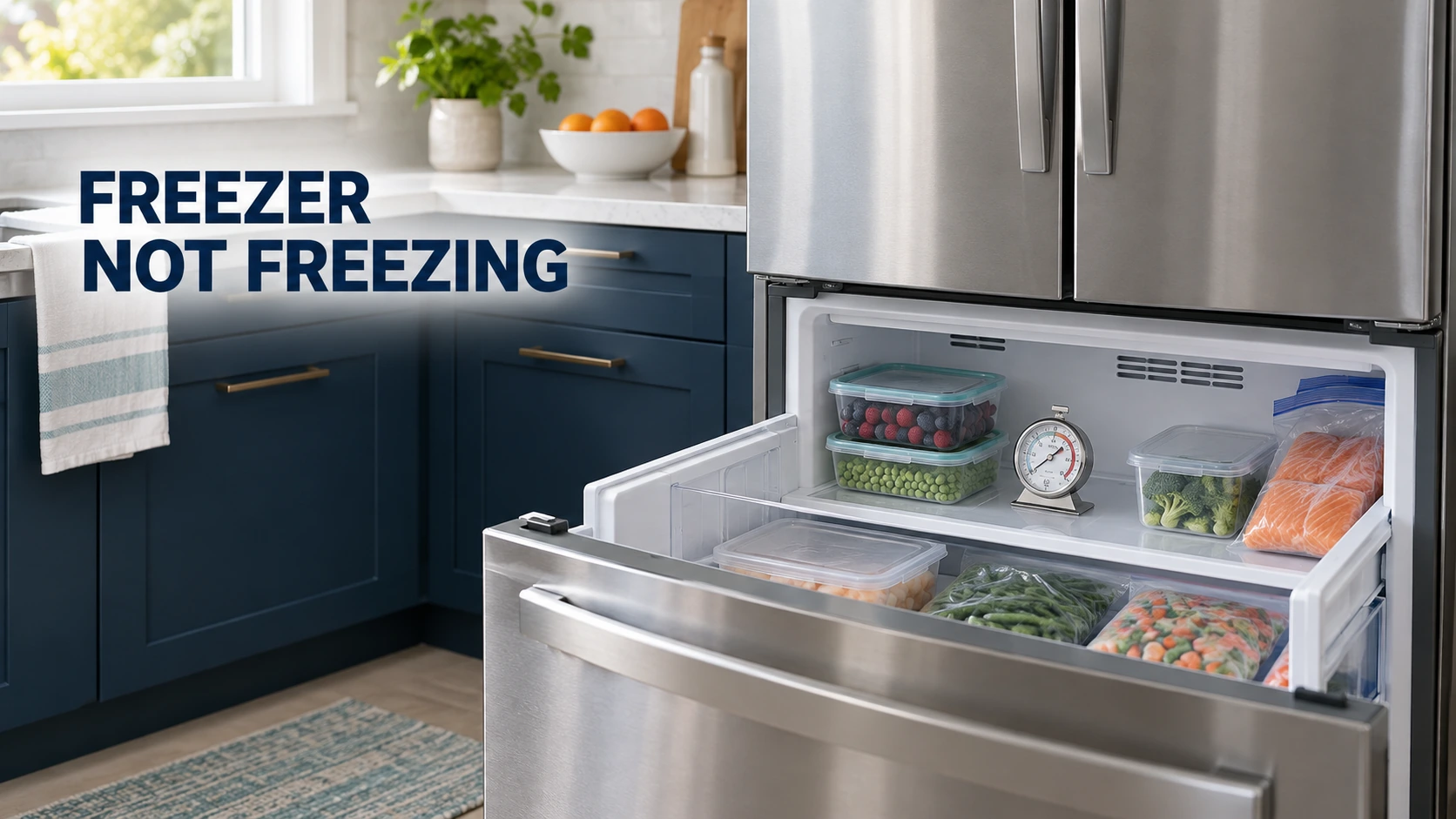
If your fridge freezer is not freezing, check whether the freezer is actually reaching 0°F (-18°C) before assuming a failed compressor. A freezer can feel cold while remaining too warm to keep food firmly frozen. Start with the temperature setting, a door that may not seal, food blocking vents, excessive frost, and the space around the appliance.
Protect the food first. Keep the door closed while you check temperatures and move vulnerable food to a working freezer if necessary. Do not taste thawed food to decide whether it is safe. FoodSafety.gov says previously frozen food can generally be refrozen if it still has ice crystals or measures 40°F (4°C) or below, but use its food-specific discard guidance for food that has warmed further or whose history is uncertain.
Is the fridge cold while the freezer is not freezing?
The difference matters. If the refrigerator compartment is maintaining a safe temperature but frozen food is softening, concentrate on the freezer’s own settings, door, airflow and frost. That pattern does not prove the compressor or refrigeration circuit is healthy. If both sections are warming, the problem may affect overall cooling capacity or power. And if the freezer is properly frozen but the fridge is warm, follow the separate freezer-cold, fridge-warm troubleshooting guide instead.
| What you observe | Most useful next check | When to escalate |
|---|---|---|
| Freezer feels cold but ice cream is soft | Measure its temperature with a freezer-safe thermometer | If it cannot maintain 0°F (-18°C) after basic checks |
| Fridge seems normal, freezer food is thawing | Freezer setting, door seal, blocked vents and frost | If cooling remains weak or thawing continues |
| Both compartments are too warm | Power, operating mode, cabinet ventilation and overall cooling | If temperatures continue to rise |
| Thick frost or ice near a panel | Door closure and visible frost accumulation | If frost repeatedly returns or airflow stays poor |
| Repeated clicking or an electrical burning smell | Stop using the appliance if an electrical hazard is suspected | Arrange qualified service; do not access internal circuits |
Check these causes in a safe order
1. Confirm the freezer temperature and controls
Place a freezer-safe thermometer where its instructions recommend and compare the reading with the selected temperature. The normal target for food storage is 0°F (-18°C) or colder. A display may show the set temperature rather than the air’s actual temperature. Check that the appliance is not in a cooling-off or showroom setting; names and button sequences vary by model. Use your own manual, not a reset shortcut for another brand.
2. Look for a door that is not fully closed
A food container, protruding drawer or frost along the edge can prevent the door from closing. Inspect the accessible gasket for dirt, tears, folds or gaps and clean it as directed by the manufacturer. Warm, moist room air entering through the door may cause frost and weak freezing. If the door is misaligned or the seal is damaged, ask for model-specific repair rather than forcing the hinges.
3. Move food away from freezer vents
Check for packages pushed against the inside air outlets or an overfilled drawer. Rearrange food so that air can move through the freezer. Whirlpool’s freezer troubleshooting guidance identifies blocked airflow, incorrect settings and door seals as useful first checks. The position of vents and fans is model-dependent; do not remove a rear interior panel to locate them.
4. Check for heavy frost, without chipping ice
Unusual frost can result from a door left ajar, poor sealing or a defrost-system problem. A frost-free model with persistent heavy buildup needs assessment, especially if the ice returns soon after normal operation resumes. If your manual permits manual defrosting, follow its complete procedure and protect the food elsewhere. Never use knives, an ice pick, a heat gun or other pointed or high-heat tools against the freezer liner: hidden tubing and plastic can be damaged.
5. Check installation conditions and permitted cleaning
Make sure vents outside the appliance are clear and the fridge freezer has the clearance required by its manual. A room outside the model’s rated ambient-temperature range can also affect performance, especially in a garage. LG’s freezer performance guidance identifies door closure, food loading, heat exposure and installation conditions as possible factors. Clean only condenser areas explicitly identified as user-accessible by the manufacturer; do not remove service panels.
What if these checks do not restore freezing?
Possible service-level faults include an evaporator or condenser fan problem on applicable models, a defrost-control fault, a temperature sensor or control problem, compressor starting difficulties, or reduced sealed-system performance. Symptoms alone cannot establish which component has failed. Some modern units also have multiple evaporators or variable-speed compressors, so generic fan or relay tests may not apply.
Do not test live wiring, handle compressor capacitors, open refrigerant tubing or bypass protection devices. A refrigerator that is repeatedly tripping its breaker, producing a burning smell or showing signs of a refrigerant leak needs qualified attention. For suspected refrigerant damage, keep away from ignition sources and follow the appliance safety instructions.
How to decide what to do with thawing food
Use the actual food condition and temperature, not whether the freezer still feels chilly. FoodSafety.gov’s frozen-food safety chart distinguishes foods that still contain ice crystals or are no warmer than 40°F (4°C) from food exposed to higher temperatures for too long. Frozen meat, poultry, fish and prepared meals require particular care. When you cannot establish safe storage conditions, discard high-risk items rather than relying on smell or taste.
The often-cited 48 hours for a full unopened freezer and 24 hours for a half-full freezer apply to power-outage estimates with the door kept closed. They do not establish that an already malfunctioning freezer will preserve food for those periods.
When to book a freezer repair
- The measured freezer temperature remains above 0°F (-18°C) despite correcting the setting, airflow, door and installation conditions.
- Food continues thawing or visible frost keeps returning.
- Both sections are warming or cooling stops intermittently.
- You notice repeated abnormal clicking, breaker trips, electrical damage or a possible refrigerant problem.
Before contacting service, record the full model number, actual freezer temperature, whether the fridge is still cold, any frost pattern, and when thawing began. This separates a freezer-specific problem from broader cooling failure and makes model-specific diagnosis more useful than guessing which part to replace.

Ahmad Raza is the website administrator and content operations manager at Error Code Vault. With 11 years of experience in technical publishing, he manages site accuracy, author verification, source quality, updates, user feedback, and editorial compliance.