
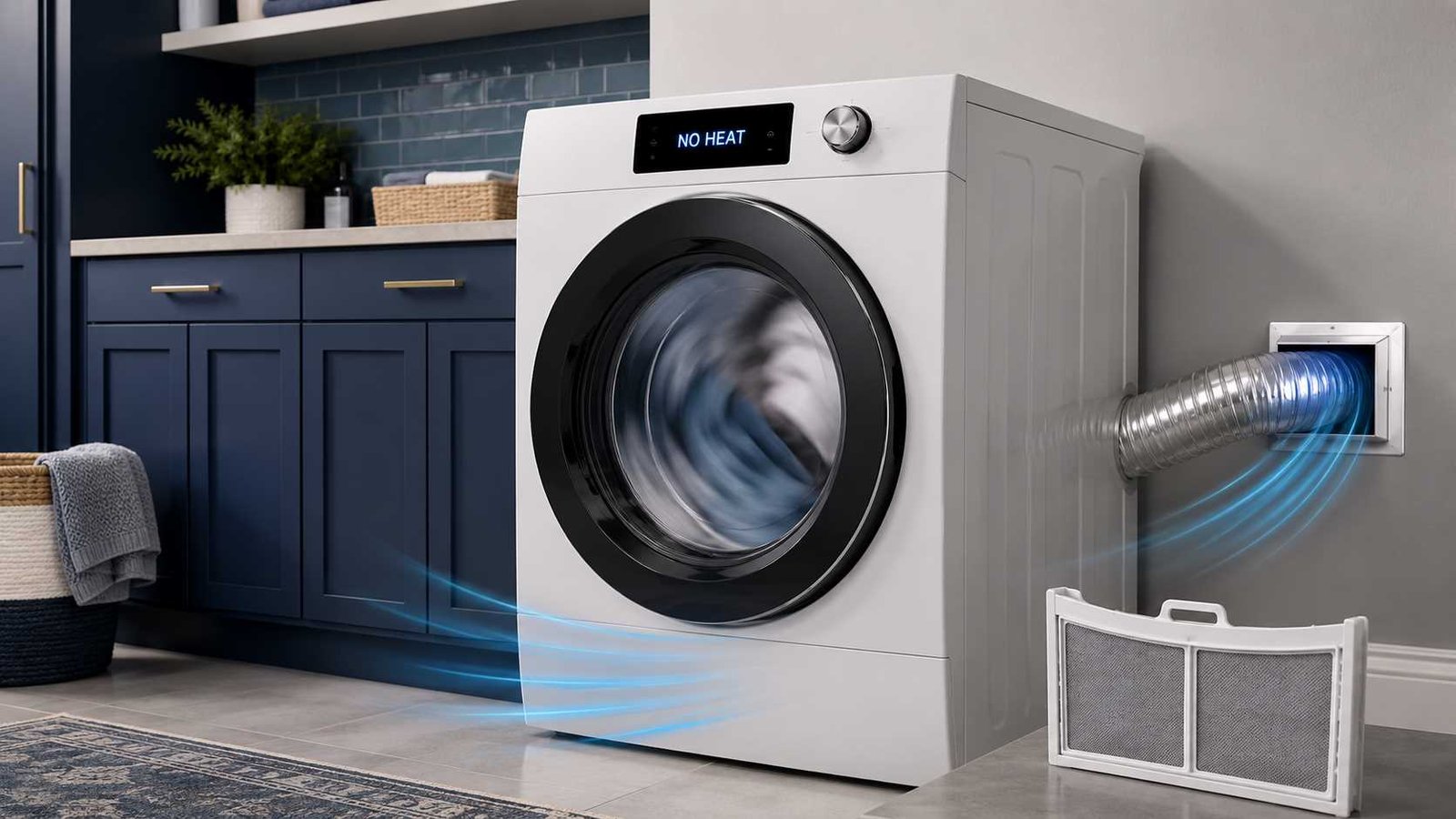
 When a dryer runs but does not heat, the drum motor and controls are receiving enough power to operate, but the heating system is not producing warm air. The cause may be as simple as an Air Only setting, a tripped household breaker, a closed gas valve, or a filter that needs cleaning. It may also involve a failed heating element, thermal safety device, burner component, sensor, or control.
Start by selecting a heated cycle, checking the lint filter, and confirming the correct electrical or gas supply. Do not open the dryer cabinet or test internal wiring yourself. Stop using the appliance immediately if you notice a burning smell, gas odour, smoke, scorch marks, a hot plug, crackling sounds, or repeated breaker trips.
Quick Answer
| Item | Details |
|---|---|
| Problem | Dryer drum turns, but little or no heat is produced |
| Appliance | Electric, gas, vented, condenser, or heat-pump clothes dryer |
| Brand | Can affect any brand; causes and circuits vary by model |
| Error code | Often no code; selected models may display a supply or heating code |
| Common first causes | Cool-air cycle, power-supply problem, closed gas valve, dirty filter, or restricted airflow |
| Safe first check | Run the correct heated cycle and inspect accessible filters and supplies |
| Repair difficulty | Easy for external checks; internal diagnosis requires professional service |
| Can it still be used? | Do not keep running heated cycles until the cause is understood |
| Professional help needed | When external checks do not restore heat or a safety warning appears |
A North American electric dryer may continue turning when one side of its electrical supply is unavailable, while a gas dryer may tumble normally when its gas shutoff valve is closed. Official manufacturer guidance therefore places cycle selection, breakers, fuses, and gas supply among the first checks.
Safety warning: Unplug or isolate the dryer and stop troubleshooting if you see smoke, scorching, a damaged cable, a hot plug or socket, or hear buzzing or crackling. Leave the area immediately if you smell gas. Do not operate switches, use a phone near the suspected leak, or try to find the leak yourself. Contact the local gas emergency service from a safe location.
Why Can a Dryer Run Without Heating?
The dryer motor, controls, and heating system do not always use the same part of the appliance circuit.
On many electric dryers sold in the United States and Canada, the motor can receive enough power to turn the drum even when the heater does not receive its full supply. This is why a dryer may appear to operate normally while blowing cold air.
A gas dryer uses electricity for its motor and controls but relies on gas for heat. If the gas supply is closed or interrupted, the drum can still rotate.
Heat-pump dryers work differently again. They recycle heat through a refrigerant-based system and normally operate at lower temperatures than conventional vented or condenser models. A heat-pump dryer that feels only mildly warm may be operating normally, especially early in the cycle.
First Decide: No Heat or Slow Drying?
These symptoms are related, but they are not identical.
Complete loss of heat
The drum and fan operate, but the inside remains cold during a proper heated cycle. Likely areas include:
- Incorrect cycle selection
- Incomplete electrical supply
- Closed or unavailable gas supply
- Failed heater or burner component
- Open thermal safety device
- Sensor, wiring, relay, or control failure
Dryer heats but clothes stay wet
The drum becomes warm, but drying takes too long. More likely causes include:
- Dirty lint filter
- Crushed or obstructed exhaust hose
- Blocked external vent
- Overloaded drum
- Clothes entering the dryer too wet
- Dirty condenser or heat exchanger
- Full water container or drainage problem
- Incorrect sensor cycle
Heat-pump dryer feels cooler than expected
Heat-pump models use lower drying temperatures and may take longer to become noticeably warm. Let the selected programme run instead of repeatedly opening the door. Clean the filters and accessible heat exchanger as directed in the model manual.
Common Causes of a Dryer Running Without Heat
1. Air Only or Cool Air Is Selected
Air Only, Air Fluff, Cool Air, and similar programmes tumble clothes without activating the heating system. Many dryers also stop applying heat during the final cool-down stage.
Check both the main programme and any separate temperature setting. Select a normal heated or timed-dry programme for testing. Whirlpool and Maytag recommend testing selected conventional dryers by running an empty heated timed cycle for about five minutes and then checking whether the drum has become warm.
Do not use a brief five-minute test to judge every heat-pump dryer. Some heat-pump systems need more time to build operating pressure and temperature.
2. An Electric Dryer Has Lost Part of Its Power Supply
Many full-size North American electric dryers use a paired household breaker or two fuses. One side may operate the motor while the other supplies the heating circuit. If one breaker trips, the dryer may turn without heating.
Turn both linked dryer breakers fully off and then back on once. A breaker can sometimes appear to be on even though it has tripped internally.
Do not:
- Remove the dryer’s electrical cover
- Inspect the terminal block while connected
- Measure live voltage
- Fit a higher-rated fuse
- Repeatedly reset a breaker that continues to trip
Persistent breaker problems should be investigated by a qualified electrician. Selected Whirlpool dryers may show an L2 code when low or missing line voltage prevents the heater from operating, but this code is not universal.
3. The Gas Supply Is Closed or Interrupted
A gas dryer can run normally without heat if its shutoff valve is closed. Where the valve is safely visible and accessible, confirm that it is in the operating position described in the appliance manual.
Also check whether:
- The household gas service is active
- An LPG or propane tank is empty
- Other gas appliances are experiencing a supply problem
- The dryer was recently installed or moved
Do not loosen gas fittings, test for leaks with a flame, remove the burner cover, or attempt to repair an ignition system yourself. Internal gas work requires an appropriately licensed or registered professional.
4. The Lint Filter or Exhaust Path Is Restricted
A clogged lint filter, crushed vent hose, obstructed duct, or blocked outdoor flap reduces airflow. Restricted airflow more commonly causes long drying times or overheating than an immediate total loss of heat. However, excessive temperature can activate or damage a thermal safety component on some models.
Clean the lint filter according to the manual. On a vented dryer, inspect the accessible exhaust hose for crushing or sharp bends and check whether the outdoor flap opens while the dryer operates.
Do not run the dryer without its lint filter.
Lint and vent maintenance is also a fire-safety issue. The US Fire Administration reports that failure to clean was the leading factor contributing to ignition in home clothes-dryer fires between 2018 and 2020. CPSC guidance advises keeping the lint filter, exhaust pipe, and outdoor vent flap clear.
5. A Condenser or Heat Exchanger Needs Cleaning
Condenser and heat-pump dryers do not always use an external exhaust vent, but they still rely on clear internal airflow.
Depending on the model, safe maintenance may include:
- Cleaning the lint filter
- Emptying and reinstalling the water container
- Checking the drain hose for kinks
- Cleaning an accessible condenser
- Removing lint from an accessible heat exchanger compartment
- Checking a filter or condenser warning symbol
Follow the model manual because some heat exchangers can be cleaned by the user while others are designed differently. Avoid bending delicate metal fins. Electrolux warns that operating a dryer with a blocked condenser can damage the appliance.
6. The Heating Element Has Failed
An electric resistance dryer uses a heating element to warm the moving air. If the element opens or becomes damaged, the drum may continue turning while the air remains cold.
A failed element cannot be confirmed safely from the outside. Proper diagnosis may require cabinet access, electrical isolation, model-specific resistance checks, and inspection for damaged connections.
Do not order a heating element based only on the symptom. A supply problem, thermostat, thermal cutoff, wiring fault, or control relay can produce the same result.
7. A Thermal Fuse or Thermal Cutoff Has Opened
Dryers use temperature-sensitive safety devices to limit overheating. Depending on the dryer’s circuit design, an open thermal fuse or cutoff may stop the heater, stop the motor, or disable the appliance completely.
A thermal safety device is not a reset button. If it has operated, a technician should determine why. Possible underlying conditions include restricted airflow, a damaged heater, a failed thermostat, or another overheating fault.
Replacing a thermal device without finding the cause may allow the fault to return. Manufacturer information confirms that thermal fuses are safety components and that their effect varies with appliance design.
8. A Gas Ignition or Burner Component Has Failed
If the gas supply is available but the dryer remains cold, possible professional findings include:
- Failed igniter
- Flame-sensing fault
- Gas valve coil problem
- Burner-control fault
- Open thermal safety device
- Damaged wiring or connector
These parts are located inside the appliance and work with gas, electricity, or combustion. Diagnosis should be left to a qualified appliance or gas technician.
9. A Sensor, Relay, Timer, Wiring Connection, or Control Has Failed
The heating system depends on several components working together. A temperature sensor may report an incorrect value, a relay may not energise the heater, or a wiring connection may have overheated.
Electronic control faults are possible, but the control board should not automatically be blamed. Power supply, airflow, sensors, and heating components should be checked first using the model’s service information.
Safe Checks to Perform
Step 1: Identify the Dryer Type
Check the rating label or user manual.
Determine whether the appliance is:
- Electric resistance
- Gas
- Vented electric
- Condenser
- Heat pump
- Combination washer-dryer
Do not assume a dryer is conventional electric simply because it has a power cable.
Step 2: Select a Definite Heated Programme
Cancel the current cycle and select:
- Timed Dry
- Normal Dry
- Cotton
- High or medium heat
Avoid Air Only, Cool Air, Refresh, Fluff, or a programme designed mainly for airing clothes.
Step 3: Test for Heat Appropriately
For a conventional vented electric or gas dryer, run an empty heated timed cycle for about five minutes. Open the door and carefully check whether the drum air feels warm.
For a heat-pump model, follow the manual or allow the machine to run much longer. Heat-pump dryers may remain relatively cool during the first part of the programme.
Step 4: Clean the Lint Filter
Remove lint from the complete filter surface and reinstall it correctly.
A filter may look clean while still being coated with detergent or fabric-softener residue. Where the manual permits washing, allow the filter to dry fully before reinstalling it.
Step 5: Check Accessible Airflow
For a vented dryer:
- Switch off and unplug the appliance.
- Check that the flexible exhaust hose is not crushed or sharply bent.
- Look for visible lint at accessible openings.
- Confirm that the outdoor flap is not stuck.
- Arrange professional duct cleaning if the concealed duct is long or inaccessible.
Do not insert sharp tools deep into the appliance or duct.
Step 6: Check the Household Supply
For a North American electric dryer, reset both linked dryer breakers once.
For a plug-connected dryer, check for:
- A fully inserted plug
- Visible cable damage
- Scorching
- Heat at the plug or socket
- A blown plug fuse, where applicable
Do not operate a tumble dryer through an extension lead. Electrical Safety First advises unplugging and seeking professional assistance when plugs or sockets show burn marks, heat, arcing sounds, blown fuses, or repeated breaker trips.
Step 7: Check the Gas Supply Externally
Only check a visible shutoff valve or the status of the household gas supply. Do not move the dryer merely to access gas fittings unless the manufacturer’s installation allows this to be done safely.
Stop immediately if you smell gas.
Step 8: Check Condenser or Heat-Pump Maintenance Items
Depending on the model:
- Empty the water tank
- Refit the tank firmly
- Check the direct-drain hose
- Clean accessible filters
- Clean the user-serviceable condenser
- Check the heat exchanger warning
- Confirm that airflow openings are unobstructed
Step 9: Record What the Dryer Does
Before requesting service, note:
- Whether the drum is completely cold or slightly warm
- How long the cycle has been running
- Any error code
- Whether the heat starts and then stops
- Whether a breaker trips
- Whether airflow outside is strong or weak
- Any unusual smell or sound
- The full model number
These details help separate a supply issue from an appliance component failure.
Can Resetting the Dryer Restore Heat?
A power reset may clear a temporary electronic-control problem, but it cannot repair a failed element, restore missing supply voltage, open a gas valve, or replace a thermal fuse.
Where the manufacturer permits it:
- Cancel the cycle.
- Switch the dryer off.
- Unplug it or isolate its circuit.
- Wait for the period stated in the manual.
- Restore power and select a heated cycle.
There is no universal dryer-reset sequence. Button combinations found for another model may activate a diagnostic or service function instead. Maytag advises referring to the owner’s manual for model-specific reset guidance.
What If the Basic Checks Do Not Work?
The filter is clean, but there is still no heat
A clean lint filter does not confirm that the full exhaust duct is clear. It also does not rule out a power, heater, thermal device, burner, sensor, or control fault.
Check the accessible vent path and correct supply. If the dryer remains cold, arrange professional diagnosis.
The breaker was reset, but heat did not return
Do not repeatedly cycle the breaker. The problem may involve:
- Missing voltage at the outlet
- Loose or heat-damaged electrical connection
- Heating element
- Thermal device
- Relay or control
A qualified electrician should check the household circuit when the supply is questionable. An appliance technician should diagnose internal dryer components.
The dryer heats sometimes
Intermittent heat may be associated with:
- An obstructed vent causing temperature cycling
- A loose or damaged connection
- An intermittent sensor
- A failing relay
- A gas ignition component
- A control problem
Stop using the dryer if intermittent heat is accompanied by electrical smells, scorching, or breaker problems.
A heating element was replaced, but the dryer is still cold
The element may not have been the original cause. The replacement may also be unsuitable for the exact model, incorrectly installed, or unable to operate because of another open component.
Further diagnosis should use the full model number and manufacturer service information.
A thermal fuse was replaced and failed again
A repeat thermal-device failure strongly suggests that the underlying overheating condition was not resolved. Airflow, vent installation, thermostat operation, heater condition, and wiring may require inspection.
Do not bypass the fuse or fit a different rating.
The dryer shows no error code
Many basic dryers do not monitor every part of the heating circuit. A failed heater, fuse, thermostat, igniter, or gas valve component may therefore produce no display code.
Absence of a code does not prove the dryer is safe or mechanically sound.
Possible Faulty Parts
| Component | Dryer type | Possible symptom | Homeowner repair? |
|---|---|---|---|
| Heating element | Electric resistance | Drum turns but air stays cold | Professional diagnosis recommended |
| Thermal fuse or cutoff | Electric or gas | No heat, no start, or model-dependent shutdown | Do not bypass; professional replacement |
| Operating thermostat | Electric or gas | No heat, overheating, or irregular cycling | Professional diagnosis |
| Thermistor or temperature sensor | Electronic models | Incorrect temperature or cycle behaviour | Professional diagnosis |
| Igniter | Gas | Drum turns but burner does not light | Gas-appliance professional |
| Flame sensor | Gas | Ignition sequence does not complete | Gas-appliance professional |
| Gas valve coils or valve assembly | Gas | Burner fails or operates intermittently | Gas-appliance professional |
| Heater relay, timer, or control | Electric or gas | Heating circuit not energised | Professional diagnosis |
| Wiring or terminal connection | Any electric dryer | No heat, smell, scorching, intermittent operation | Electrician or appliance technician |
| Compressor or sealed heat-pump system | Heat pump | Long cycles, little heat, possible code | Authorised service required |
The component names and circuit behaviour vary by model. Always use the complete model number before identifying or ordering a part.
Regional Differences
United States and Canada
Many full-size electric dryers use a paired 208/240-volt circuit. The drum may turn when only part of that supply is available. Gas dryers commonly use household electricity for the drum and gas for heat.
Reset both linked breakers once, but leave outlet voltage, terminal connections, and gas work to qualified professionals.
United Kingdom and Ireland
The appliance is more commonly called a tumble dryer. Do not apply North American two-breaker advice to a plug-connected UK or Irish machine.
Check the plug, socket, cable, programme, filter, condenser, and water container as appropriate. Do not use an extension lead. Gas appliance work should be handled by an appropriately registered professional.
Australia and New Zealand
Vented, condenser, and heat-pump models are all used. Maintenance access and warning symbols vary considerably, so follow the local manual for the exact model.
Do not assume that an accessible lower cover contains a removable condenser. On some models, only the filters and exposed heat exchanger surface are intended for user cleaning.
When to Call a Professional
Call an appliance technician when:
- A proper heated cycle remains completely cold
- The correct supply is available
- Filters and accessible airflow paths are clear
- The dryer displays a heating or supply error
- Heat starts and stops abnormally
- A replacement part failed again
- The appliance requires cabinet removal
- The heat-pump system may have failed
Call an electrician when:
- The dryer breaker repeatedly trips
- A fuse repeatedly blows
- The socket, plug, cable, or connection becomes hot
- There are scorch marks or crackling sounds
- The household circuit may not be supplying the correct voltage
Call a licensed or registered gas professional when:
- The gas supply is available but the burner does not heat
- A gas connector or valve appears damaged
- There are soot marks or unusual combustion signs
- Internal igniter, sensor, valve, or burner work is required
Call the gas emergency service immediately when:
- You smell gas
- You hear gas escaping
- A gas line or connector appears to be leaking
Leave the area before making the call.
How to Reduce the Chance of Another No-Heat Fault
- Clean the lint filter at the frequency stated in the manual.
- Keep the exhaust duct and outside flap clear.
- Do not crush the vent hose behind the dryer.
- Empty condenser-dryer water tanks as required.
- Clean user-serviceable condensers and heat exchangers.
- Do not overload the drum.
- Use an adequate washer spin cycle before drying.
- Avoid extension leads.
- Investigate repeat breaker or thermal-fuse failures.
- Have gas and electrical faults repaired by qualified professionals.
- Check manufacturer and national product-recall databases if the dryer appears unsafe or is subject to a known safety concern.
Frequently Asked Questions
Why does my electric dryer spin but not heat?
On many North American electric dryers, the motor and heater depend on different parts of the electrical supply. One tripped breaker or blown fuse can leave the drum operating while the heater remains off. A failed element, thermal device, or control can cause the same symptom.
Can a clogged vent cause a dryer to stop heating?
A clogged vent usually causes long drying times, overheating, or frequent heat cycling. On some models, prolonged overheating may operate a thermal safety device and result in complete heat loss.
Is it safe to run a dryer that does not heat?
Do not continue running heated cycles until you understand the cause. A wrong cycle selection may be harmless, but missing heat can also be connected to an electrical, airflow, gas, or overheating problem.
How do I know whether the heating element has failed?
You cannot confirm an element failure safely from the outside. The correct supply, thermal devices, wiring, and controls can produce the same symptom. Model-specific electrical testing should be performed with the dryer isolated by a competent person.
Why is my heat-pump dryer not getting very hot?
Heat-pump dryers normally operate at lower temperatures and may take longer to feel warm. Let the programme run, clean the filters and heat exchanger as directed, and check the water tank or drain. Request service if the drum remains cold and clothes do not dry after the full programme.
Will unplugging the dryer reset the heat?
It may clear a temporary electronic problem, but it will not repair a failed heating component, restore a missing power supply, or correct a closed gas valve. Follow the model manual for any reset procedure.
Can I replace the thermal fuse myself?
The fuse is a safety component, and its location and effect vary by model. Replacement may require significant disassembly and electrical testing. More importantly, the cause of overheating must be found. Professional diagnosis is the safer choice.
Why did my dryer stop heating again after repair?
The original diagnosis may have been incomplete, or the underlying cause may remain. Repeat failures can be related to airflow restriction, overheating, damaged connections, an unsuitable part, or another failed component.

Daniel Brooks is a US-based appliance troubleshooting researcher with 12 years of experience studying washer, dryer, refrigerator, and dishwasher faults. He reviews manufacturer manuals and converts technical error codes into safe, practical guidance for homeowners.