
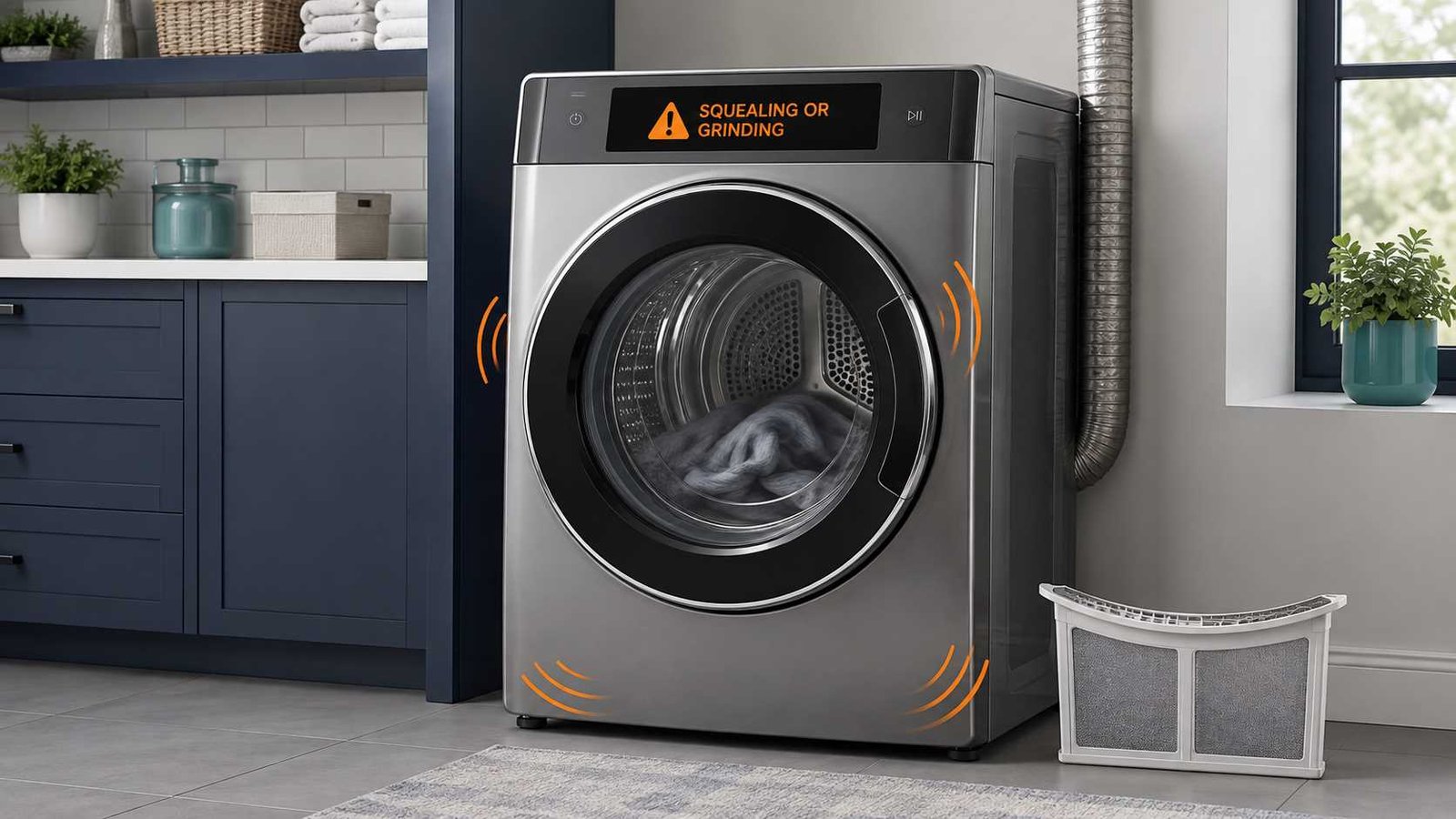
 A dryer making a squealing or grinding noise may be overloaded, unlevel, or affected by a loose object inside the drum. However, a sound that continues with a normal load or while the dryer is empty may indicate a worn belt, drum roller, idler pulley, drum glide, bearing, blower wheel, or drive motor.
Stop the cycle first. Remove heavy or excessively wet items, check the pockets and clothing fasteners, and make sure the dryer is level. Do not continue using the appliance if you hear severe metal-on-metal grinding, notice a burning smell, see smoke, or find that the drum is struggling to turn.
The exact internal parts vary between dryer models, so the sound alone cannot confirm which component has failed.
| Item | Guidance |
|---|---|
| Appliance | Clothes dryer or tumble dryer |
| Problem | Squealing, squeaking, screeching, scraping, or grinding |
| Common first cause | An overloaded or excessively wet load |
| Safe first check | Stop the cycle, reduce the load, and remove loose objects |
| Other possible causes | Unlevel feet, worn belt, pulley, rollers, bearing, glides, blower wheel, or motor |
| Can you keep using it? | Only when the sound was clearly load-related and disappears with a normal load |
| Stop using it when | Grinding persists, metal scrapes, the drum struggles, or there is heat, smoke, or a burning smell |
| Repair difficulty | External checks are simple; internal diagnosis normally requires service |
| Universal reset available? | No. A reset cannot repair a worn mechanical part |
Is a Squealing or Grinding Dryer Normal?
A brief sound is not always evidence of a fault. The important questions are how long it lasts, when it happens, and whether it continues after the load has been corrected.
Brief squeak during startup
On selected heat-pump dryers, a short high-pitched sound can occur when the drum begins turning or reverses direction. LG explains that temporary belt friction can produce a brief squeak before the components settle into normal operation. This does not apply to every model, so check the sound information in the appliance manual. continues throughout the cycle is different from a momentary startup squeak.
Squealing under a heavy load
An overloaded dryer places additional pressure on the drum-support and drive system. Samsung advises stopping the cycle immediately when squealing, squeaking, or grinding occurs, reducing the load, and removing excess water through an additional washer spin cycle when necessary. disappears after the load is reduced, overloading was probably contributing to the problem. Do not treat that result as proof that every internal component is in good condition, especially if the noise returns with ordinary loads.
Persistent grinding or metallic scraping
Persistent grinding is not considered a normal operating sound. Whirlpool associates grinding with possible wear in drum bearings or drum glides, while LG advises service when sharp metallic scraping continues through the cycle. These problems normally require internal inspection. the Dryer When These Warning Signs Appear
Switch the dryer off and disconnect it from the electrical supply when it is safe to do so if you notice:
- Severe or continuous metal-on-metal grinding
- Sharp metallic scraping throughout the cycle
- A burning or hot-rubber smell
- Smoke, sparks, buzzing, or crackling
- A plug, outlet, or power cord that feels unusually hot
- Repeated circuit-breaker trips
- A drum that hesitates, jams, or stops rotating
- Excessive cabinet heat
- Visible damage to the power cord or plug
Electrical Safety First advises users not to ignore strange appliance noises. Its guidance is to unplug the appliance and contact the manufacturer or a qualified repair technician when a fault is suspected. heavy dryer forward while it is running. Do not remove panels, touch internal wiring, or attempt gas-system work.
Identify When the Noise Happens
The noise pattern can help narrow the possibilities, although it cannot provide a confirmed diagnosis.
| Noise pattern | Possible explanation | Recommended action |
|---|---|---|
| Only with a very heavy load | Overloading or excess retained water | Reduce the load and use a higher washer spin speed |
| Only with zippers, buckles, or buttons | Clothing fasteners striking the drum | Fasten items and turn them inside out |
| While the dryer is empty | Installation issue or internal mechanical wear | Check level and external contact; arrange service if it continues |
| Briefly at startup | May be normal on selected models | Check the model manual and confirm the noise stops quickly |
| Once during every drum rotation | Roller, glide, bearing, belt, seam, or trapped-object issue | Stop use if scraping or grinding is present |
| From the lower front | Idler-pulley or drive-system issue may be possible | Professional inspection |
| From the rear | Bearing, roller shaft, glide, or belt wear may be possible | Professional inspection |
| Deep rumbling rather than grinding | Blower wheel or drum-support issue may be possible | Check external causes, then arrange service |
| Sharp metallic scraping | Worn or damaged internal part | Stop the dryer and request service |
Samsung recommends service when squealing or grinding continues with a normal test load of approximately four wet towels. It also advises service when thumping occurs while the dryer is empty. ses of Dryer Squealing or Grinding
1. An overloaded or excessively wet load
Large blankets, towels, bedding, and heavily saturated clothing can place more weight on the drum than expected. The load may also collect on one side of the drum.
Stop the cycle and divide the laundry into smaller loads. When clothing leaves the washer unusually wet, run another spin cycle before transferring it to the dryer. Samsung identifies excessive load weight as a common cause of squealing, squeaking, and grinding sounds. keys, zippers, buttons, or buckles
Metal objects may strike the drum and create noises that sound like scraping or grinding. A coin or small item can also become trapped near an accessible drum edge or lint-filter opening.
Check every pocket. Fasten zippers and buttons, and turn garments with hard fasteners inside out. Whirlpool and LG both identify coins, keys, buttons, buckles, and zippers as common sources of dryer noise. deeply into the lint chute or attempt to retrieve an object through internal openings.
3. The dryer is not level
Loose or uneven feet can allow the cabinet to move and vibrate. The resulting sound may be mistaken for an internal squeal.
Place a level on the dryer’s top surface from front to back and side to side. Adjust only the accessible levelling feet according to the installation instructions. Make sure all feet are firmly in contact with the floor. Whirlpool and Samsung both recommend checking dryer level as an early troubleshooting step. nt or another object is touching the cabinet
A vent pipe, power cord, wall, storage item, pedestal drawer, or nearby washing machine may vibrate against the dryer.
Check for contact around the outside of the appliance while it is switched off. The vent should be secure and correctly aligned without being crushed or pushed hard against the cabinet. Samsung and Whirlpool note that external contact and vent alignment can create rattling or vibration-related noises. rmally produces rattling rather than a true mechanical grind, but the sound can be difficult to identify from another room.
5. Worn drum rollers or roller shafts
Many dryers use rollers to support the rotating drum. A worn roller surface, damaged shaft, or material buildup may produce a repetitive squeak, screech, rumble, or rough rotating sound.
Not every dryer uses the same roller arrangement. Access normally requires substantial disassembly, so confirmation should be left to a qualified repair professional. Whirlpool identifies damaged roller shafts as a possible squealing cause. dler pulley
The idler pulley maintains tension on the drive belt. If the pulley no longer rotates smoothly, it may squeal as the drum turns.
A front-area squeal can point toward the idler pulley on some dryer designs, but sound location is not a reliable substitute for internal inspection. Whirlpool recommends professional repair when a broken or loose pulley is suspected. cracked, or worn drive belt
The drive belt wraps around the drum and transfers movement from the motor. Cracking, fraying, stretching, or poor tracking may produce a squeak or slapping sound.
When a belt breaks completely, the motor may still run while the drum does not turn. Belt replacement requires the correct model-specific part and usually involves opening the cabinet. rum glides or slides
Some dryers support the front of the drum with glides or slides rather than a full set of rollers. Worn surfaces can allow the drum to rub, creating scraping or grinding.
Whirlpool identifies worn glides and bearings as possible causes of grinding. A professional should confirm the condition before parts are ordered. ear drum bearing or drum shaft
A rear bearing supports the drum on selected dryer designs. Wear, looseness, or a lubrication problem may cause squealing or metal-like scraping.
Whirlpool and LG both include drum bearing or drum-shaft conditions among possible causes of continuing squealing or scraping. Internal inspection is required to distinguish this problem from roller, glide, belt, or motor noise. r-wheel obstruction or damage
The blower wheel moves heated air through the drum and exhaust system. Debris, looseness, or imbalance may produce rumbling, vibration, or a rough mechanical sound.
Whirlpool advises professional assistance when blower-wheel noise persists. nal lint buildup
Lint may collect around internal moving parts and contribute to belt or pulley noise. Whirlpool states that internal lint buildup can cause squealing or squeaking around belts and pulleys, but cleaning these areas may require panel removal and a service call. r-accessible lint filter before or after every load. Do not use compressed air to push lint deeper into the cabinet.
12. Drive-motor wear
Motor bearings or other motor components may produce squealing, grinding, or a loud rotating sound. Motor replacement involves electrical connections and internal disassembly, so it is not a safe basic homeowner check.
Whirlpool lists a malfunctioning motor as a possible squeal source and recommends professional motor diagnosis and replacement. leshooting Steps
Step 1: Stop the current cycle
Do not let the dryer continue grinding while you investigate. Allow the appliance and laundry to cool before handling the load.
Step 2: Reduce the load
Remove bulky, heavy, or waterlogged items. Test the dryer with a smaller, balanced load. For comparison, Samsung uses approximately four wet towels as an example of a normal test load. nspect pockets and clothing fasteners
Remove coins, keys, pens, screws, hair clips, and other hard objects. Close zippers and fasten buttons. Turn garments with large metal fittings inside out.
Step 4: Check the drum and lint-filter area
With the dryer switched off and disconnected, visually inspect the drum and accessible lint-filter area for loose objects. Do not remove covers or force your fingers into narrow openings.
Step 5: Confirm the dryer is level
Check the appliance from side to side and front to back. Correct loose or uneven feet according to the installation manual.
Step 6: Check external clearance
Make sure the dryer is not touching a wall, washing machine, shelf, power cord, or other object. Confirm that the exhaust duct is secure and not pressing against the cabinet.
Step 7: Clean the lint filter
Remove visible lint from the filter and reinstall it correctly. US fire-safety guidance recommends cleaning the lint filter before dryer use and keeping the vent system maintained because lint can restrict airflow and contribute to overheating. un a brief comparison test
After correcting the load and installation, run the dryer briefly with a normal load.
Stop the test if the sound is severe, metallic, or accompanied by heat or smell. If the same noise occurs with a normal load or while the drum is empty, arrange professional inspection.
What Not to Do
Do not spray lubricant into the dryer
Do not apply WD-40, general-purpose oil, silicone spray, or another unapproved lubricant through drum gaps or vents. Whirlpool specifically warns against using WD-40 because it is combustible and dryers operate at high temperatures. icant and procedure specified for the exact model should be used, normally by a service professional.
Do not remove appliance panels while it is connected
Dryers contain mains-voltage electrical components. Gas dryers also contain fuel and combustion components. Disconnecting electrical power does not make untrained gas-system work safe.
Do not order parts based only on the sound
A worn pulley, roller, glide, bearing, belt, blower wheel, and motor can produce overlapping symptoms. Find the complete model number before consulting a parts diagram or service provider.
Do not rely on a reset
A power cycle may restart electronic controls, but it cannot restore a damaged bearing surface, straighten a worn shaft, repair a belt, or remove a trapped internal object.
Possible Parts Requiring Inspection
| Possible part | Sound it may produce | Other possible clue | Homeowner repair? |
|---|---|---|---|
| Drum roller | Repetitive squeak, rumble, or rough rotation | Sound repeats as the drum turns | Professional inspection recommended |
| Roller shaft | Squeal or screech | Noise may come from the rear | Professional inspection recommended |
| Idler pulley | High-pitched squeal | Sound may be strongest near the front or lower cabinet | Professional inspection recommended |
| Drive belt | Squeak, slap, or rubbing | Drum may stop if the belt breaks | Professional inspection recommended |
| Drum glide or slide | Scraping or grinding | Drum may rub near the front opening | Professional inspection recommended |
| Rear bearing | Squeal, screech, or grinding | Sound follows drum speed | Professional inspection recommended |
| Blower wheel | Rumbling, vibration, or rough noise | Airflow may also change | Professional inspection recommended |
| Drive motor | Squeal, grinding, or loud hum | Drum may hesitate or fail to turn | Professional inspection required |
The parts fitted to a dryer depend on its design. A model may use rollers, glides, a rear bearing, or a combination of support components.
Vented, Condenser, Heat-Pump, and Gas Dryer Differences
A traditional vented dryer moves moist air through an exhaust duct. A condenser or heat-pump dryer manages moisture internally and may include a compressor and drain pump.
LG states that compressor humming and drain-pump gurgling can be normal on applicable heat-pump models. It also notes that a brief belt sound may occur when the drum starts or reverses. A sharp metallic scraping sound that continues through the cycle is not treated the same way and should be inspected. y produce repeated clicking as the gas valve cycles during normal operation. Whirlpool identifies this clicking as a normal sound on gas models. noises should not be confused with continuous squealing, screeching, or grinding.
What to Do When the Basic Checks Do Not Work
Stop troubleshooting when you have:
- Reduced the load.
- Removed loose objects.
- Checked the lint filter.
- Confirmed that the dryer is level.
- Checked the vent and surrounding clearance.
- Tested with a normal load.
If the sound continues, the dryer probably requires model-specific internal inspection. Manufacturer guidance generally directs users toward service for suspected belts, bearings, pulleys, rollers, glides, motors, and blower components. t video of the noise from a safe distance. Note whether it occurs at startup, during the whole cycle, once per revolution, with heat, or only with certain loads. This information can help the service provider, but it does not replace physical diagnosis.
When to Call a Dryer Technician
Arrange professional service when:
- Squealing continues with a normal load
- Grinding occurs while the drum is empty
- A sharp metallic scraping sound continues
- The drum wobbles, hesitates, or stops
- The sound comes from inside the cabinet
- The dryer has a burning smell or overheats
- The belt, bearing, pulley, roller, motor, glide, or blower wheel is suspected
- Internal lint removal is needed
- The appliance is a gas dryer requiring internal access
- The dryer is still under warranty
Use the manufacturer’s authorised service network when warranty coverage or safety notices may apply.
Should You Repair or Replace the Dryer?
A noisy dryer does not automatically need replacement. Consider:
- The age of the appliance
- Its maintenance history
- Whether it has other heating, airflow, or control problems
- The availability of model-specific parts
- The extent of drum, cabinet, or motor damage
- Current warranty coverage
- The written repair estimate
A belt, roller, pulley, or glide problem may be repairable. Replacement may make more sense when the dryer has several major faults, serious structural damage, unavailable parts, or a repair cost that is difficult to justify against its remaining service life.
Ask the technician to identify the failed part and explain whether other components were damaged by continued use.
How to Reduce Future Dryer Noise
- Check every pocket before washing and drying.
- Fasten zippers, hooks, snaps, and large buttons.
- Avoid overloading the drum.
- Use an adequate washer spin speed for towels and bedding.
- Keep the dryer level and stable.
- Leave suitable clearance around the appliance.
- Clean the lint filter before or after every load.
- Maintain the vent system according to the dryer manual.
- Investigate a new mechanical noise before it becomes severe.
- Do not run the dryer while sleeping or away from home.
The U.S. Fire Administration reports that failure to clean is a leading factor in residential dryer fires, while Electrical Safety First advises against leaving tumble dryers operating unattended. Asked Questions
Is a squealing dryer dangerous?
A brief load-related squeal may stop after the load is reduced, but continuing squealing should not be ignored. It may indicate friction or wear in the drive or drum-support system. Stop using the dryer immediately if the sound is accompanied by a burning smell, smoke, overheating, electrical noise, or difficulty turning the drum. my dryer if it is grinding?
Do not continue using a dryer with persistent grinding or metallic scraping. Worn bearings or glides may be involved, and continued operation could cause additional damage. Arrange professional inspection. y dryer squeal only with a heavy load?
The added weight may put excessive pressure on the drum, belt, and support system. Reduce the load and remove excess water in the washer. If the dryer also squeals with an ordinary load, it may require service. y dryer squeak once per drum rotation?
A repeating sound may be related to a drum-support component, belt, glide, drum seam, or trapped object. Because several parts can create the same pattern, the cause cannot be confirmed without model-specific inspection.
Can lint make a dryer squeal?
Internal lint accumulation may contribute to squealing around belts and pulleys. Clean the accessible lint filter regularly, but leave internal cabinet cleaning to a qualified professional when panel removal is required. squeak when a heat-pump dryer starts normal?
It can be normal on selected models. LG explains that temporary belt friction may create a brief high-pitched sound when the drum starts or reverses. A continuing metallic squeal or scrape should be inspected. ting the dryer stop a grinding noise?
A reset cannot repair a worn bearing, pulley, roller, glide, belt, blower wheel, or motor. It may restart electronic controls, but a mechanical sound that returns still needs diagnosis.
Can I lubricate dryer rollers or pulleys myself?
Do not apply a general-purpose lubricant. Dryer access normally requires disassembly, and the wrong product may create a fire or contamination risk. Whirlpool advises against using WD-40 and recommends professional service for lubrication-related work.

Daniel Brooks is a US-based appliance troubleshooting researcher with 12 years of experience studying washer, dryer, refrigerator, and dishwasher faults. He reviews manufacturer manuals and converts technical error codes into safe, practical guidance for homeowners.