
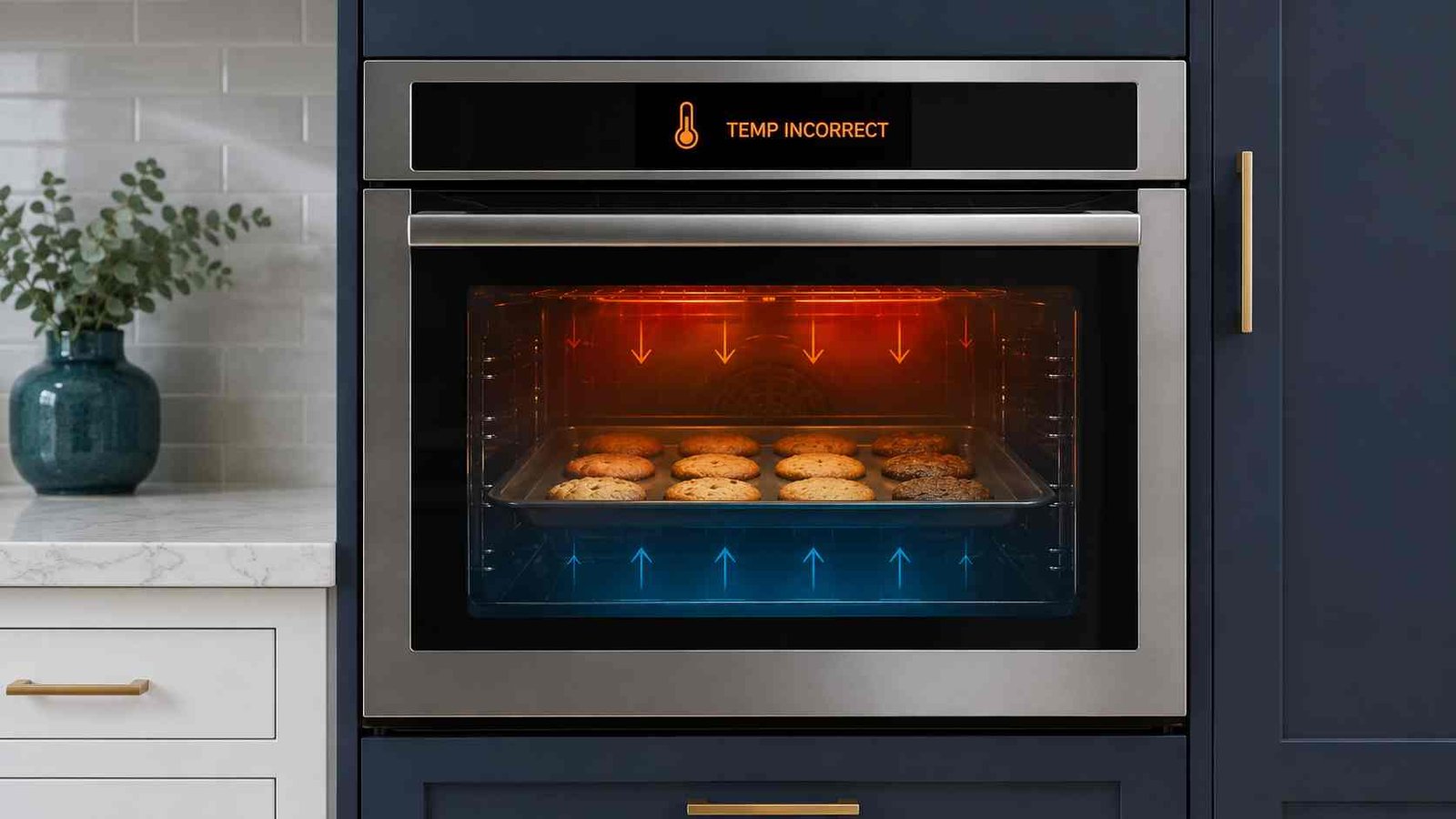
 When an oven temperature is incorrect, the appliance may cook consistently too hot, too cold, unevenly, or fail to maintain heat after preheating. However, a reading above or below the selected temperature does not always mean the oven is faulty. Ovens normally cycle their heating elements or gas burners on and off, so the cavity temperature rises and falls during cooking.
Start by confirming the cooking mode, allowing the oven to preheat fully, and checking the rack and cookware placement. Calibration may help when the oven has a small, consistent temperature offset. Stop using the appliance if it smells of gas, overheats uncontrollably, sparks, or repeatedly trips the circuit breaker.
| Item | Guidance |
|---|---|
| Problem | Oven cooks too hot, too cold, unevenly, or does not hold the selected temperature |
| Common first cause | Normal temperature cycling, wrong cooking mode, rack position, cookware, or blocked airflow |
| Safe first check | Select Bake, preheat fully, use the centre rack, and test a familiar recipe |
| May calibration help? | Yes, when the difference is small and consistent |
| May service be needed? | Yes, when heating is erratic, the oven cannot reach temperature, or calibration makes no improvement |
| Can the oven still be used? | Only when the temperature difference is small, predictable, and there are no gas or electrical warning signs |
| Stop using it when | You smell gas, see sparks, experience uncontrolled overheating, or the breaker repeatedly trips |
Why the Oven Temperature May Appear Incorrect
An oven does not maintain one exact air temperature every second. It heats above and cools below the selected setting as its elements or burner cycle on and off. The average temperature over several cycles is more useful than one momentary reading.
GE also warns that oven thermometers can give misleading results because their position, response time, and the need to open the door can affect the reading. Cooking a repeatable food item can sometimes provide a better indication of overall baking performance.
The oven may also appear inaccurate because:
- The wrong cooking mode is selected.
- The oven has not fully preheated.
- A fan or convection setting changes cooking behaviour.
- Dark pans absorb more heat.
- The rack is too close to an element.
- Large trays restrict airflow.
- Foil covers the oven bottom or an entire rack.
- The door is opened repeatedly.
- The recipe was written for a different oven type.
Before adjusting calibration or considering replacement parts, rule out these simpler causes.
Signs the Oven May Have a Real Temperature Problem
One disappointing meal is not enough to confirm an oven fault. Look for a repeated pattern.
A genuine temperature issue is more likely when:
- Cakes, biscuits, or bread burn repeatedly before the stated time.
- Food remains undercooked well beyond the expected time.
- The preheat cycle takes much longer than usual.
- The oven reaches temperature but quickly loses heat.
- One side of every tray is much darker than the other.
- The oven becomes much hotter than the selected setting.
- Heating changes unpredictably from one use to the next.
- An oven temperature or sensor error appears.
- Calibration does not improve the results.
A consistent difference may indicate that calibration is needed. Large or unpredictable changes are more likely to require diagnosis.
Check These Simple Causes First
1. Confirm the Cooking Mode
Make sure the oven is set to Bake, rather than Broil, Grill, Warm, Proof, Air Fry, Convection Roast, or another specialised function.
Fan-assisted and convection modes move hot air around the cavity and can cook some foods faster than conventional Bake. Some models also apply an automatic temperature conversion. Consult the owner’s manual before assuming the display is wrong.
2. Check Fahrenheit, Celsius, or Gas Mark
A control accidentally changed from Fahrenheit to Celsius can create a major temperature difference.
For example:
- 350°F is approximately 177°C.
- 180°C is approximately 356°F.
- Gas Mark 4 is approximately 177°C or 350°F.
Gas Mark remains common on some UK and Irish gas cookers. The setting system and conversion options vary by model.
3. Allow the Oven to Preheat Fully
Wait for the preheat signal before placing food inside unless the recipe or manufacturer specifically says otherwise.
Short-bake foods such as biscuits, pastries, and thin cakes are particularly sensitive to incomplete preheating. GE notes that failure to preheat can significantly affect foods with short cooking times.
Some ovens continue stabilising after the preheat signal. Use repeatable cooking results rather than assuming that one thermometer reading at the signal confirms a fault.
4. Use the Recommended Rack Position
Food placed too close to the top element may brown or burn early. Food placed too low may cook slowly on top or develop an overcooked base.
For a general baking test, use one rack near the centre of the oven unless the manual or recipe gives different instructions.
5. Check the Cookware
Dark, dull, or non-stick pans absorb more radiant heat than light, shiny pans. This can produce darker edges and faster browning without an oven fault.
GE advises reducing the selected temperature by 25°F when using certain dark baking pans. That is brand guidance rather than a universal rule, so check the cookware instructions and your appliance manual.
Also avoid:
- Oversized trays touching the cavity walls
- Several crowded pans on one rack
- Warped baking sheets
- Placing one tray directly above another
- Using cookware not suitable for the selected mode
6. Keep Airflow Clear
Leave space around pans so heated air can circulate. Samsung recommends at least one inch around items, while other manufacturers may specify different spacing.
Do not line the entire rack or oven bottom with aluminium foil unless the manufacturer explicitly permits it. Foil can block airflow, alter cooking results, damage surfaces, or trap excessive heat.
7. Avoid Opening the Door Repeatedly
Every door opening releases hot air and forces the oven to recover. This can extend cooking time and create the impression that the oven is running cold.
Use the oven light and window when possible.
8. Inspect the Door Seal
With the oven cool and switched off, visually inspect the gasket around the door.
Look for:
- Tears
- Flattened areas
- Loose sections
- Missing gasket material
- Food deposits preventing the door from closing
- A rack installed backwards and obstructing the door
Do not pull, scrub aggressively, or remove the gasket. Frigidaire identifies damaged or detached gasket material as a possible cause of heat loss.
How to Evaluate Oven Temperature Safely
A basic evaluation should focus on repeatable cooking performance, not one momentary air reading.
Step 1: Use a Familiar Recipe
Choose a simple food that you have prepared successfully before. Follow the package or recipe instructions accurately.
For the most useful comparison:
- Use the same pan each time.
- Use the same rack position.
- Allow full preheating.
- Avoid opening the door.
- Record the selected mode and temperature.
- Record whether the food is consistently overcooked or undercooked.
Whirlpool recommends a bake-performance test before deciding that calibration is needed. Its published example uses refrigerated biscuits on a shiny, low-sided aluminium sheet, although owners should follow guidance for their particular model.
Step 2: Use an Oven Thermometer Carefully
An oven-rated thermometer can provide supporting information, but it should not be treated as perfect.
Place it:
- Near the centre of the oven
- Close to the position where food normally sits
- Away from the walls and heating elements
- Where it can be viewed without repeatedly opening the door
Allow the oven to cycle several times. Do not judge the appliance from the highest or lowest reading alone.
AEG notes that the measured result can change according to thermometer position, measurement time, thermometer type, and accuracy.
Step 3: Decide Whether the Difference Is Consistent
Calibration is most suitable when the oven repeatedly cooks slightly hotter or colder by a similar amount.
Service is more appropriate when:
- The difference changes dramatically.
- The temperature rises without cycling off.
- The oven stops heating during cooking.
- Different functions fail in different ways.
- The oven cannot reach the selected temperature.
- An error code appears.
- The control display behaves abnormally.
When Oven Calibration May Help
Calibration changes the relationship between the selected temperature and the oven’s temperature control. It does not increase heating power or repair a failed part.
Consider calibration when:
- Food consistently cooks too quickly or slowly.
- The oven has a small, repeatable offset.
- The door closes and seals correctly.
- The appliance reaches and maintains heat.
- The selected mode and cookware are appropriate.
- No gas or electrical warning signs are present.
Manufacturers use different adjustment limits. Samsung documents adjustments up to 35°F higher or lower on supported models. Whirlpool lists several control methods, with some allowing adjustments of approximately 30°F or 17–18°C in either direction.
How to Calibrate Safely
- Find the oven’s complete model number.
- Locate the official owner’s manual.
- Open the temperature calibration or thermostat adjustment section.
- Note the current setting before changing it.
- Make a small adjustment in the required direction.
- Save the setting according to the manual.
- Repeat the same cooking test.
- Avoid making several large changes at once.
Do not use a button sequence found for a different model. Even ovens from the same brand may use different controls, menu names, increments, and maximum adjustments.
Understand the Adjustment Direction
A positive adjustment normally makes the oven hotter. A negative adjustment normally makes it cooler.
Check the display carefully. Samsung warns that overlooking the minus sign can move the temperature in the wrong direction.
Will Resetting the Oven Correct the Temperature?
A reset may clear a temporary control problem, but it does not replace calibration and will not repair a damaged sensor, element, igniter, gasket, or control board.
Where the owner’s manual permits a power reset:
- Cancel the cooking cycle.
- Let the oven cool.
- Switch the appliance off using its dedicated breaker or approved isolation method.
- Wait for the period stated in the manual.
- Restore power and set the clock if required.
- Test the oven once.
Do not keep resetting a breaker that trips again. Repeated tripping may indicate an electrical fault, incorrect installation, damaged wiring, or a failed component. Stop using the oven and arrange professional service.
Why an Oven Runs Too Hot
Incorrect Calibration
A previous user may have entered a positive temperature adjustment. Check the stored calibration setting before adding another correction.
Wrong Mode or Automatic Convection Conversion
Convection and fan modes can brown food more quickly. Some ovens automatically reduce the entered temperature, while others expect the user to convert the recipe.
Dark Cookware or Incorrect Rack Position
Dark pans and food placed close to a heating element can burn before the centre is cooked.
Temperature Sensor or Thermostat Problem
The temperature sensor or mechanical thermostat helps regulate heat. If it provides incorrect information, the oven may heat beyond the intended range.
Testing resistance, live voltage, wiring, gas controls, or internal control circuits is technician-level work.
Electronic Control or Stuck Relay
A control fault can allow an element to remain energised longer than intended. An oven that continues heating without normal cycling should be switched off and professionally inspected.
Why an Oven Runs Too Cold
Incorrect Negative Calibration
A large negative adjustment can make the oven cook cooler than expected.
Heat Escaping Around the Door
A damaged gasket, obstructed door, bent hinge, or misaligned door can allow heat to escape.
Failed Electric Heating Element
An electric oven may still produce some heat when one element is damaged, especially when another element operates during preheating.
With the oven cool and power disconnected, a homeowner may visually check an exposed element for obvious cracks, blistering, or breaks. Do not remove panels or wiring.
Weak Gas Igniter or Burner Problem
A weak igniter may delay ignition or prevent reliable burner operation. Gas pressure, combustion, burner, valve, and igniter work should be handled by an appropriately qualified professional.
Incorrect Electrical Supply
Some electric ovens can appear to operate while lacking the full supply required for proper heating. Frigidaire advises that an oven struggling to preheat may need its installation or electrical supply checked by an installer or electrician.
Why the Oven Preheats but Will Not Hold Temperature
A small drop after cold food is inserted is normal. The oven should then recover through its regular heating cycles.
The appliance may have a fault when it:
- Loses heat and does not recover
- Heats only during preheat
- Works intermittently
- Takes progressively longer to cycle
- Produces different results every time
Possible causes include a failing element, weak gas igniter, sensor fault, damaged door seal, loose electrical connection, or electronic control problem.
Possible Parts Involved
| Possible part | Typical symptom | Appliance type | Safe homeowner check | Professional diagnosis? |
|---|---|---|---|---|
| Door gasket | Slow cooking or heat escaping | Gas and electric | Visual inspection while cool | Usually required for replacement |
| Temperature sensor | Erratic, too-hot, or too-cold operation | Mostly electronic ovens | Check for an error code or visible displacement only | Yes |
| Mechanical thermostat | Consistent or uncontrolled temperature error | Selected older models | Check knob setting and manual | Yes |
| Bake element | Slow heating, uneven cooking, visible damage | Electric | Visual inspection with power disconnected | Yes for testing or replacement |
| Convection element or fan | Poor fan-mode cooking | Electric convection ovens | Listen for normal fan operation | Yes |
| Gas igniter | Delayed or unreliable heating | Gas | Observe whether ignition occurs normally without opening panels | Yes |
| Electronic oven control | Erratic cycling or continuous heating | Gas and electric | Try one manual-approved reset | Yes |
| Power connection | Slow or incomplete heating | Electric | Check for other installation symptoms | Electrician or service professional |
This table identifies possibilities, not confirmed diagnoses. Several different faults can produce similar cooking results.
Electric and Gas Oven Differences
Electric ovens normally use one or more resistance heating elements. A damaged bake element can cause slow preheating, poor recovery, or uneven cooking.
Gas ovens use a burner and ignition system. The burner may cycle during normal operation, but delayed ignition, unusual flame behaviour, soot, popping, or a gas smell is not a calibration issue.
Gas safety warning: If you smell gas, do not continue testing or attempt to relight a malfunctioning appliance. Avoid switches and flames, leave the area, and contact the appropriate gas emergency service for your country. In the UK, Gas Safe Register directs users who smell gas to the national gas emergency service.
Regional and Model Differences
The basic troubleshooting approach is similar across countries, but terminology and controls differ.
- United States and Canada: Fahrenheit, range, and wall oven are common terms.
- United Kingdom and Ireland: Celsius, cooker, fan oven, conventional oven, grill, and Gas Mark are common.
- Australia and New Zealand: Celsius and fan-forced oven are commonly used.
- Double ovens: Upper and lower cavities may have separate calibration settings.
- Smart controls: Calibration may appear under Settings, Options, Tools, or Thermostat Adjustment.
- Older controls: Some ovens use mechanical thermostat knobs rather than electronic menus.
Australian manufacturer guidance may list different temperatures for conventional and fan-forced cooking. One Electrolux example uses 180°C conventional and 170°C fan forced, showing why the selected mode matters when comparing recipe results.
Always follow the manual for the complete model number and market region.
Stop Using the Oven and Arrange Service When
Stop troubleshooting and disconnect or isolate the appliance safely when:
- You smell gas.
- Ignition is delayed or abnormal.
- The oven overheats uncontrollably.
- An element sparks or has visibly ruptured.
- The breaker or RCD repeatedly trips.
- The power cord, outlet, or connection becomes hot.
- Smoke appears without a cooking-related cause.
- The door cannot close securely.
- A temperature-sensor or over-temperature error returns.
- The oven stops and starts unpredictably.
- Calibration makes no meaningful improvement.
Do not remove service panels, test live voltage, adjust gas components, bypass a safety device, or alter internal wiring.
Can You Continue Cooking With an Inaccurate Oven?
A small and predictable offset may sometimes be managed temporarily by adjusting the recipe temperature, provided the oven heats steadily and has no safety warning signs.
Do not continue using it when heating is unstable, the oven cannot reach temperature, food remains unsafe, or the appliance overheats.
Oven air temperature also does not prove that food is safe to eat. Use a food thermometer to check the centre of meat, poultry, seafood, casseroles, and reheated food. FoodSafety.gov lists 165°F or 74°C for poultry and leftovers, 160°F or 71°C for ground meat, and 145°F or 63°C with applicable rest time for many whole cuts.
Frequently Asked Questions
How much oven temperature fluctuation is normal?
Some fluctuation is normal because the burner or elements cycle on and off. The exact range depends on the model, mode, load, thermometer position, and point in the heating cycle. Judge performance over several cycles rather than one reading.
Why does my oven thermometer disagree with the display?
The display usually shows the selected setting or a control-system value, while the thermometer measures air at one location. Its response time, accuracy, position, and door opening can all affect the result.
How do I know whether the oven needs calibration?
Calibration may be appropriate when the oven repeatedly cooks slightly too hot or too cold by a similar amount. It is less likely to help when heating is erratic, the oven cannot reach temperature, or a component stops operating.
Can I calibrate both gas and electric ovens?
Many modern gas and electric ovens support user calibration, but not every model does. Adjustment limits and control sequences vary. Use the official manual for the exact model.
Will calibration fix an oven that does not heat properly?
No. Calibration changes the temperature offset. It cannot repair a failed element, weak igniter, damaged gasket, inadequate power supply, sensor failure, or control fault.
Why does my new oven cook differently from my old one?
A new oven may use different element placement, insulation, airflow, fan operation, preheating logic, or control cycling. Whirlpool notes that a new oven may cook faster or slower than the appliance it replaced even when it is operating correctly.
Is it safe to use an oven that runs too hot?
A small, stable offset may be manageable until calibration or service is arranged. Do not use an oven that overheats uncontrollably, produces smoke, sparks, gas smells, or fails to cycle off.
Who should repair an inaccurate oven?
Use an authorised appliance service provider or another appropriately qualified technician. Gas-system work should be performed by a qualified gas professional, while supply-circuit problems may require a licensed electrician.
Daniel Brooks is a US-based appliance troubleshooting researcher with 12 years of experience studying washer, dryer, refrigerator, and dishwasher faults. He reviews manufacturer manuals and converts technical error codes into safe, practical guidance for homeowners.