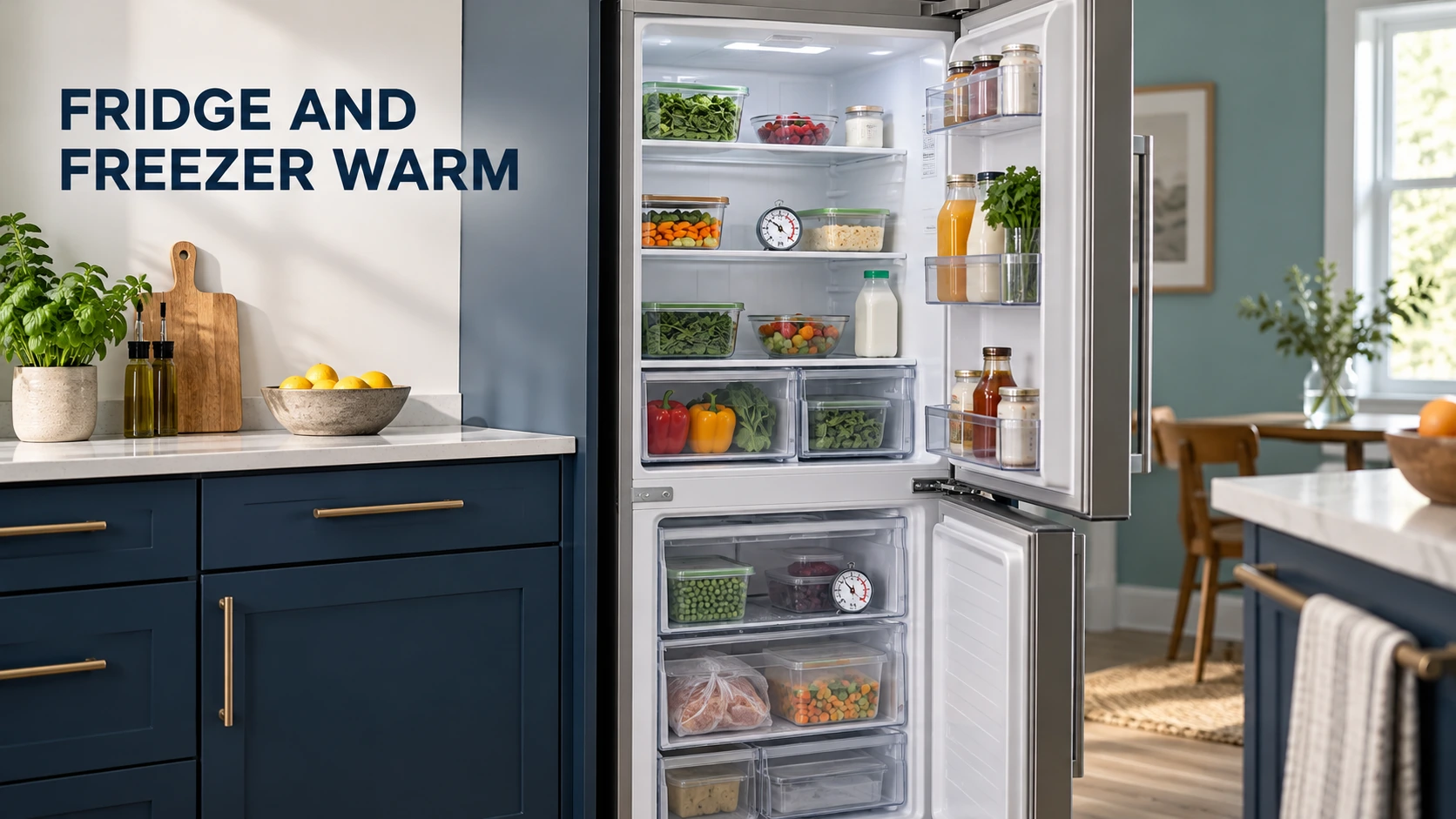
If your Frigidaire refrigerator will not cool or freeze, first confirm that it has power and cooling is switched on, then check both compartment temperatures, clear blocked vents, and inspect the doors. When the refrigerator and freezer are both warm, these shared checks are more useful than immediately replacing a fan or compressor. Frigidaire recommends checking the installation, settings, door seals and airflow before scheduling service.
Protect perishable food first. A refrigerator should keep food at 40°F (4°C) or below, and a freezer should be at 0°F (-18°C) or below. Use separate appliance thermometers; the temperature shown on a control panel may be a setpoint. Move vulnerable food to a working refrigerator or appropriately iced cooler if cooling has stopped. Never taste food to judge safety. Consult the FoodSafety.gov food discard charts when temperatures or outage duration are uncertain.
Start with Frigidaire’s basic cooling checks
- Verify power. Check that the appliance is plugged in and whether the interior lights or control indicators work. If an accessible GFCI outlet or household breaker has tripped, follow normal electrical safety guidance; do not repeatedly reset a circuit that trips again. Frigidaire advises using the electrical supply specified in the individual installation manual.
- Confirm cooling settings. Frigidaire’s US guidance suggests 37°F (3°C) for the refrigerator and 0°F (-18°C) for the freezer as factory targets. Check your model’s controls for an OFF or cooling-disabled mode; do not use button sequences from a different model.
- Close both doors fully. Check whether a package, bin or drawer prevents closure. Clean accessible gaskets with warm soapy water as permitted by the manual and inspect for visible tears or gaps.
- Unblock internal vents. Move containers away from air openings and avoid tightly packing shelves or drawers. Cold-air circulation can be reduced when packages block outlets.
- Check placement. Keep the installation clearances specified for the model. Frigidaire’s US support cautions against locations dropping below 55°F (13°C); regional and model-specific climate limits may differ.
Frigidaire documents these first checks in its refrigerator not cooling and freezer not cooling support articles. The electrical specifications quoted there are for the referenced US products, not universal worldwide ratings.
Use both temperature readings to narrow the problem
| What you observe | Likely diagnostic direction | Next step |
|---|---|---|
| Both compartments are warm and the display is dark | Power supply or appliance start-up | Check the accessible supply and breaker safely; stop if electrical faults recur. |
| Lights work but neither compartment cools | Controls, ventilation or shared cooling-system problem | Verify settings and airflow; seek service if temperatures do not recover. |
| Freezer is cold but refrigerator is warm | Fresh-food airflow or compartment-specific problem | Follow the separate freezer cold, fridge warm guide. |
| Both sections are cool but above target | Door sealing, food load, placement or reduced cooling performance | Record actual readings and check door closure and installation. |
| Heavy frost or ice obstructs airflow | Door left ajar, poor sealing or possible defrost issue | Inspect accessible door areas; do not chip ice or remove inner covers. |
| Repeated clicks, unusual burning smell or breaker trips | Potential electrical or start-up fault | Stop unsafe operation and arrange qualified service. |
If the display works but the fridge and freezer stay warm
A lit display or operating interior lamp confirms only that some power is reaching the appliance. It does not prove the compressor or cooling circuit is operating normally. Check whether the appliance is in a model-specific cooling-off setting and whether the temperature settings were accidentally changed.
Listen from outside the closed appliance for whether normal operating sounds are present, but do not diagnose a specific part from sound alone. Frigidaire notes that compressor humming, fans and refrigerant gurgling can occur during cooling. No sound at one moment is not necessarily a malfunction because cooling systems cycle.
Why it may stop cooling after installation or a power outage
Frigidaire advises allowing up to 24 hours for temperatures to stabilize after installation or a power interruption in applicable models. That is a stabilization guideline, not permission to keep perishable food at unsafe temperatures or proof that the appliance is repairing itself. Continue checking actual temperatures and preserve food elsewhere if needed.
For an unopened refrigerator during a complete power outage, FoodSafety.gov estimates about four hours of cold retention. A full unopened freezer may hold temperature for approximately 48 hours, or around 24 hours if half full. These estimates assume a power outage and closed doors; they should not be applied to a refrigerator that was already failing to cool.
Check frost, ventilation and door seals
Frost near a door edge can result from warm moist air entering a poorly closed compartment. Heavy frost inside a frost-free refrigerator can also restrict airflow, but it does not identify the exact failed component. Check visible gaskets, bins and stored items first. Never use a knife, pick, heat gun or unapproved heater to remove ice, because liners and concealed tubing may be damaged.
Clean only condenser surfaces described as owner-accessible in your exact use-and-care manual. Some Frigidaire designs have covered or different condenser arrangements. Do not dismantle panels or reach around moving fans or electrical wiring.
What a technician may need to diagnose
If both sections remain warm after the owner checks, a qualified technician may assess the compressor starting system, controls and sensors, condenser or evaporator fans where fitted, defrost-related airflow restrictions, and the sealed refrigeration circuit. These are possible causes, not confirmed failures. Frigidaire models vary by age and configuration, so an online list of parts is not a diagnosis.
Stop and seek professional service if a breaker repeatedly trips, electrical connections show damage, there is a burning smell, or refrigerant piping appears damaged. Do not test live circuitry, handle capacitors, bypass protective components, or open a refrigerant circuit. If the appliance uses flammable refrigerant, follow its labeling and safety instructions and avoid ignition sources if leakage is suspected.
When to contact Frigidaire service
Schedule service when the fridge and freezer still cannot maintain appropriate temperatures after the safe setting, airflow, door and placement checks. Frigidaire specifically recommends service if an applicable unit has run for 24 hours and still does not cool. For very recent installations, its support guidance may direct you to the installer first.
Before calling, record the full model number from the rating label, refrigerator and freezer thermometer readings, whether the lights operate, any display message, when cooling stopped, recent outages, and whether frost is visible. With both compartments warm, those observations help separate a whole-appliance cooling problem from a refrigerator-only airflow issue without guessing which part to replace.

Ahmad Raza is the website administrator and content operations manager at Error Code Vault. With 11 years of experience in technical publishing, he manages site accuracy, author verification, source quality, updates, user feedback, and editorial compliance.