
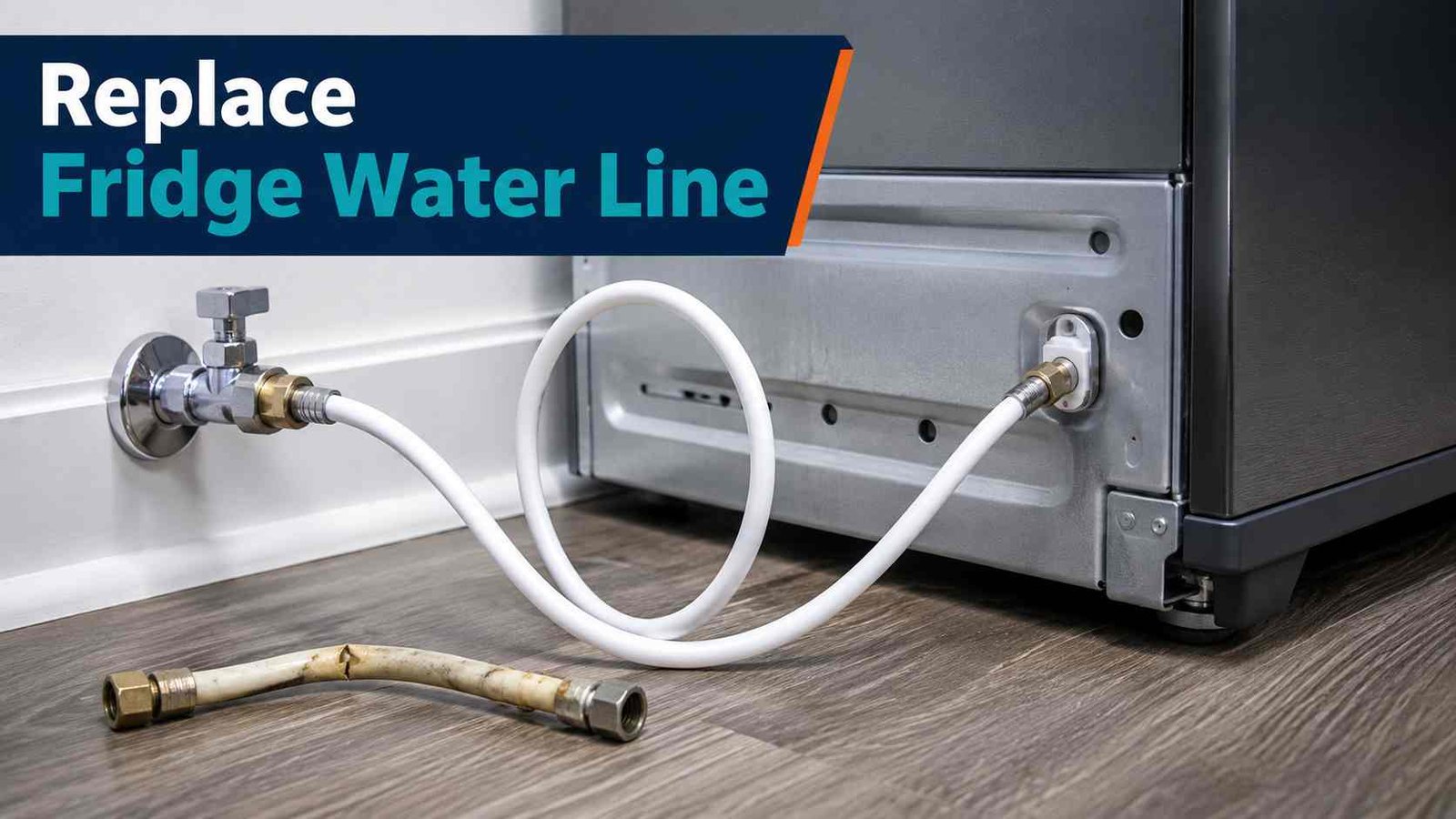
 If the water line behind your refrigerator is leaking, cracked, badly kinked, or deteriorated, you can often replace the external water supply line without opening the refrigerator.
The basic process is to shut off the cold-water supply, unplug the refrigerator, disconnect the old tube, fit a manufacturer-approved replacement, flush it, reconnect the refrigerator, and carefully check every joint for leaks. Whirlpool describes this general sequence for refrigerator water-line installation.
But do not buy a replacement line based only on size. Although 1/4-inch outside diameter tubing is common, manufacturers differ on approved materials and fittings. Whirlpool supports soft copper or PEX in its guidance, GE recommends copper or its approved SmartConnect tubing, and Samsung US recommends 1/4-inch copper while placing restrictions on plastic tubing.
Safety: If the leak is inside the refrigerator, the household shutoff valve needs replacement, plumbing must be routed through a wall or floor, or your regional manufacturer instructions require professional installation, stop and use an appropriate plumber or appliance technician.
Refrigerator Water Line Replacement: Quick Answer
| Item | What to Know |
|---|---|
| Common supply-line size | 1/4-inch outside diameter on many North American refrigerators |
| Water source | Cold potable water |
| First step | Shut off the refrigerator water supply |
| Electrical safety | Unplug the refrigerator while making the connection |
| Common materials | Copper, PEX, or approved manufacturer-specific tubing |
| DIY difficulty | Moderate when replacing an accessible existing line |
| Flush after replacement? | Yes, following your model’s instructions |
| Main mistake to avoid | Wrong tubing, kinked tubing, or overtightened fittings |
| Call a professional when | Household plumbing or internal refrigerator components need repair |
Manufacturer requirements take priority over this general guide. Whirlpool specifically advises checking the installation instructions for the individual refrigerator because required supplies and procedures can differ.
First, Identify Which Water Line You Need to Replace
The phrase refrigerator water line can describe two different things.
External refrigerator supply line
This is the tube running from your home’s cold-water supply to the refrigerator. It normally disappears behind the appliance and connects near the lower rear of the cabinet.
This is the line covered by the replacement procedure below.
Internal refrigerator water tubing
A refrigerator may also contain tubing connecting components such as the:
- Water inlet valve
- Water filter
- Door dispenser
- Ice maker
- Internal reservoir
Replacing these tubes is model-specific and may require removing covers, doors, panels, or refrigerator components. Do not assume that the procedure for the external supply line also applies to internal tubing.
Plumbed vs. non-plumbed refrigerators
Not every refrigerator with a water dispenser has a household water line. LG UK, for example, sells both plumbed models connected directly to the household supply and non-plumbed models that use a refillable internal tank.
If you have a non-plumbed model, there may be no external supply line to replace.
When Should You Replace a Refrigerator Water Line?
Replacement makes sense when you find:
- Visible cracks or deterioration
- A pinhole leak in the tubing
- Permanent kinks
- A crushed or pinched section
- Damage caused while moving the refrigerator
- A fitting that can no longer seal correctly
- An old hose set that the manufacturer says should not be reused
A kink is more than a cosmetic problem. Whirlpool notes that kinked supply tubing can reduce water flow and recommends leaving enough tubing behind the appliance so it is not pinched when the refrigerator is pushed back.
If water is coming from the refrigerator cabinet rather than the external tube or its connection, the problem could instead involve the inlet valve, filter housing, or internal water system. That should be diagnosed separately.
What Size Water Line Does a Refrigerator Use?
Many refrigerators designed for a plumbed ice maker or water dispenser use 1/4-inch outside diameter tubing.
Whirlpool specifies 1/4-inch tubing in its US guidance, while GE says its current ice-maker connections require a 1/4-inch compression fitting and 1/4-inch outside-diameter tubing.
However, size alone does not tell you which replacement to buy.
Copper tubing
Copper remains accepted by several manufacturers. Samsung US recommends a 1/4-inch copper installation kit containing the appropriate compression nut and ferrule. Whirlpool also provides installation guidance for soft copper tubing.
PEX or approved polymer tubing
Whirlpool states that selected refrigerator installations can use 1/4-inch soft copper or PEX tubing.
GE recommends either copper or its approved SmartConnect refrigerator tubing rather than simply recommending any generic plastic tube.
Plastic tubing
Do not assume that any 1/4-inch plastic tube is acceptable.
Samsung US says that if plastic tubing is used with the connection described in its guidance, it needs the appropriate molded end or bulb and compression nut. Samsung also states that plastic tubing is not its recommended option.
The safest buying rule
Before purchasing a replacement:
- Find your refrigerator model number.
- Check the installation or owner’s manual.
- Identify the required tubing material.
- Check the refrigerator-side fitting type.
- Check the household valve connection.
- Buy tubing and fittings approved for potable-water refrigerator use.
Do not assume the old line was installed correctly just because it worked previously.
Tools and Materials
Your exact requirements depend on the connection, but a typical accessible-line replacement may require:
- Manufacturer-approved replacement tubing or hose
- Correct compression nuts, ferrules, connectors, or supplied fittings
- Adjustable wrench
- Small bucket or bowl
- Towels
- Good lighting
- Floor protection
Whirlpool’s installation guidance lists adjustable wrenches among its common tools and instructs users to flush the open tubing into a bucket or sink before completing the refrigerator connection.
How to Replace a Refrigerator Water Line
Step 1: Pull the refrigerator forward carefully
Move the refrigerator only far enough to access the supply connection.
Protect hardwood, vinyl, laminate, or other easily damaged flooring before moving a heavy appliance.
Do not pull the refrigerator aggressively. A short existing line could already be under tension.
Step 2: Locate the shutoff valve
Follow the water line away from the refrigerator.
The shutoff may be:
- Behind the refrigerator
- Inside a nearby cabinet
- Under the kitchen sink
- In another accessible plumbing location
If you cannot find a reliable shutoff, do not disconnect the tubing.
Step 3: Shut off the water
Close the refrigerator’s water-supply valve.
Whirlpool instructs users to turn off the water supply before making the line connection. Its installation guidance also begins with the refrigerator disconnected from electrical power.
Place towels and a bowl near the connection because some residual water may remain inside the old tubing.
Step 4: Unplug the refrigerator
Disconnect the refrigerator from electrical power before working around its rear water connection.
LG UK’s current installation guidance similarly tells owners of plumbed ice-dispenser models to unplug the refrigerator before connecting its water line.
Step 5: Examine the existing connections
Before removing anything, look at how the old tube connects at both ends.
You may have:
- A compression nut and ferrule
- A manufacturer-specific molded tube end
- A supplied coupler
- Another model-specific connector
Taking a photo before disassembly can help you compare the new installation with the original arrangement.
Do not automatically transfer old fittings to the new tube. Use the fittings specified for the replacement tubing and refrigerator.
Step 6: Disconnect the old line from the refrigerator
Place a towel and container below the connection.
Loosen the fitting according to its design while supporting the mating connection so you are not twisting refrigerator components.
Samsung’s US guidance describes plastic and copper connections differently, which is why the fitting type needs to be identified before removal or installation.
Drain residual water into the bowl.
Step 7: Disconnect the other end
Remove the old tube from the existing refrigerator shutoff valve.
This guide assumes that a suitable cold-water valve is already installed.
If the valve is corroded, leaking, seized, damaged, or requires household plumbing modification, stop here. Whirlpool advises checking local plumbing codes and recommends a licensed plumber when there are questions about the home’s plumbing.
Step 8: Measure and position the new line
The new tubing must be long enough to reach both connections without tension and still allow the refrigerator to be pulled forward for cleaning or service.
GE specifically recommends providing extra tubing so the refrigerator can be moved away from the wall, while Whirlpool similarly recommends a service loop.
Do not create:
- Sharp bends
- Kinks
- Pinched sections
- Tight loops
- Tubing stretched between fittings
Step 9: Connect the new tubing to the water supply
Install the tubing using the fitting system specified by your refrigerator manual and water-line kit.
For a compression-type copper connection, manufacturers may specify a compression nut and ferrule. Plastic arrangements can use a different end treatment. Samsung’s current US instructions show this distinction clearly.
Do not improvise fittings based only on appearance.
Step 10: Flush the new water line
Before connecting the free end to the refrigerator, place it in a bucket or sink.
Slowly open the water supply and allow water to flow through the new line.
Whirlpool recommends flushing until the water is clear before completing the refrigerator connection.
Turn the supply off again before making the final connection.
Step 11: Connect the line to the refrigerator
Route the tubing naturally to the refrigerator inlet without twisting or kinking it.
Install the correct fitting and tighten according to the manufacturer or tubing-kit instructions.
Do not overtighten.
Both Whirlpool and Samsung warn against excessive tightening at refrigerator water connections. Samsung specifically notes that overtightening its compression connection can cause a leak.
Step 12: Restore the water supply
Slowly reopen the shutoff valve.
Inspect:
- Refrigerator connection
- Supply-valve connection
- Any couplers
- Entire visible length of tubing
Use a dry paper towel around a fitting if necessary to help reveal a very small leak.
If you see water, shut the supply off again before correcting the connection.
Step 13: Reconnect power
Once the water connections remain dry, plug the refrigerator back in.
Do not immediately push it against the wall.
Step 14: Flush the refrigerator dispenser
Run water through the dispenser according to your refrigerator’s manual.
There is no single universal flushing quantity.
Samsung US instructs users of applicable dispenser models to dispense one gallon after installation, while Samsung Australia specifies approximately 10 litres or 6 to 7 minutes for the Australian models covered by its guide. Whirlpool gives its own flushing guidance.
This difference is a good reason to follow the instructions for your exact model.
Step 15: Check again for leaks
Check every connection while water is actively being dispensed.
Then check again several minutes later.
A fitting that initially appears dry can sometimes reveal a slow leak after remaining pressurized.
Step 16: Push the refrigerator back carefully
Watch the tubing while repositioning the refrigerator.
Make sure the service loop remains free and the line does not become:
- Trapped under a wheel
- Folded against the wall
- Crushed by the cabinet
- Pulled tight
Whirlpool notes that a pinched or kinked water line can reduce water flow.
How Tight Should a Refrigerator Water-Line Fitting Be?
There is no useful universal number of wrench turns because fittings vary.
The correct rule is to follow the instructions supplied with the refrigerator or connection kit.
For the Samsung compression connection described in its current US guidance, Samsung explicitly cautions against overtightening because doing so can cause leakage.
If a fitting leaks after reasonable tightening, do not simply keep applying more force. Check whether:
- The tubing is inserted correctly
- The ferrule or molded end is correct
- The tube end is damaged
- The fitting is cross-threaded
- The wrong tubing type has been installed
- The connection itself is damaged
Refrigerator Water Line Still Leaking After Replacement
Where the water appears tells you what to check next.
| Leak Location | What to Check |
|---|---|
| New tubing itself | Damage, cut, kink, or incompatible tubing |
| Refrigerator connection | Correct fitting, alignment, tube insertion |
| Household valve | Valve body, outlet, or plumbing connection |
| Coupler | Correct installation and tube seating |
| Inside refrigerator | Possible internal tube, filter housing, or inlet-system problem |
If the external supply tube stays dry but water continues appearing underneath or inside the refrigerator, stop treating the problem as a simple water-line replacement.
An appliance technician may need to inspect the internal water system.
No Water After Replacing the Refrigerator Water Line
If the leak is gone but the dispenser produces little or no water, check the simple installation issues first.
Make sure the shutoff valve is fully open
A valve that was closed during replacement may not have been reopened completely.
Look for a kink
Inspect the service loop behind the refrigerator.
Whirlpool specifically identifies kinks as a cause of restricted refrigerator water flow.
Check the connection
Verify that the new line is connected to the correct inlet and is properly seated.
Some refrigerators have more than one tube. Samsung, for example, states that selected RS27T and RS22T models use two lines that must not be cross-connected.
Flush air from the system
A new line can initially contain air. Follow the manufacturer’s dispenser-flushing procedure before concluding that there is a component failure.
Check the water filter
On models using a refrigerator filter, make sure it is properly installed.
If water flow was poor before the line was changed and remains poor after a correct installation, the cause may be elsewhere in the refrigerator or household water supply.
Can You Keep Using the Refrigerator With the Water Turned Off?
The refrigerator’s cooling system and its water supply are separate functions on typical plumbed models. However, the water dispenser and automatic ice maker cannot receive household water while the supply is shut off.
Samsung’s refrigerator replacement guidance tells users to turn off the ice maker while disconnecting an old refrigerator water supply.
If you need to leave the water disconnected while waiting for parts or service, follow your model’s instructions for disabling the ice maker.
What About an Internal Refrigerator Water Line?
If by “replace water line in refrigerator” you mean tubing inside the appliance, the repair becomes much more model-specific.
Internal tubing can run through or connect with:
- Doors
- Filter housings
- Inlet valves
- Water reservoirs
- Dispensers
- Ice-making assemblies
Do not remove refrigerator panels or electrical components based on a generic external-line guide.
Search for the exact model number plus the component or water-line location, or use the manufacturer’s parts documentation and service options.
Regional Differences Matter
United States and Canada
Manufacturer guidance commonly provides homeowner installation procedures for accessible refrigerator supply lines, but the approved tubing and fittings still vary by brand and model. Whirlpool, Samsung US, and GE all provide refrigerator water-connection information, but their tubing recommendations are not identical.
United Kingdom and Ireland
First confirm whether the appliance is plumbed at all. LG UK distinguishes between refrigerators connected to the water mains and models using refillable water tanks.
Australia and New Zealand
Do not assume North American DIY instructions apply.
Samsung Australia’s guidance for the refrigerator models covered by its support page says the water line must be connected by a qualified technician and that new supplied hose sets should be used instead of reusing old ones.
Always check the manufacturer’s regional instructions for your exact appliance.
When to Call a Plumber or Appliance Technician
Call a plumber if:
- The shutoff valve leaks
- No suitable refrigerator valve exists
- Household pipes need modification
- The line must pass through walls or floors
- The existing plumbing is corroded
- You are unsure whether the connection complies with local plumbing requirements
Whirlpool notes that longer or complicated routing through floors and walls is a reasonable reason to use professional help.
Call an appliance technician if:
- Water leaks from inside the refrigerator
- The refrigerator’s inlet connection is damaged
- Internal tubing needs replacement
- The filter housing appears to leak
- Significant refrigerator disassembly is required
- The dispenser still fails after the external line and supply have been verified
FAQs
Can I replace a refrigerator water line myself?
Often, yes, when you are replacing an existing, easily accessible external line and the manufacturer’s instructions allow homeowner installation. Whirlpool describes refrigerator water-line connection as a task that may not require a plumber depending on skill level, but recommends professional help when routing or plumbing becomes complicated.
What size is a refrigerator water line?
1/4-inch outside diameter is common on North American refrigerator and ice-maker connections. Whirlpool and GE both specify 1/4-inch connections in their current guidance. Check your individual model before purchasing tubing.
Is copper or PEX better for a refrigerator water line?
There is no universal answer. Whirlpool supports soft copper or PEX in its general guidance, GE recommends copper or GE SmartConnect tubing, and Samsung US recommends 1/4-inch copper while saying its plastic option is not recommended. Use the material approved for your model.
Why is my new refrigerator water line leaking at the fitting?
Possible reasons include an improperly seated tube, incorrect fitting, damaged tube end, poor alignment, or excessive tightening. Samsung specifically warns that overtightening its compression connection can create a leak.
Should I flush a new refrigerator water line?
Yes. Manufacturer guidance commonly includes flushing after installation, but the required volume varies by brand and model. Follow the instructions for your specific refrigerator rather than relying on one universal quantity.
Why is the water dispenser slow after replacing the line?
First check for a partially closed supply valve, a kink or pinch behind the refrigerator, and incorrect tubing installation. Whirlpool states that kinked supply tubing can reduce water flow.
Can I reuse my old refrigerator water hose?
Do not assume you should. Inspect the line and check the refrigerator’s regional installation instructions. Samsung Australia explicitly tells users of the models covered by its guide to use new supplied hose sets rather than reusing old ones.
Do I need to replace the refrigerator water line if it is only kinked?
A minor flexible-tubing bend that can be safely corrected may not require replacement, but tubing that remains sharply kinked, crushed, cracked, or damaged should not simply be hidden behind the refrigerator. Whirlpool warns that kinks restrict flow.

Daniel Brooks is a US-based appliance troubleshooting researcher with 12 years of experience studying washer, dryer, refrigerator, and dishwasher faults. He reviews manufacturer manuals and converts technical error codes into safe, practical guidance for homeowners.