
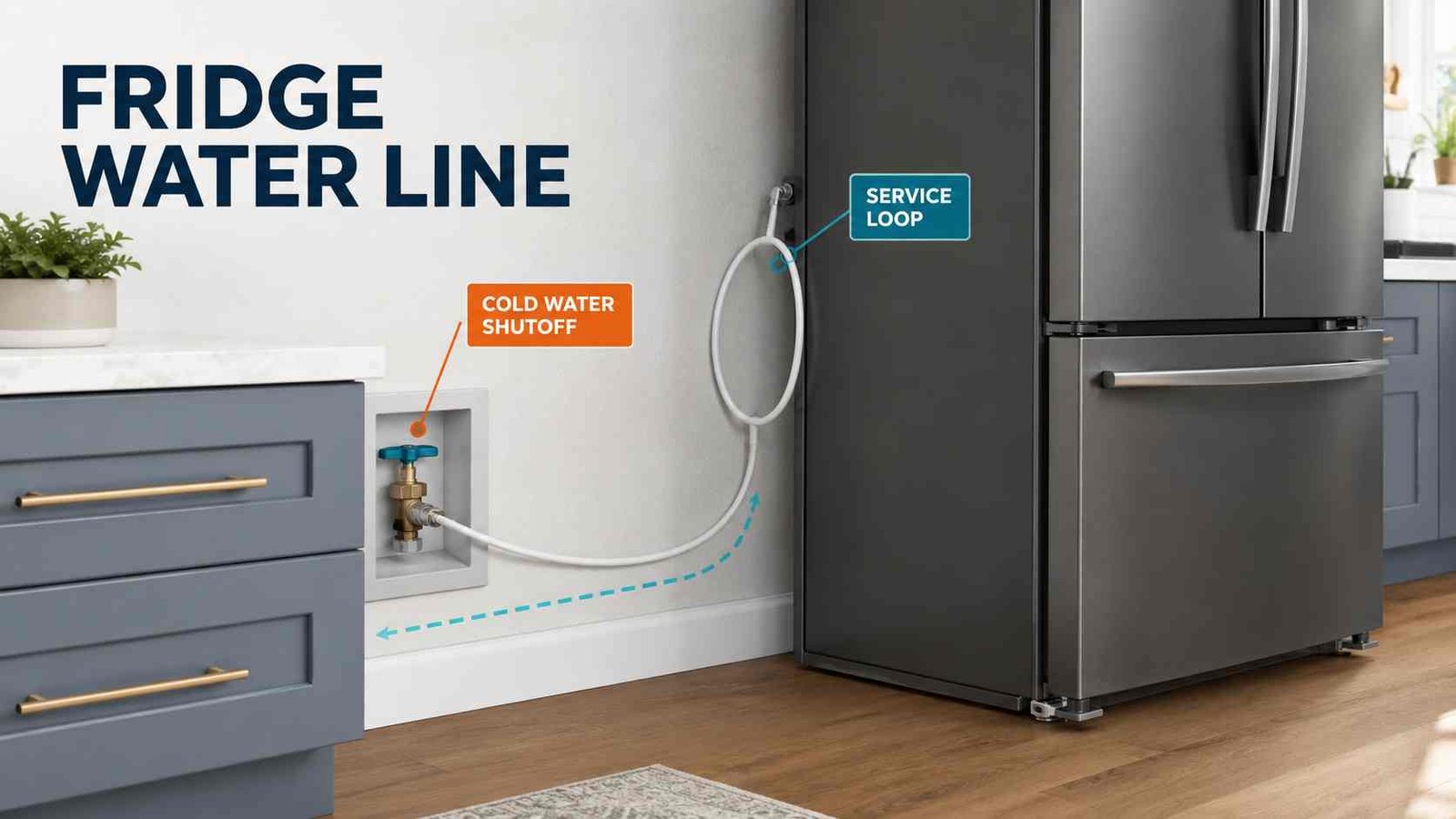
 To run a water line for a fridge, you need to connect the refrigerator to an approved cold potable-water supply, route suitable tubing safely to the appliance, leave enough extra line for the fridge to be pulled forward, and then test every connection for leaks.
In many North American refrigerators, the supply connection uses 1/4-inch outside-diameter tubing, although the exact tubing, fittings, water-pressure requirements, and connection method depend on the refrigerator model. Whirlpool, for example, specifies 1/4-inch soft copper or PEX for many refrigerators, while Samsung US recommends a 1/4-inch copper installation kit.
If installing the line requires unfamiliar plumbing work, drilling through walls or floors, or altering household pipework, use a qualified plumber. Some manufacturers and regions specifically recommend or require professional installation.
| Item | General guidance |
|---|---|
| Water source | Cold potable water |
| Common US/Canada tubing size | 1/4-inch OD |
| Possible routes | Through cabinets, floor/basement, or an approved wall route |
| Extra tubing | Leave a service loop behind the fridge |
| First test | Restore water and inspect every connection for leaks |
| Water pressure | Check your refrigerator manual |
| DIY difficulty | Moderate when an approved valve already exists |
| Call a plumber | For new household plumbing, difficult routing, uncertain drilling, or regional requirements |
Whirlpool confirms that its applicable refrigerators should connect to a cold-water supply using 1/4-inch copper or PEX and recommends leaving a service loop so the refrigerator can be moved without stressing the line.
Before You Run the Water Line
Start by checking whether the refrigerator actually needs a permanent water connection.
A refrigerator with a plumbed water dispenser or automatic ice maker normally needs a water supply. Some models, especially in the UK, Australia, and other markets, have refillable tanks and are sold as non-plumbed refrigerators. Samsung UK, for example, sells both plumbed and non-plumbed water-dispenser models.
Then locate the refrigerator’s water inlet and read its installation manual.
Do not assume that instructions for another refrigerator are suitable for yours. Connection sizes, filters, pressure requirements, supplied adapters, and hose arrangements can differ.
Samsung even notes that selected RS27T and RS22T refrigerators use two water lines that can cause incorrect dispenser and ice-maker operation if they are cross-connected.
Where Should the Fridge Water Line Come From?
Use an accessible cold potable-water supply approved for connection to the refrigerator.
For many kitchens, the closest practical source is the cold-water plumbing beneath the kitchen sink. Whirlpool specifically describes connecting a refrigerator supply from the water supply below the sink when no existing refrigerator line is present.
Your route might then pass:
- Through adjacent base cabinets.
- Down through the floor into a basement or accessible space.
- Through an appropriately planned wall or service cavity.
- Directly from an existing refrigerator shutoff valve.
Choose the shortest route that protects the tubing from crushing, sharp edges, freezing temperatures, heat, and movement.
If you do not know what is behind a wall, cabinet panel, or floor, do not drill blindly. Hidden electrical wiring, plumbing, gas services, or structural components can make an apparently simple installation unsafe.
What Size Water Line Does a Fridge Use?
For many refrigerators sold in North America, 1/4-inch outside-diameter tubing is standard.
Whirlpool specifies 1/4-inch, or 6.35 mm, soft copper or PEX tubing between the shutoff valve and applicable refrigerators. Samsung US also recommends a kit containing 1/4-inch copper tubing, compression nuts, and ferrules.
That does not mean every refrigerator worldwide uses exactly the same installation hardware.
Always check:
- Refrigerator installation instructions
- Required inlet fitting
- Supplied adapters
- External filter arrangement, if fitted
- Approved tubing material
- Required water pressure
Copper or PEX for a Refrigerator Water Line?
There is no single material that is correct for every refrigerator.
| Material | What to know |
|---|---|
| Soft copper | Common in traditional North American installations |
| PEX | Accepted by Whirlpool for many current models |
| Plastic refrigerator tubing | Compatibility varies significantly by manufacturer |
| Braided appliance connector | Use only when compatible with the refrigerator, valve, and intended installation |
Whirlpool approves both soft copper and PEX for many refrigerators. Samsung US recommends copper and says its generic plastic-tubing option is not recommended, even though it provides instructions for compatible plastic kits with molded ends.
The refrigerator manual should therefore decide the material, not a generic online recommendation.
How to Run a Water Line for a Fridge
1. Turn Off the Water Supply
Shut off the household water supply or the appropriate branch valve before opening or modifying a water connection.
If working near the refrigerator connection itself, follow the manufacturer’s electrical safety instructions as well. Whirlpool’s general installation procedure starts with the refrigerator disconnected from power and the water supply shut off.
If there is already a dedicated refrigerator valve, inspect it for corrosion, damage, or leakage before reusing it.
2. Plan the Entire Route
Measure from the water source to the refrigerator before buying or cutting tubing.
Do not measure only the straight-line distance.
Include enough tubing to:
- Follow the actual cabinet or floor route
- Reach fittings without tension
- Avoid tight corners
- Leave extra line behind the refrigerator
A slightly longer, gently routed line is preferable to one stretched tightly between two fittings.
3. Provide an Approved Shutoff Connection
A refrigerator should have a practical way to shut off its water supply.
If an approved refrigerator valve already exists, you may only need to connect the new tubing.
If you need to cut into household plumbing, add a branch fitting, alter the sink plumbing, or install a new valve and you are not experienced with plumbing, this is the point to call a qualified plumber.
Also check local plumbing requirements. Whirlpool states that plumbing must comply with applicable plumbing codes and local ordinances.
4. Route the Tubing Toward the Refrigerator
Feed the tubing along your chosen path without twisting or sharply bending it.
When running through cabinets, position the line where drawers, stored items, hinges, and cabinet hardware cannot crush it.
Protect tubing where it passes through an opening or contacts an edge.
For a floor or basement route, keep the tubing accessible where practical and away from places where it may freeze. Whirlpool specifically advises installing refrigerator water tubing only where temperatures remain above freezing.
5. Leave a Service Loop Behind the Fridge
Do not cut the tubing to the exact distance between the wall and refrigerator.
Leave a loose service loop behind the appliance.
Whirlpool recommends extra copper or PEX tubing so the refrigerator can be pulled away from the wall for cleaning or service. It also warns that a kink can reduce water flow.
The loop should be broad and relaxed rather than tightly wound or folded.
6. Flush the New Supply Line
Before connecting a newly installed line to the refrigerator, flush it according to the manufacturer’s instructions.
Whirlpool instructs users to direct the free end into a bucket or sink and run water until it is clear. This can remove debris from the newly installed tubing before it enters the refrigerator valve or filter.
Turn the supply off again before making the refrigerator connection.
7. Connect the Line to the Refrigerator
Connect the tubing using the exact fittings specified for the refrigerator.
With compression-style connections, make sure the tubing is fully seated and the components are correctly positioned.
Do not overtighten the fitting. Samsung specifically warns that overtightening a compression nut can create a leak.
Do not improvise adapters simply because they appear to fit.
8. Turn the Water Back On Slowly
Restore the water supply and inspect the complete installation.
Check:
- Household shutoff connection
- Any adapters or unions
- Tubing along the route
- Refrigerator inlet connection
- External filter connections, if fitted
Look and feel for moisture around each accessible joint.
Samsung tells users to turn the water on and inspect the connection areas for drops or leakage. Whirlpool gives similar instructions after restoring the supply.
If a joint leaks, turn the water off before adjusting it.
9. Move the Refrigerator Back Carefully
Watch the supply line as the appliance moves toward the wall.
A correctly installed line can still stop the dispenser from working if the refrigerator crushes or kinks it when pushed into position.
Whirlpool specifically warns against pushing the refrigerator so far back that the supply line becomes pinched.
10. Flush the Refrigerator Water System
Once the refrigerator is connected, flush the dispenser according to its manual before drinking the water.
The amount varies by manufacturer and model.
For example, Samsung US currently instructs users of applicable dispenser models to dispense one gallon after connection and discard the initial ice described in its instructions. Samsung UK tells users to run several litres through the system after installation.
Use the instructions for your specific refrigerator rather than applying one flushing quantity to every model.
Can You Run a Fridge Water Line Through Cabinets?
Yes, this is often the most practical route when the refrigerator is reasonably close to the kitchen sink.
A typical layout is:
Cold-water supply under sink → refrigerator shutoff connection → tubing through lower cabinets → refrigerator
Keep the line against a protected part of the cabinet rather than allowing it to hang loosely where cookware, drawers, or stored products can catch it.
Any holes should be positioned only after confirming that the drilling path is clear of electrical and plumbing services.
Can You Run the Water Line Through the Floor?
A floor route can make sense when there is an accessible basement, crawlspace, or service area below the kitchen.
This is particularly useful when the refrigerator is separated from the sink by several cabinets or an awkward kitchen layout.
However, routing through floors raises the difficulty. Whirlpool recommends professional help when a water line has to travel over a long distance or through floors or walls.
Call a plumber if the route requires new household plumbing or you cannot confidently identify a safe path.
Should You Use a Saddle Valve?
Treat this as a model and local-code issue, not a universal recommendation.
Current manufacturer instructions are not identical.
Whirlpool warns against piercing-type and 3/16-inch saddle valves because they can reduce water flow and clog more easily. It says any saddle-type installation must comply with local plumbing requirements.
Samsung US, however, currently illustrates a generic installation in which a valve pierces the cold-water pipe.
Because official guidance conflicts, the safest approach is simple: follow the installation manual for your refrigerator and your local plumbing requirements. If either is unclear, have a qualified plumber provide the household connection.
How Much Water Pressure Does a Refrigerator Need?
There is no single pressure specification for every fridge.
For example, Whirlpool currently says most of its refrigerators with water and ice features operate with 30 to 120 psi, while LG US gives 20 to 120 psi for the refrigerator guidance cited here. Both manufacturers tell users to check their model requirements.
Samsung US says the applicable ice maker in its general water-line guide requires at least 30 psi.
This is why you should not diagnose low pressure using a number taken from a different brand or model.
Fridge Has No Water After Installing the Line
If the dispenser does not work after installation, start with the simple external checks.
Check the Shutoff Valve
Make sure the refrigerator water valve is fully open.
A partially closed valve can restrict flow.
Check for a Kink
Pull the refrigerator forward carefully and inspect the service loop.
A pinched or kinked line can substantially reduce water flow.
Check the Water Filter
Make sure the filter is correctly fitted if your model requires one.
A restricted filter can also reduce dispenser flow. LG and Whirlpool both identify filter and water-supply restrictions as possible causes of slow water delivery.
Confirm the Correct Connection
Check the refrigerator manual to ensure the household supply is connected to the correct inlet.
This is especially important on unusual model-specific installations.
Consider Water Pressure
If the valve is fully open, the tubing is not kinked, and the filter is correctly installed, inadequate household pressure may need to be checked by a plumber.
Do not dismantle the refrigerator’s internal water valve or wiring simply because the dispenser is slow.
What If the New Water Line Leaks?
Turn off the water supply if you find an active leak.
Check accessible fittings for:
- Tubing that is not fully seated
- A loose connection
- Visible cracks
- Kinked or damaged tubing
- Moisture around the shutoff valve
- Moisture at the refrigerator inlet
Whirlpool advises checking both the household valve connection and the refrigerator-side connection and replacing damaged or cracked supply tubing.
If the leak continues after the external connection has been corrected, stop using the water supply and arrange professional service.
Common Installation Mistakes
Connecting to hot water: Refrigerator water systems are intended to connect to a cold potable supply. Samsung Australia specifically warns that connecting its filtering hose to hot water can cause the filter system to malfunction.
No service loop: A tight line can be strained when the refrigerator is moved.
Pushing the refrigerator onto the tubing: This may kink the line and reduce water or ice production.
Overtightening fittings: More force does not necessarily create a better seal and can contribute to leaks on compression fittings.
Skipping the flush: New tubing should be flushed according to the manufacturer’s procedure before normal use.
Assuming every refrigerator uses the same hardware: Tubing material, pressure, filter layout, fittings, and connection methods vary.
Regional Installation Differences
United States and Canada
Manufacturer instructions commonly describe refrigerator water-line installation as a task that a capable homeowner may perform when a suitable household connection already exists.
Whirlpool says installation may not require a plumber depending on skill level but recommends professional assistance for longer or more complicated runs through floors and walls.
Always comply with local plumbing codes.
United Kingdom and Ireland
The terms plumbed fridge freezer and non-plumbed fridge freezer are commonly used.
Samsung UK recommends seeking help from a qualified technician when connecting the refrigerator water line and directs owners to the model manual for the exact procedure.
LG UK also advises using the correct connector or adapter for the home’s water connection, reflecting the fact that plumbing arrangements can vary.
Australia and New Zealand
Check the manufacturer’s regional instructions before treating this as a DIY project.
Samsung Australia states that the water line for the cited side-by-side refrigerator procedure must be connected by a qualified technician. Samsung New Zealand gives the same requirement in its regional guidance.
These requirements should take priority over a US-based DIY tutorial.
When Should You Call a Plumber?
Professional installation is the better choice when:
- No suitable cold-water connection exists
- Household pipework must be altered
- You need a new branch or shutoff valve
- The route passes through walls or floors you cannot inspect
- You are unsure what is behind the drilling surface
- The existing valve is corroded or damaged
- Water pressure appears too low or too high
- Connections continue to leak
- Local plumbing regulations require licensed work
- The refrigerator manufacturer requires professional installation
The water-line connection is inexpensive compared with the damage that an unnoticed plumbing leak can cause.
Frequently Asked Questions
Can I Run a Refrigerator Water Line From Under the Sink?
Yes, on compatible installations the cold-water supply beneath the kitchen sink can be a practical source. Whirlpool’s general installation instructions specifically discuss connecting from below the sink when no refrigerator line already exists.
If adding the refrigerator connection requires modifying household plumbing, follow local regulations or use a plumber.
Does a Refrigerator Need a Water Line?
Not for normal refrigeration.
A permanent supply is needed when a plumbed ice maker or water dispenser requires it. Refrigerators without these features and non-plumbed dispenser models can operate without a household refrigerator water line.
What Size Water Line Is Normally Used for a Refrigerator?
Many North American refrigerators use 1/4-inch OD tubing, but always verify your model. Whirlpool specifies 1/4-inch copper or PEX for many refrigerators, while Samsung US recommends a 1/4-inch copper kit.
How Much Extra Water Line Should I Leave Behind the Fridge?
Leave enough tubing for the refrigerator to be pulled forward without stretching or kinking the supply.
Rather than relying on one universal measurement, follow your model’s installation instructions. Whirlpool specifically recommends a service loop behind the appliance.
Can I Run a Fridge Water Line Through a Wall?
It may be possible, but the installation becomes more complex because hidden pipes, wiring, structural components, and local plumbing requirements must be considered.
Whirlpool recommends professional help when the run must navigate walls or floors.
Why Is My Refrigerator Water Dispenser Slow After Installation?
Common external causes include a partially closed water valve, kinked supply line, restricted filter, or inadequate water pressure. Whirlpool and LG both identify these as checks for water-flow problems.
Can I Use a Piercing Saddle Valve for a Fridge?
Do not assume it is acceptable.
Whirlpool currently advises against piercing-type saddle valves, while Samsung US illustrates a piercing method in its generic guide. Local plumbing rules and your refrigerator installation manual should determine the permitted method.
Should I Flush a New Refrigerator Water Line?
Yes, where required by the refrigerator instructions.
Whirlpool, Samsung US, and Samsung UK all include flushing as part of their installation guidance, although the required amount varies.

Daniel Brooks is a US-based appliance troubleshooting researcher with 12 years of experience studying washer, dryer, refrigerator, and dishwasher faults. He reviews manufacturer manuals and converts technical error codes into safe, practical guidance for homeowners.