
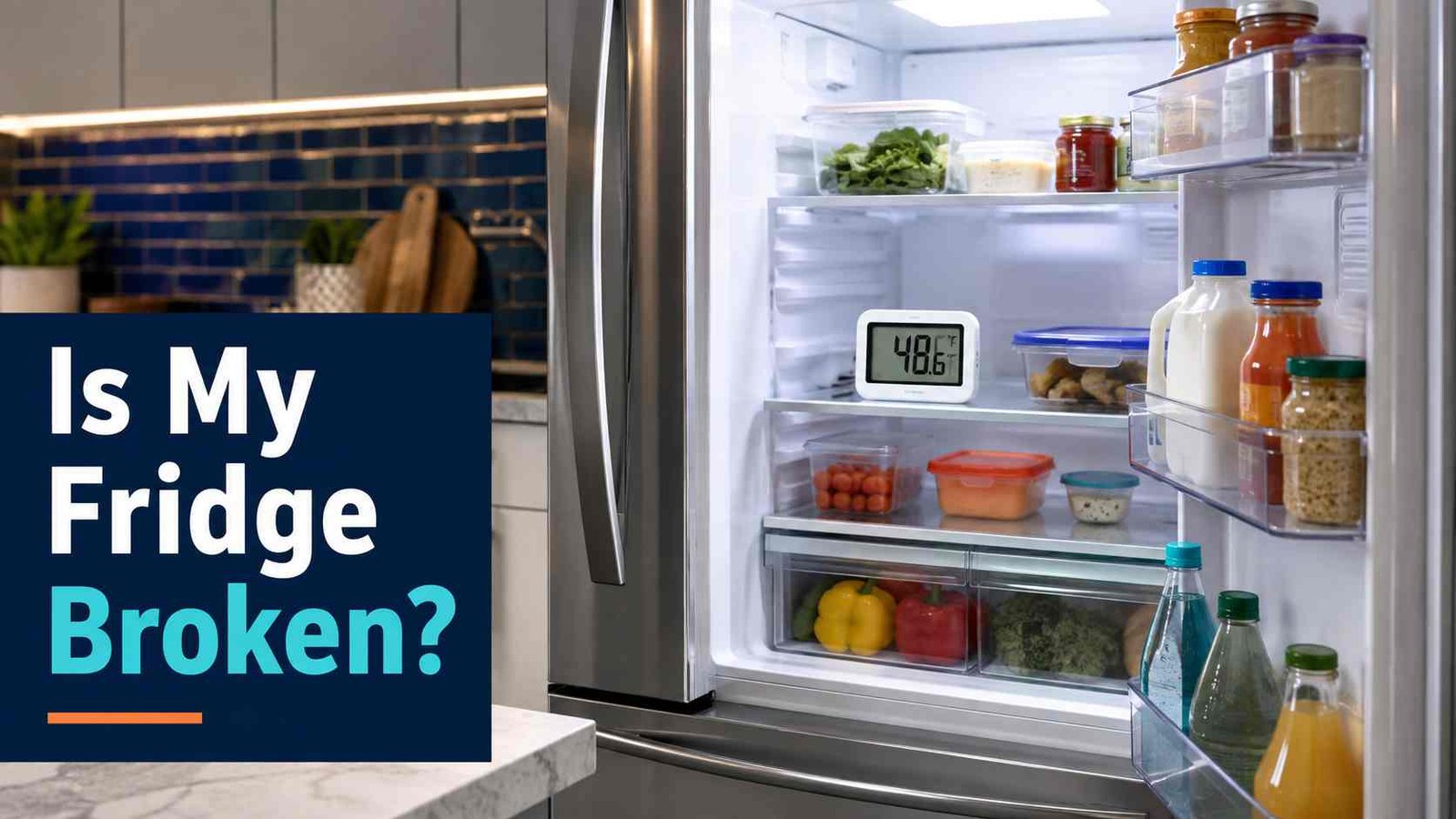
 If you are trying to figure out how to tell if your fridge is broken, start with its actual temperature rather than its noise, lights, or how cold a shelf feels. A working refrigerator should keep food consistently cold. In the US and Canada, food-safety guidance recommends 40°F/4°C or below, while the freezer should normally be around 0°F/−18°C. An inexpensive appliance thermometer is the easiest way to check.
A warm refrigerator does not automatically mean the compressor has failed. Incorrect settings, blocked vents, poor door sealing, overloading, Demo mode, or other relatively simple issues can also reduce cooling. However, stop using the appliance and seek professional help if you notice a burning smell, overheated plug or socket, arcing or crackling, or repeated breaker trips.
Is Your Fridge Broken?
| What you notice | What it may mean | First safe check |
|---|---|---|
| Fridge is warmer than 40°F/4°C | Cooling performance problem | Measure temperature with an appliance thermometer |
| Light works but food is warm | Cooling system or control issue | Check settings and Cooling Off/Demo mode |
| Freezer cold but fridge warm | Airflow or compartment-specific problem | Make sure interior vents are clear |
| Fridge runs for very long periods | High cooling demand or a cooling problem | Check doors, seals, temperature and ventilation |
| New loud or persistent noise | Fan, vibration or another mechanical issue | Confirm whether cooling is also affected |
| Heavy frost keeps returning | Air leakage or defrost-related problem | Check that doors close and seal properly |
| Food spoils unusually quickly | Temperature may be too high | Verify temperature rather than relying on touch |
| Breaker trips or plug gets unusually hot | Possible electrical fault | Stop using the appliance and seek professional help |
Here’s what matters: one symptom rarely proves that the refrigerator is broken. Several symptoms together, especially an unsafe measured temperature that persists after basic checks, are much stronger evidence of a real fault.
1. The Refrigerator Cannot Stay Cold Enough
The clearest warning sign is a refrigerator that consistently fails to maintain a safe temperature.
Do not judge this by touching a bottle, shelf, or door compartment. Temperatures vary within the cabinet, and recently opened doors can temporarily make the interior feel warmer.
Place an appliance thermometer inside and give the refrigerator time to stabilize with the doors closed.
For food storage:
- United States: 40°F/4°C or below
- Canada: 4°C/40°F or below
- Ireland: generally 0°C to 5°C
- Australia: potentially hazardous refrigerated food should be 5°C or colder
- New Zealand: government guidance recommends setting the fridge between about 2°C and 5°C
These differences are small, but they matter when assessing food safety.
If your refrigerator remains well above the recommended range despite correct settings, closed doors, and adequate time to cool, it needs further troubleshooting.
2. Food Is Spoiling Earlier Than Expected
Milk turning sour unusually quickly, meat not staying properly chilled, or other refrigerated foods repeatedly spoiling before expected can indicate that the compartment is running too warm.
Food spoilage alone is not a reliable refrigerator diagnostic because storage practices, door opening, packaging, and the food itself can affect how long it lasts.
Use the symptom as a reason to measure the refrigerator temperature.
Do not rely only on smell or appearance when deciding whether food that has become too warm is safe. FDA guidance specifically warns that appearance and odor cannot reliably determine the safety of food affected by loss of refrigeration.
3. The Light Works but the Fridge Does Not Cool
This is a common source of confusion.
An illuminated interior proves that the appliance is receiving at least some electrical power. It does not prove that the refrigeration system is operating correctly.
If the lights and display work but the fridge is warm, check these items before assuming a major component has failed:
- Confirm that cooling is switched on.
- Check the temperature setting.
- Look for Cooling Off, Demo, Showroom, Shop or similar modes.
- Make sure the doors are closing fully.
- Check whether food is blocking interior air vents.
Whirlpool includes cooling status, control settings, loading, condenser condition and Demo/Showroom mode among its refrigerator cooling checks. Samsung also documents Cooling Off or Demo mode as a condition where the refrigerator remains powered but actual cooling is disabled.
Do not guess the Demo mode button sequence
The button combination varies between models and control panels.
If the display shows something such as OF OF, O FF, OFF OFF, or another unusual indication, check the model-specific owner’s manual before pressing combinations of buttons. Samsung specifically notes that procedures vary according to the control panel.
4. The Freezer Is Cold but the Refrigerator Is Warm
This symptom can make it seem as though the refrigerator is only half broken.
On many refrigerator designs, cold air has to circulate correctly between sections. If the freezer still freezes but the fresh-food compartment becomes warm, the issue can be related to airflow rather than complete loss of refrigeration.
Start with the simple things:
- Find the interior air vents.
- Move food packages away from them.
- Avoid packing food tightly against the rear or sides where airflow is needed.
- Check that the refrigerator door closes completely.
- Confirm the compartment temperature with a thermometer.
GE/Haier troubleshooting guidance specifically recommends checking for obstructed vents when only one compartment is failing to cool correctly. New Zealand food-safety guidance also warns that overfilling a refrigerator can prevent proper cold-air circulation.
If the vents are clear but the refrigerator section stays warm, possible causes may include a fan, damper, temperature sensor, defrost problem, or control fault depending on the refrigerator design.
Those possibilities require model-specific diagnosis. They should not be treated as confirmed failed parts based on the symptom alone.
5. The Refrigerator Runs Almost Constantly
Long compressor run times do not automatically mean the refrigerator is dying.
A refrigerator may work harder after:
- frequent door opening
- adding a large amount of food
- placing warm food inside
- exposure to a hot room
- poor ventilation around the appliance
- a door that does not seal correctly
Whirlpool troubleshooting guidance lists high room temperature, loading, power interruptions, control settings, heat sources, condenser condition and other operating conditions as factors worth checking when cooling is poor.
Constant running becomes more concerning when it occurs together with poor temperature performance.
For example, if the appliance appears to run continuously but the refrigerator still remains at 48°F/9°C, that combination deserves professional diagnosis after the safe external checks have been completed.
6. New or Persistent Unusual Noises Appear
Refrigerators are not silent machines.
Normal operation can produce:
- humming
- buzzing
- whirring
- clicking
- gurgling
- hissing
- cracking or popping
- fan sounds
LG explains that compressor starting and stopping, fans, refrigerant movement, thermal expansion and defrost operation can all create noticeable sounds during normal refrigerator operation.
So a refrigerator that suddenly hums is not necessarily broken.
Pay more attention when the sound is:
- significantly louder than before
- persistent rather than occasional
- accompanied by poor cooling
- accompanied by repeated unsuccessful attempts to start
- a heavy grinding, drilling, scraping or persistent rattling noise
- associated with excessive vibration
LG advises requesting service when abnormal or excessive noise persists and cannot be explained by normal operation or appliance positioning.
Check positioning before assuming a mechanical failure
A refrigerator touching a wall or cabinet can transmit normal compressor vibration and make the appliance seem much louder.
Check that it is positioned according to the installation clearances in its manual and is sitting securely.
7. Excessive Frost or Condensation Keeps Returning
A small amount of temporary moisture does not necessarily mean a refrigerator is broken.
Repeated heavy frost, persistent condensation, or ice buildup can point to a problem if it continues under normal use.
First check:
- Is the door closing completely?
- Is food preventing the door from shutting?
- Is the gasket visibly dirty, folded, loose or damaged?
- Are the doors being opened very frequently?
- Is warm humid air repeatedly entering the cabinet?
GE notes that warm external air entering through a poorly closing door can contribute to frost buildup, and recommends checking the gasket and door closure.
If heavy frost quickly returns after the door and seal have been checked, further diagnosis may be needed. Frost-free refrigerators contain additional defrost and airflow components, and failures are model-specific.
Avoid using knives, sharp tools, hair dryers or other heating appliances to remove ice. Electrical Safety First specifically advises against using heating appliances to defrost a fridge or freezer.
8. The Plug, Socket or Breaker Shows Electrical Warning Signs
This is different from ordinary refrigerator troubleshooting.
Stop using the appliance if you notice:
- burning or scorched marks
- a burning smell
- unusual heat at the plug or socket
- electrical arcing
- persistent crackling or buzzing from the outlet
- repeated blown fuses
- repeated circuit-breaker trips
- visibly damaged power wiring
Electrical Safety First recommends professional electrical assessment when burn marks, arcing sounds, blown fuses, breaker trips or abnormal heat are present.
Do not repeatedly reset a breaker to keep a refrigerator running.
Do not open electrical compartments or test live refrigerator circuits unless you are properly qualified to do so.
How to Test Whether Your Fridge Is Working
The most useful homeowner test requires no disassembly.
Step 1: Check the power
Make sure the refrigerator is connected to power and that its controls or display appear active.
If the outlet itself appears damaged, overheated or unreliable, stop and have the electrical supply checked instead of continuing refrigerator troubleshooting.
Step 2: Check the controls
Confirm that the refrigerator has not been turned off accidentally and that the temperature control has not been moved to an unusually warm setting.
After power outages, some models may need cooling to be re-enabled. Whirlpool recommends consulting the model’s owner’s manual because control procedures vary.
Step 3: Measure the refrigerator temperature
Put a refrigerator-safe appliance thermometer inside.
Do not repeatedly open the door to check it.
The goal is to determine whether the cabinet can maintain the recommended safe range under ordinary use. FDA and Health Canada specifically recommend thermometer checks rather than relying only on the refrigerator’s control setting.
Step 4: Check the freezer separately
If the freezer is maintaining around 0°F/−18°C while the refrigerator is too warm, concentrate first on airflow and compartment-specific issues rather than assuming the entire cooling system has stopped.
Step 5: Check the doors and vents
Make sure nothing prevents either door from closing.
Check that packages are not blocking visible interior vents.
Do not overfill the refrigerator. Adequate air circulation helps maintain even cooling.
Step 6: Follow only model-approved maintenance
Some refrigerators have accessible condenser coils that require periodic cleaning; others are designed differently.
Follow the owner’s manual for your exact refrigerator. If coil cleaning is specified, disconnect power before performing manufacturer-approved cleaning. Whirlpool’s current cleaning instructions require the refrigerator to be unplugged or otherwise disconnected from power first.
Which Problems May Need a Technician?
When external checks do not restore normal temperatures, several internal problems become possible.
Fan or airflow fault
Many refrigerators use fans to move cold air.
A failed, obstructed or ice-bound fan can affect cooling, but you should not diagnose a fan solely because one compartment is warm.
Temperature sensor or control fault
Sensors and electronic controls influence cooling operation on many modern refrigerators.
Exact testing procedures and resistance values vary by model, so internal electrical testing is beyond the scope of a general homeowner guide.
Defrost-system fault
A frost-free refrigerator may develop cooling problems if ice accumulates where air needs to move.
Several different components can contribute, so visible frost alone does not identify the failed part.
Compressor or sealed-system problem
If basic checks are correct but both compartments remain warm, professional testing may be necessary.
Compressor, refrigerant and sealed-system work should be left to an appropriately qualified appliance or refrigeration professional. Do not puncture refrigerant tubing or attempt to recharge a refrigerator based on a generic online diagnosis.
Is Food Safe If the Fridge Stops Cooling?
Treat food safety separately from appliance repair.
United States
FDA guidance recommends keeping the refrigerator at 40°F/4°C or below. It states that food is generally safe if the refrigerator remains at or below 40°F, or if food has been above 40°F for no more than two hours. Do not rely on smell or appearance to judge food safety after a significant temperature problem.
Canada
Health Canada recommends 4°C/40°F or lower for the refrigerator and −18°C/0°F or lower for the freezer.
United Kingdom and Ireland
UK food-safety guidance emphasizes proper chilling to limit bacterial growth. In Ireland, the FSAI recommends refrigerator temperatures between 0°C and 5°C and notes that settings around 3°C to 4°C commonly keep food in this range.
Australia
Food Standards Australia New Zealand states that potentially hazardous refrigerated food should generally be kept at 5°C or colder. Australia also uses a 2-hour/4-hour framework for some potentially hazardous food that has been outside temperature control, so follow local food-safety guidance rather than applying another country’s discard rule automatically.
New Zealand
New Zealand’s Ministry for Primary Industries recommends setting the refrigerator between 2°C and 5°C and warns against overfilling because this can interfere with cold-air circulation.
When Should You Stop Troubleshooting?
Arrange professional service when:
- measured temperatures remain unsafe after basic settings and airflow checks
- both refrigerator and freezer sections stop cooling
- frost repeatedly returns despite proper door closure
- an abnormal mechanical noise continues and cooling performance drops
- the refrigerator repeatedly attempts to operate but does not cool
- you suspect an internal fan, sensor, electronic control, defrost, compressor or sealed-system fault
- the appliance displays a persistent model-specific fault code that the owner’s manual directs you to service
Stop using the refrigerator immediately when there are signs of electrical overheating, burning, damaged wiring, arcing, or repeated breaker trips.
Should You Repair or Replace the Fridge?
A refrigerator that has stopped cooling does not automatically need replacement.
Consider:
- the confirmed fault
- repair cost
- refrigerator age
- repair history
- availability of replacement parts
- overall condition
- energy consumption
- cost of a comparable replacement
A simple door-seal, airflow or control issue is very different from a major sealed-system repair.
Get a diagnosis before making the decision when the cause is unclear. Avoid replacing an appliance solely because it made a new noise or temporarily warmed after a door was left open.
Frequently Asked Questions
What is the first sign that a refrigerator is failing?
The strongest early warning is inability to maintain the correct temperature. Measure the temperature with an appliance thermometer before deciding that the refrigerator is failing. In the US and Canada, aim for 40°F/4°C or colder.
How do I know if my refrigerator compressor is broken?
You generally cannot confirm a failed compressor from sound alone. Poor cooling may also be caused by controls, airflow, fans, defrost problems, incorrect settings or other components. Compressor and sealed-system diagnosis should be left to a qualified professional.
Can a fridge be broken even if the light works?
Yes. The light indicates that electrical power is reaching part of the appliance, but the refrigerator may still fail to cool. Also check whether Cooling Off or Demo mode has been activated on models that support it.
Why is my freezer cold but my fridge warm?
Blocked airflow is one possible reason. Make sure packages are not covering the interior vents and avoid overfilling the compartment. If airflow is clear and the problem continues, a model-specific component diagnosis may be required.
Is a humming refrigerator broken?
Usually not based on humming alone. Compressors and fans normally make humming, buzzing and whirring sounds. A new persistent or excessive sound is more concerning when it occurs together with poor cooling.
Should my refrigerator run all the time?
Run time varies with room temperature, door opening, food load, settings and refrigerator design. Long operation becomes more suspicious when the appliance runs extensively but still cannot maintain the required temperature.
Should I unplug a fridge that is not cooling?
Not automatically. First determine whether the appliance has a simple settings or airflow problem. However, disconnect it and seek appropriate professional help if there are signs of burning, electrical overheating, damaged wiring, arcing, or repeated breaker trips.
Can I reset a refrigerator to fix poor cooling?
Some models can recover from a temporary control issue after a manufacturer-approved reset, but reset procedures vary. Do not use a generic button sequence. Check the owner’s manual for your exact model. GE, Samsung and Whirlpool all publish model-dependent cooling and control guidance.
Daniel Brooks is a US-based appliance troubleshooting researcher with 12 years of experience studying washer, dryer, refrigerator, and dishwasher faults. He reviews manufacturer manuals and converts technical error codes into safe, practical guidance for homeowners.