
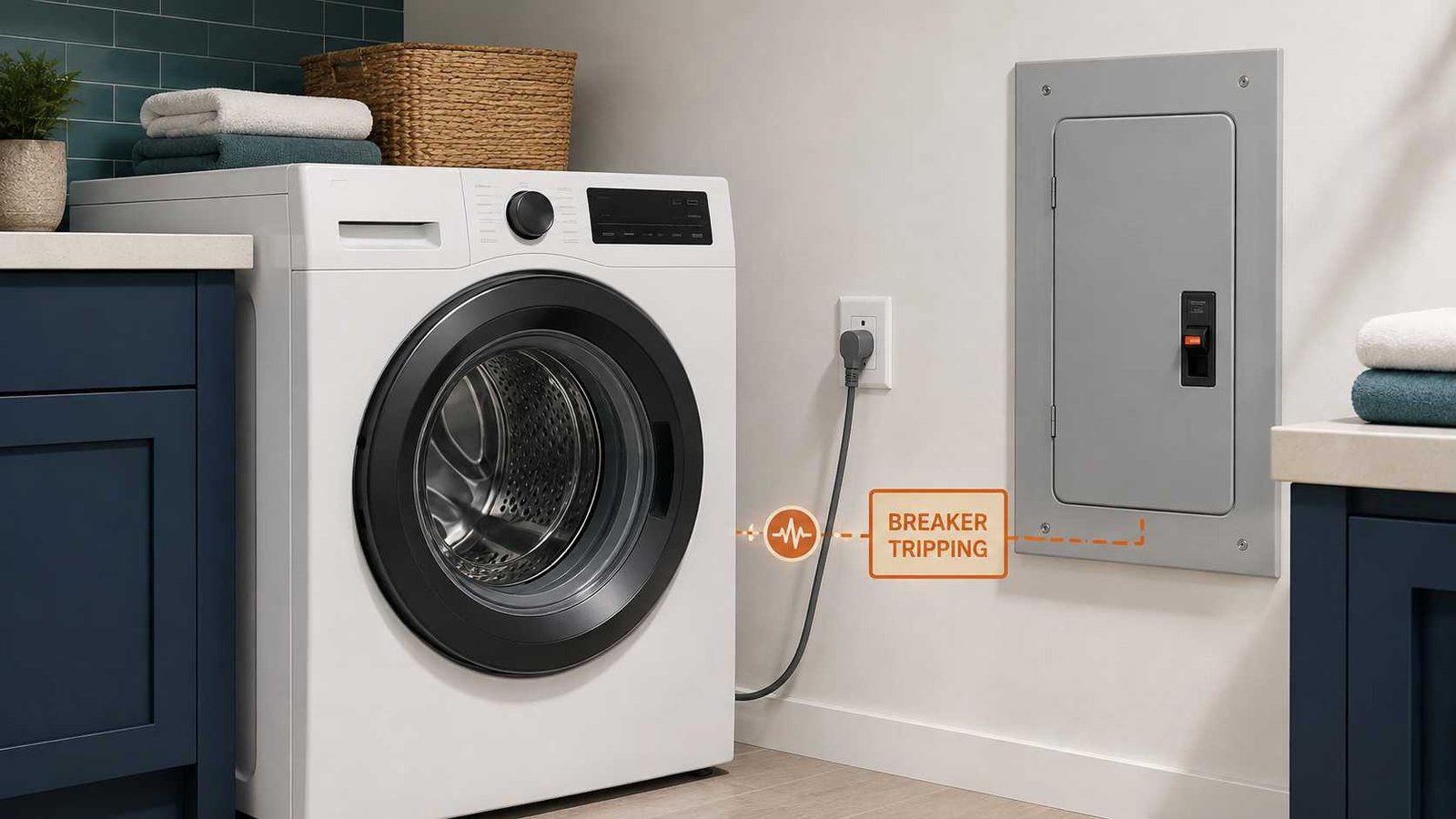
 An appliance that keeps tripping the circuit breaker may be overloading the circuit, developing an internal electrical fault, leaking current to ground, or exposing a problem in the outlet or household wiring. The trip may also come from a GFCI, AFCI, RCD, RCBO, safety switch, or fused plug rather than a standard breaker.
Switch off and unplug the appliance before doing anything else. Check for smoke, heat, a burning smell, water, sparks, or visible cord damage. Do not continue using an appliance that repeatedly trips electrical protection. The U.S. Consumer Product Safety Commission advises disconnecting an appliance that repeatedly blows a fuse or trips a breaker and having it repaired or replaced. er
| Question | Answer |
|---|---|
| What does the problem mean? | The circuit is detecting excessive current, leakage, arcing, or another electrical fault. |
| Most common causes | Circuit overload, damaged cord, appliance fault, moisture, heating-element leakage, motor fault, wiring problem, or faulty protective device |
| Safe first action | Switch off and unplug the appliance. Disconnect other loads from the affected circuit. |
| Can the appliance still be used? | Not if it trips the protection repeatedly or shows signs of electrical damage. |
| Can I reset the breaker? | A single controlled reset may be reasonable after unplugging the appliance and checking for obvious hazards. Do not keep resetting it. |
| Repair difficulty | Professional diagnosis is often required. |
| Call an appliance technician when | One appliance consistently causes the trip during operation. |
| Call an electrician when | The breaker trips with the appliance disconnected, several appliances cause trips, or the outlet, breaker, or wiring appears faulty. |
Why an Appliance Trips the Circuit Breaker
A protective device disconnects power because it has detected an electrical condition outside its expected limits. The exact meaning depends on which device has tripped.
A normal circuit breaker or miniature circuit breaker generally trips because too much current is flowing. That may result from an overloaded circuit, a short circuit, a failed appliance component, or a household wiring fault. Safe Electric Ireland explains that an MCB can trip because of a heavy circuit load or a fault in the circuit. United States or Canada and an RCD or safety switch in other markets are designed to respond to current leaking from its intended path. Leakage can occur when an appliance is damaged or when electrical parts become wet. nds to dangerous arcing associated with damaged, overheated, stressed, or compromised wiring and devices. herefore a warning. It does not automatically prove that the breaker is defective.
First Identify What Actually Tripped
Look at the electrical panel, outlet, or appliance plug without removing covers.
| Protective device | Common terminology | What it mainly detects |
|---|---|---|
| Circuit breaker | Breaker, MCB | Excess current from an overload or short circuit |
| GFCI | GFCI or GFI outlet/breaker | Current leaking to ground |
| AFCI | Arc-fault breaker | Dangerous electrical arcing |
| RCD | RCD, tripswitch, safety switch | Current leaking to earth |
| RCBO | Combined breaker and RCD | Excess current and earth leakage |
| Fuse | Panel fuse or fused plug | Excess current that melts the fuse element |
A GFCI may have TEST and RESET buttons on an outlet. An RCD, MCB, RCBO, or AFCI is usually located in the electrical panel, consumer unit, fuse box, or switchboard.
Do not remove the panel cover or touch internal conductors.
What the Timing of the Trip Can Tell You
The point at which power trips can help a technician narrow the fault. It does not confirm which part is defective.
| When the trip occurs | Possible explanation |
|---|---|
| Immediately when plugged in | Damaged cord, plug fault, input-filter fault, internal short, moisture, or earth leakage |
| When the appliance is switched on | Motor, compressor, control, starting component, or wiring fault |
| When heating begins | Heating-element leakage, damaged connection, or overloaded circuit |
| During draining | Drain-pump fault, moisture, or damaged pump wiring |
| During spinning or agitation | Motor, motor control, harness, or excessive mechanical load |
| During refrigerator defrost | Defrost heater or associated electrical circuit |
| When an air conditioner starts | Shared-circuit overload, supply problem, compressor-related fault, or power-cord protection trip |
| Randomly after running normally | Intermittent moisture, heat-related connection fault, damaged wiring, or a component that cycles on and off |
Bosch lists the motor, heater, suppressor, wiring shorts, and water reaching an electrical part among possible reasons a washing machine trips the electrics. GE also identifies shorted heaters, loose wiring, timers, and failed components as possible causes across major appliances. n Causes
1. Too Many Appliances on the Same Circuit
Several high-current products operating together can overload a circuit. Common examples include kettles, toasters, heaters, microwaves, air conditioners, washers, dryers, dishwashers, and cooking appliances.
Whirlpool advises reducing or relocating other loads when an air conditioner shares a circuit with too many appliances. s more likely when:
- The breaker trips only when two or more appliances run together.
- Each appliance works when used separately.
- The trip occurs during a high-power stage such as heating or compressor startup.
- The affected outlet shares power with other rooms or appliances.
Reducing the load may stop an overload, but it will not correct damaged wiring or an appliance fault.
2. The Appliance Needs a Dedicated or Correctly Rated Circuit
Some major appliances require or recommend a separate circuit. The required voltage, grounding method, breaker size, receptacle, and wiring arrangement depend on the specific installation instructions.
For example, Whirlpool recommends a separate circuit for selected North American washers and refrigerators. It also advises against using an extension cord with a refrigerator. These ratings should not be applied to every appliance or region. tallation manual for your exact model. Do not replace an existing breaker with a higher-rated one to match the appliance. Increasing breaker capacity without verifying the wiring can create a fire risk.
3. Damaged Power Cord or Plug
A crushed, cut, melted, loose, or discoloured cord or plug may short internally, overheat, or leak current.
Inspect only the visible parts. Stop using the appliance if you find:
- Cracked insulation
- Exposed conductors
- Bent or burned plug pins
- Melted plastic
- A loose plug
- Scorching around the outlet
- Heat at the plug or socket
Do not wrap a damaged mains cord with tape and return the appliance to service.
4. Internal Short Circuit
A short circuit creates an unintended low-resistance electrical path and can produce a rapid breaker trip.
Possible appliance-side sources include damaged wiring, failed terminals, a shorted component, or insulation breakdown. Locating the fault normally requires resistance, insulation, or leakage testing after the appliance has been safely isolated.
These are technician-level tests.
5. Current Leaking to Earth or Ground
A GFCI, RCD, safety switch, or RCBO may trip when current escapes through moisture, damaged insulation, a heating element, a motor, a compressor, or another grounded metal part.
Ground-fault protection is intended to disconnect power quickly when the outgoing and returning current no longer match. the device or move the appliance to an unprotected outlet simply to keep it running. That removes an important safety warning rather than correcting the fault.
6. Moisture Reaching Electrical Parts
Leaks and condensation can cause electrical leakage. This is particularly relevant to:
- Washing machines
- Dishwashers
- Refrigerators
- Coffee machines
- Kettles
- Dehumidifiers
- Air conditioners
- Appliances stored in damp areas
Disconnect the appliance if water is visible around the plug, cord, controls, base, or electrical connection.
Do not tilt, open, energise, or dismantle a wet appliance to find the source.
7. Heating-Element Fault
Heating elements are used in ovens, dryers, dishwashers, washing machines, water heaters, coffee machines, and some refrigerator defrost systems.
A damaged element may continue to look normal while its insulation leaks current as it heats. This often causes the trip at a consistent point in the cycle.
The element should not be replaced based only on trip timing. Model-specific electrical testing is required.
8. Motor, Pump, Fan, or Compressor Problem
A stalled or electrically damaged motor, pump, fan, or compressor may draw excessive current or develop leakage.
The trip may occur:
- As soon as the motor starts
- Under a heavy mechanical load
- During draining or spinning
- When a compressor starts
- After the component becomes warm
Compressors, refrigerant systems, and mains-powered motors are not suitable for homeowner electrical testing.
9. Household Wiring or Outlet Fault
The appliance may not be the cause. A loose outlet connection, damaged cable, incorrectly wired receptacle, overloaded branch circuit, or panel problem can also cause trips.
GE advises unplugging the appliance and resetting the protective device. If it trips immediately while the appliance remains disconnected, the household wiring or breaker box may require diagnosis by an electrician. y Breaker, GFCI, RCD, or RCBO
Protective devices can wear out or become defective, but this should not be the first assumption. A replacement must have the correct type and rating and should be installed by a suitably qualified electrical professional.
A breaker that feels hot, smells burned, buzzes, will not reset, or trips without any connected load needs professional attention.
Stop Immediately If You Notice These Warning Signs
Electrical safety warning: Do not reset the breaker or touch the appliance if you see smoke, sparks, melted plastic, water around electrical parts, or signs of fire. Move away and disconnect power only when it is safe to do so.
Stop using the appliance when you notice:
- Smoke or a burning smell
- Sparks or flashes
- Buzzing or crackling
- A hot outlet, plug, cord, or breaker
- Black marks or melted plastic
- An electric shock or tingling sensation
- Water around the plug or appliance base
- A breaker that trips immediately every time
- The main household breaker tripping
- Damage following flooding, a power surge, or a lightning event
Electrical Safety First advises users not to ignore burn marks, arcing sounds, unusual heat, blowing fuses, or tripping breakers. WorkSafe New Zealand advises immediately disconnecting an appliance that repeatedly trips protection or has given someone a shock. s You Can Perform
Only perform these checks when there is no smoke, heat, visible electrical damage, shock, or water hazard.
1. Switch Off and Unplug the Appliance
Use the appliance’s power control first, then remove the plug by gripping the plug body. Do not pull the cord.
For a hardwired dishwasher, oven, cooktop, air conditioner, or other fixed appliance, do not remove covers or disconnect wiring. Leave it off and arrange professional help.
2. Disconnect Other Appliances on the Circuit
Switch off and unplug other accessible appliances that lost power at the same time.
Queensland electrical-safety guidance recommends unplugging appliances on the affected circuit, resetting the safety switch, and reconnecting appliances individually to identify which one may be causing the trip. t Accessible Parts
Check the appliance’s:
- Power cord
- Plug
- Wall outlet
- External controls
- Base and surrounding floor
- Visible inlet and drain-hose areas
Do not remove a rear panel, kick plate, terminal cover, control panel, or electrical-box cover.
4. Reset the Protection Once
After the suspect appliance and other loads have been disconnected, a single controlled reset may help determine whether the circuit holds.
Some breakers must be pushed fully to OFF before being moved back to ON. A double-pole breaker can sometimes appear to be on even though it has partially tripped. esetting a device that trips again.
For refrigerators, freezers, air conditioners, and other compressor appliances, follow the model instructions before restarting. Some manufacturers require a short delay after switching the unit off. Whirlpool, for example, tells users of selected room air conditioners to wait at least three minutes before restarting. e What Happens Without the Appliance
If the protective device trips while the appliance remains unplugged, stop testing and call an electrician.
If it remains on, the appliance becomes a stronger suspect, but that is not conclusive. The fault may depend on the outlet, circuit load, or operating stage.
6. Record the Exact Trip Point
Write down:
- Whether it trips when plugged in
- Whether it trips when Start is pressed
- The cycle and elapsed time
- Whether heating, draining, spinning, cooling, or defrosting had started
- Which other appliances were operating
- Which breaker or protective device tripped
- Any error code, smell, sound, or visible leak
This information can make professional diagnosis faster and more accurate.
7. Check the Installation Manual
Confirm:
- Required voltage
- Circuit type
- Grounding requirements
- Whether a dedicated circuit is required
- Whether GFCI or RCD installation has model-specific conditions
- Whether extension leads are prohibited
- The manufacturer’s response to repeated trips
Use the manual for the exact model and country.
8. Check for Product Recalls
Search the official product-safety or recall database for your country using the brand and exact model number.
Stop using the appliance if it is covered by an unresolved electrical, fire, overheating, shock, or wiring recall.
Checks You Should Not Perform
Do not:
- Open the electrical panel
- Touch panel wiring
- Install a larger breaker or fuse
- Bypass a GFCI, RCD, RCBO, fuse, thermal cut-out, or door switch
- Use foil, wire, or another object in place of a fuse
- Test live voltage
- Perform insulation or leakage tests without suitable training and equipment
- Open a microwave cabinet
- Work on a compressor or refrigerant circuit
- Disconnect gas components
- Repair internal mains wiring
- Use an extension cord to test a major appliance
- Move the appliance repeatedly between protected and unprotected outlets
- Continue resetting the breaker until the appliance runs
CPSC warns against replacing a correctly sized fuse with a larger one and advises investigating why protection is operating rather than simply resetting it. Specific Clues
Washing Machine
A washer may trip during filling, heating, draining, agitation, or spinning. Possible areas include the heater, motor, suppressor or input filter, drain pump, wiring, and water reaching an electrical part. Bosch identifies several of these as possible causes but recommends professional inspection because the exact fault can be difficult to determine. ryer or Tumble Dryer
A trip when heating starts may involve the heating circuit. A trip when the drum starts may involve the motor or wiring. Vent restriction can make a dryer overheat, but it does not by itself prove why the electrical protection tripped.
Disconnect the dryer if its plug, receptacle, or terminal area smells burned or feels unusually hot.
Dishwasher
A dishwasher may trip while filling, heating, circulating, or draining. Bosch recommends checking whether the household supply is being overloaded. If the dishwasher itself appears responsible, switch it off, close the water supply, and arrange inspection. tor or Freezer
A refrigerator can trip during compressor startup, defrost, fan operation, or after moisture reaches electrical parts.
Check that it is connected according to the model’s installation instructions. Whirlpool recommends a separate circuit for selected North American refrigerators and states that an extension cord should not be used. ge, or Cooktop
A trip during preheating may point toward a heating circuit, connection, or wiring problem. A hardwired cooking appliance should be left switched off for professional diagnosis.
Do not remove terminal covers or heating elements unless you are qualified to perform the work.
Microwave
Microwaves contain high-voltage components that can remain dangerous even after the appliance is unplugged.
GE advises confirming that selected microwaves are on the required dedicated circuit, trying one reset, and unplugging the microwave for service if the breaker trips again. microwave cabinet.
Air Conditioner or Heat Pump
An air conditioner may trip because of excessive shared load, a power-cord protection device, supply problems, or an internal component fault.
Whirlpool advises reducing other loads on the circuit for selected room air conditioners and waiting before restarting the unit. ompressor wiring, capacitors, refrigerant components, or internal high-voltage parts.
Coffee Machine, Kettle, or Small Appliance
Small heating appliances can trip protection because of moisture, cord damage, element leakage, or an internal short.
Do not keep trying the appliance in different sockets. Disconnect it and arrange repair or replacement if it repeatedly trips protection.
Is the Appliance or the Circuit Responsible?
Use this table only as a safe decision guide.
| What happens? | More likely area | Next action |
|---|---|---|
| Breaker trips with appliance unplugged | Circuit, outlet, wiring, or protective device | Call an electrician |
| Several unrelated appliances trip the same circuit | Circuit loading, wiring, outlet, or breaker | Call an electrician |
| One appliance trips different suitable circuits | Appliance fault | Stop using it and call an appliance technician |
| Trip occurs at the same cycle stage | Component energised during that stage | Call an appliance technician |
| Plug or outlet is burned, loose, or hot | Connection or wiring fault | Stop use and call an electrician |
| Hardwired appliance trips protection | Appliance or fixed wiring | Leave it off; arrange qualified diagnosis |
| GFCI/RCD trips near water | Leakage or moisture fault | Disconnect the appliance and arrange inspection |
Do not test a suspect appliance on an unsuitable circuit or with an extension lead.
Should You Reset the Circuit Breaker?
Resetting restores power. It does not repair the fault.
One reset may be appropriate when:
- The appliance has been unplugged.
- Other loads have been removed.
- There is no smoke, heat, water, shock, or visible damage.
- You can operate the breaker without opening the panel.
- The appliance manual does not prohibit immediate restarting.
Stop after the protection trips again.
CPSC advises consumers to investigate repeated trips because they may indicate overloading, a malfunctioning product, or a short circuit. ll an Appliance Technician
Contact an appliance repair technician when:
- One appliance consistently causes the trip.
- The circuit remains stable while that appliance is disconnected.
- The trip occurs at a repeatable cycle stage.
- The appliance has an error code, leak, unusual noise, or operational fault.
- The plug, outlet, and accessible cord appear normal.
- The manufacturer recommends service after a repeated trip.
The technician may need to test insulation resistance, current draw, wiring, heaters, motors, pumps, filters, compressors, controls, or other model-specific components.
When to Call a Licensed Electrician
Call an electrician when:
- The breaker trips with the appliance unplugged.
- Several appliances cause the same circuit to trip.
- The outlet is loose, burned, hot, or damaged.
- The breaker, RCD, GFCI, or panel is hot or buzzing.
- The protective device will not reset.
- The main breaker trips.
- A fixed-wiring fault is suspected.
- You are unsure whether the circuit meets the appliance’s installation requirements.
- A hardwired appliance is involved and the fault cannot be isolated safely.
WorkSafe New Zealand advises calling a licensed electrician when a circuit breaker continues to trip after lights and appliances on the affected circuit have been switched off or unplugged. ppliance Parts Involved
The following parts may be involved, depending on the appliance and the trip timing:
| Possible part | How it may relate to tripping |
|---|---|
| Heating element | Insulation leakage or short when energised |
| Motor | Excess current, winding fault, or leakage |
| Compressor | Startup or winding fault |
| Drain or circulation pump | Motor fault, blockage-related stress, or water intrusion |
| Power cord or plug | Damaged insulation or loose connection |
| Input filter or suppressor | Short or leakage near the mains input |
| Terminal block | Loose, burned, or damaged connection |
| Wiring harness | Chafing, heat damage, moisture, or loose connector |
| Control board | Failed mains-side component or damaged connection |
| Defrost heater | Leakage or short during defrost |
| Starting component | Fault during motor or compressor startup |
This table does not confirm which part has failed. Internal testing should be based on the appliance’s model-specific service information.
Regional Terminology
The underlying safety principle is similar across the target countries, but the names of protective devices differ.
United States and Canada
Readers commonly refer to:
- Circuit breakers
- Breaker panels
- GFCI or GFI outlets
- AFCI breakers
- Dedicated circuits
Installation requirements vary by appliance and local electrical rules.
United Kingdom and Ireland
Readers commonly refer to:
- Consumer units
- Fuse boxes
- MCBs
- RCDs
- RCBOs
- Fused plugs
- An appliance tripping the electrics
Safe Electric Ireland explains that an MCB trip can indicate excessive current from a heavy load or a circuit fault. and New Zealand
Readers commonly refer to:
- Switchboards
- Circuit breakers
- Safety switches
- RCDs
- RCBOs
- An appliance tripping the power
Queensland electrical-safety guidance recommends isolating appliances and reconnecting them individually only when it is safe to do so. ntinue Using the Appliance?
Do not continue using an appliance that repeatedly trips a breaker, fuse, GFCI, RCD, safety switch, or RCBO.
A one-time trip caused by an obvious temporary overload may not mean the appliance itself is defective. However, the circuit load and installation should still be checked before the appliance is used again.
Repeated trips, immediate trips, shocks, moisture, overheating, or burning smells require the appliance to remain disconnected until it has been professionally assessed.
Frequently Asked Questions
Can a faulty appliance trip a circuit breaker?
Yes. A failed heater, motor, pump, compressor, power filter, cord, connection, wiring harness, or other electrical component may cause excessive current or leakage. The exact cause requires model-specific diagnosis.
Is it safe to keep resetting the breaker?
No. Repeatedly resetting it without finding the cause can leave an overload, short circuit, leakage fault, or damaged connection unresolved. Disconnect the appliance and arrange diagnosis if the device trips again. he appliance trip the breaker only after a few minutes?
A component that operates later in the cycle may be responsible. Examples include a heating element, pump, fan, compressor, or defrost circuit. Heat-related insulation or connection faults may also appear only after the appliance warms up.
Why does the appliance trip the RCD but not the normal breaker?
An RCD responds to current leaking to earth, while a standard breaker mainly responds to excessive current. An appliance can therefore develop enough leakage to trip an RCD without drawing enough total current to trip an ordinary breaker. the appliance into another outlet to test it?
Do not move a repeatedly tripping appliance to another circuit unless the manufacturer or a qualified professional specifically directs you to do so. Never use an extension cord or unsuitable outlet for a major appliance. Moving it may expose another circuit to the same fault.
Can a weak circuit breaker cause nuisance tripping?
A defective or deteriorated breaker is possible, but overloads, appliance faults, wiring problems, and leakage should also be considered. A licensed electrician should inspect and replace the breaker when required.
Should I call an electrician or an appliance technician?
Call an electrician when the breaker trips with the appliance disconnected, several products affect the same circuit, or the outlet, panel, wiring, or protective device appears faulty.
Call an appliance technician when one appliance consistently causes the trip and the household circuit remains stable without it.
Can water cause an appliance to trip the breaker?
Yes. Water or condensation can create leakage paths or damage electrical insulation. Disconnect the appliance and do not energise it again until the leak and electrical condition have been assessed.

Daniel Brooks is a US-based appliance troubleshooting researcher with 12 years of experience studying washer, dryer, refrigerator, and dishwasher faults. He reviews manufacturer manuals and converts technical error codes into safe, practical guidance for homeowners.