
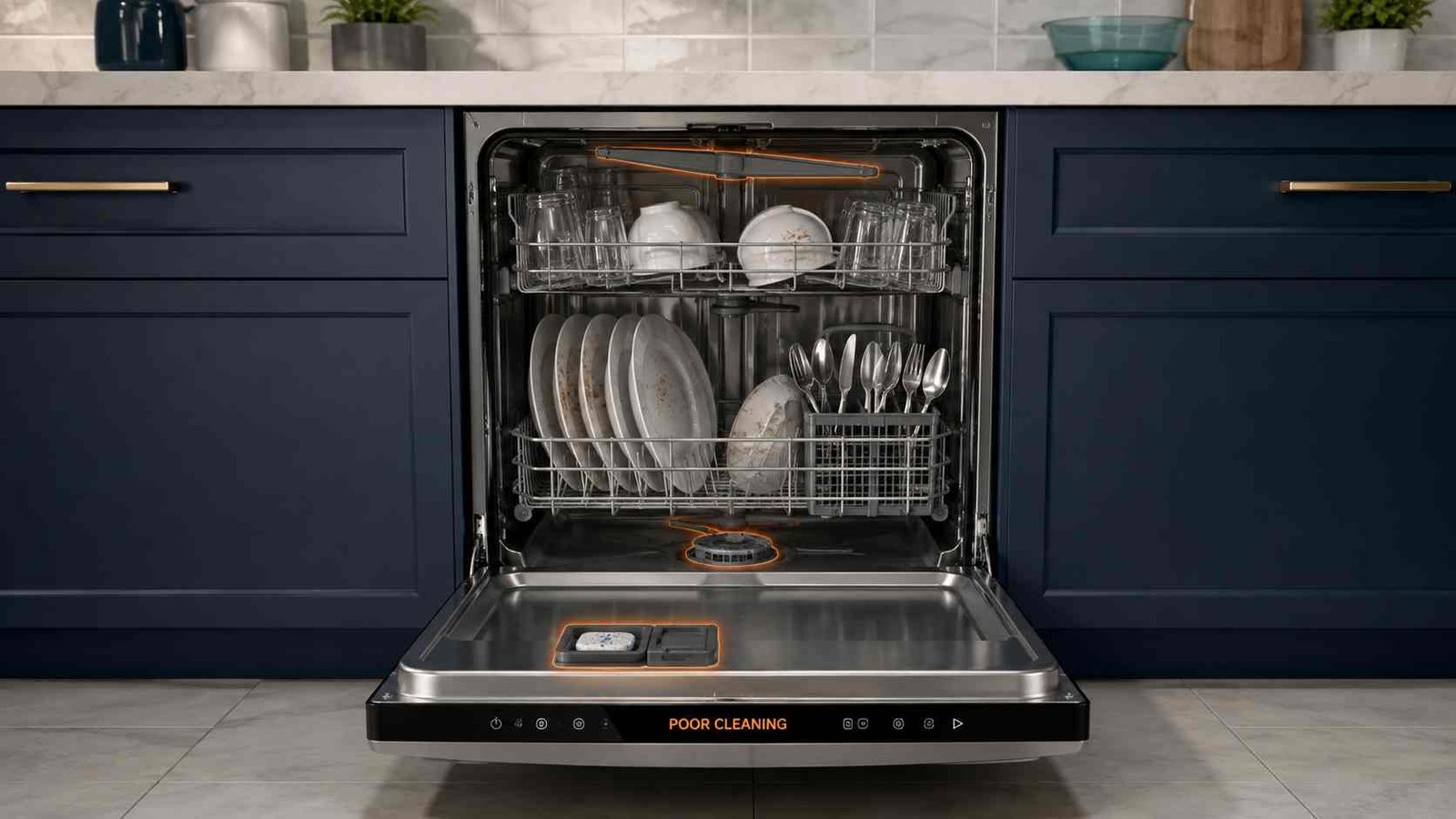
 A dishwasher that completes its cycle but leaves dishes dirty usually has a problem with water reaching the load effectively. Common causes include incorrect loading, blocked spray arms, a clogged or incorrectly fitted filter, unsuitable detergent, the wrong programme, or an inadequate water supply.
Start by checking that plates and utensils are not blocking the spray arms or detergent dispenser. Then rotate each accessible spray arm by hand and inspect the filter according to the instructions for your model.
Stop using the dishwasher if it leaks, produces a burning smell, trips the electrical supply, makes a severe grinding noise, or repeatedly leaves dirty water inside. Those symptoms may require professional diagnosis rather than another wash cycle.
| Item | Details |
|---|---|
| Problem | Dishwasher completes a cycle but dishes remain dirty |
| Error code | Usually no error code is displayed |
| Most common causes | Poor loading, blocked spray arms, dirty filter, unsuitable detergent or incorrect cycle |
| Safe first check | Confirm that the spray arms can rotate without touching the dishes |
| Repair difficulty | Usually easy when caused by loading, filter or detergent issues |
| Can another cycle be run? | Yes, when the machine drains normally and there are no leaks, electrical symptoms or unusual noises |
| When service may be needed | Weak circulation, inadequate filling, cold washing, repeated drainage problems or detergent dispenser failure |
| Applies to | Most built-in, freestanding, compact and drawer-style dishwashers, with model-specific differences |
Identify What Is Left on the Dishes
The type of residue can help narrow down the cause.
| What you see | More likely explanation | First checks |
|---|---|---|
| Food particles | Blocked filter, weak spray or overloading | Filter, spray arms and loading |
| Sand-like grit | Food recirculation or detergent not dissolving | Filter, water temperature and detergent |
| Greasy surfaces | Programme too light, poor detergent performance or insufficient heat | Cycle, detergent and model-specific water guidance |
| White powder | Excess detergent, hard-water deposits or undissolved detergent | Detergent amount and water hardness |
| Cloudy glasses | Mineral film, unsuitable detergent or permanent glass etching | Test whether the film wipes off |
| Tablet left in dispenser | Blocked dispenser, poor spray or unsuitable short cycle | Dispenser clearance and spray arms |
| Dirty water marks | Drainage restriction or water flowing back into the machine | Drain hose and sink connection |
| Only one rack is dirty | Blocked rack-level spray arm or selected wash-zone setting | Spray arm, loading and control settings |
Cloudy glassware is not always a washing failure. A removable white film may be caused by minerals or detergent residue. Permanent cloudiness that does not wipe away may be glass etching and cannot normally be removed by another wash.
Safety Checks Before Troubleshooting
Safety warning: Switch the dishwasher off before removing filters, spray arms or other user-maintenance parts. Wear protective gloves because broken glass or sharp food fragments may be hidden near the filter.
Only remove parts described as user-accessible in the appliance manual. Filter assemblies and spray-arm fittings differ between brands and models.
Do not attempt to test:
- Live electrical wiring
- Heating components
- Pumps or motors
- Water inlet valves
- Control boards
- Internal sensors
- Door-lock circuits
Contact a qualified appliance technician when diagnosis requires electrical testing, major disassembly or access beneath the machine.
1. Check How the Dishwasher Is Loaded
Poor loading is one of the most common reasons a dishwasher runs normally but does not clean properly.
Water must reach the dirty surfaces of every item. Plates should not be pressed tightly together, bowls should not overlap, and cutlery should not form tightly nested groups.
Large trays, chopping boards, pan handles and long utensils can block:
- The lower spray arm
- The middle spray arm
- The detergent-dispenser door
- Water flow toward the upper rack
After loading, turn each accessible spray arm by hand. It should rotate without hitting a plate, utensil or rack item. Electrolux specifically recommends checking spray-arm movement after loading, while Whirlpool advises facing dirty surfaces toward the spray action.
Avoid overloading the dishwasher. A smaller test load is useful because it shows whether crowding is responsible for the poor result.
2. Inspect the Spray Arms
Spray arms distribute pressurised water around the dishwasher. Food particles and mineral deposits can block their small openings, while incorrectly loaded dishes can prevent them from rotating.
Check the following:
- Remove the racks only as far as necessary.
- Turn each visible spray arm by hand.
- Look for food or scale inside the spray holes.
- Remove the spray arm only when your manual explains how.
- Rinse it with warm water.
- Clear accessible holes gently with a wooden toothpick or another method approved by the manufacturer.
- Refit it securely.
Do not force an arm, locking ring or retaining clip. Some arms pull upward, while others use threaded or locking fittings.
Bosch identifies blocked spray arms as a cause of poor water distribution and undissolved detergent. Its maintenance guidance also recommends checking that the openings remain clear.
3. Clean and Refit the Dishwasher Filter
A dirty filter can restrict water flow or allow loose food to circulate back onto plates and glasses.
The filter is commonly found below the lower rack near the bottom spray arm, but its design varies. Some machines have a cylindrical filter with a separate flat screen. Others use different filtration or food-disposal arrangements.
For a removable filter:
- Switch off the dishwasher.
- Remove the lower rack.
- Follow the manual’s instructions to unlock the filter.
- Lift it carefully and check for sharp debris.
- Rinse it under warm running water.
- Use a soft brush for stubborn deposits.
- Clean the surrounding accessible area without reaching into the pump.
- Reinstall every filter section firmly.
An incorrectly seated filter can also reduce cleaning performance. Check that it sits flat and locks into position.
Whirlpool notes that some filters are not removable, so a general twisting instruction should not be applied to every dishwasher. Its filter guidance recommends warm water and a soft brush rather than rough pads or wire brushes.
4. Select a Suitable Programme
A quick, delicate, glassware or energy-saving programme may not remove dried or heavily baked-on food as effectively as an intensive or heavy cycle.
Choose a programme that matches the load:
- Light or quick: Recently used, lightly soiled dishes
- Normal or auto: Everyday mixed loads
- Heavy or intensive: Pots, pans and dried food
- Sanitise or extra-hot option: Only where suitable for the items and supported by the model
- Upper, lower or zone wash: Only when the dishes are placed in the selected wash area
Check whether a half-load, rack-only or zone-wash option was selected accidentally. On machines with targeted wash zones, items outside the selected area may receive less wash action.
GE advises matching the cycle to the soil level and notes that selected wash-zone settings can affect which part of the dishwasher receives full cleaning action.
5. Check the Detergent
Use only detergent labelled for automatic dishwashers. Ordinary hand-washing liquid can create excessive foam, interfere with washing and potentially cause leakage.
Poor results may occur when detergent is:
- Old or exposed to moisture
- Clumped inside the container
- Unsuitable for local water conditions
- Used in an incorrect amount
- Placed in the wrong compartment
- Unable to dissolve during a very short or unsuitable programme
Too little detergent may leave grease and food behind. Too much can leave powdery residue or film. Follow the detergent label and appliance manual rather than using one amount for every load.
Store powder and tablets in a dry place with the package closed.
6. Make Sure the Dispenser Can Open
A tall plate, pan handle or utensil may block the detergent-dispenser door.
Before starting a test cycle:
- Load the dishwasher.
- Close the racks fully.
- Check the area in front of the dispenser.
- Move any item that could touch the dispenser door.
- Confirm that the dispenser is dry before adding powder or a tablet.
If the programme ends with detergent still inside the dispenser, the problem may involve blocked spray action, unsuitable detergent, low water temperature on relevant models, or a dispenser that is not opening correctly.
Electrolux recommends ensuring that water spray can reach the detergent cup and that dishes do not obstruct it. Bosch also links blocked spray arms with tablets that fail to dissolve.
7. Confirm That the Dishwasher Is Filling
Insufficient water can produce weak spray pressure even though the dishwasher makes noise and appears to run.
Check that:
- The household water supply is available
- The dishwasher’s water valve is fully open
- The inlet hose is not visibly crushed or sharply kinked
- No water-supply warning or error code is displayed
- Other taps in the home are not showing unusually low pressure
Do not disconnect plumbing or remove the inlet valve unless you are competent and permitted to do so. A faulty inlet valve, flow system or level sensor requires professional diagnosis.
Samsung lists low water pressure, a closed supply valve and spray-arm blockage among the causes of poor dishwasher cleaning. Its published pressure figures apply to selected products and should not be treated as universal specifications.
8. Follow the Model’s Water-Temperature Guidance
Water-temperature requirements vary by market and dishwasher design.
Many North American dishwashers are connected to a household hot-water line. GE advises an incoming temperature of at least 120°F for its relevant models and recommends running the nearby hot tap before starting the dishwasher. These figures and steps should not automatically be applied to every brand or country.
Other dishwashers may use a different inlet arrangement or heat water internally. Check the installation guide before changing the household water-heater setting or assuming the appliance has a heating fault.
Use caution with very hot water because it can cause burns and may damage temperature-sensitive items.
9. Check Rinse Aid, Salt and Water Hardness
Hard water can leave white film, spots or mineral deposits on dishes and inside the dishwasher.
Rinse aid helps water drain from surfaces more evenly and can reduce spotting. It is not a substitute for detergent and will not correct blocked spray arms or a dirty filter.
Some dishwashers, especially models sold in the UK, Ireland and parts of Europe, have an internal water-softening system. These machines may require:
- Dishwasher salt
- A correct water-hardness setting
- Regular refilling of the salt reservoir
- Rinse-aid adjustment
Only add salt when the dishwasher has a designated salt reservoir. Do not pour dishwasher salt into the tub or detergent dispenser.
Bosch UK explains that salt use depends on local water hardness and that the hardness setting determines how the softening system operates. It also identifies hard water as a cause of white residue.
10. Check for Dirty-Water Backflow
A dishwasher can wash poorly when dirty drain water flows back into the tub.
Inspect the visible drain hose beneath the sink. It should not be:
- Crushed
- Folded
- Sharply kinked
- Sitting in dirty water
- Installed contrary to the manufacturer’s instructions
Depending on local plumbing rules and the dishwasher design, the drain may require an air gap or a high loop. Samsung explains that the high point helps prevent water from flowing back into the appliance.
Do not modify plumbing blindly. Compare the installation with the manual or ask a plumber or appliance installer to inspect it.
Step-by-Step Dishwasher Cleaning Test
After completing the basic checks, use this controlled test:
Step 1: Empty the Dishwasher
Remove the existing load and inspect the bottom of the tub for loose labels, food fragments or broken glass.
Step 2: Clean the Filter
Remove and wash it only as instructed by the manufacturer. Reinstall it securely.
Step 3: Inspect Every Accessible Spray Arm
Confirm that each arm rotates and that its nozzles are clear.
Step 4: Check the Dispenser
Remove residue around the lid and make sure dishes cannot block it.
Step 5: Load a Small Test Load
Use a few normally soiled plates, bowls and glasses. Leave enough space for water circulation.
Step 6: Use Fresh Detergent
Measure the detergent according to its instructions and your dishwasher manual.
Step 7: Select a Normal or Heavy Programme
Avoid quick wash for this test unless the manufacturer specifically recommends it for the load.
Step 8: Check Model-Specific Water Requirements
For relevant hot-water-connected models, follow the manual’s preparation advice. Do not apply another brand’s temperature specifications.
Step 9: Start the Cycle
Listen for normal filling, circulation and draining sounds. Do not open the door repeatedly.
Step 10: Inspect the Results
Look separately for:
- Food residue
- Grease
- White film
- Undissolved detergent
- Water remaining inside
- A difference between upper and lower racks
The result will help determine whether the problem concerns water distribution, detergent, water chemistry, drainage or an internal component.
Dishwasher Not Cleaning but the Filter Is Clean
A clean filter does not rule out other causes.
Check these next:
- Filter installation: A clean filter that is not locked into place may still allow debris to circulate.
- Upper or middle spray arm: These are easy to overlook when only the top rack is affected.
- Spray-arm movement: A large item may stop an otherwise clean arm from rotating.
- Dispenser clearance: The detergent door may remain trapped behind a plate or pan.
- Rack-only setting: A selected wash zone may reduce cleaning elsewhere.
- Water filling: Weak filling can reduce circulation pressure.
- Drain backflow: Dirty water may be returning after the wash stage.
- Detergent and hard water: The residue may be mineral film rather than food.
- Circulation sound: A dishwasher that fills but produces little wash noise may require service.
- Water heating: Poor cleaning combined with cold dishes and poor drying may require model-specific diagnosis.
Do not assume that the circulation pump, heater or inlet valve has failed based only on dirty dishes. Further testing is needed before any part is replaced.
Why Is Only the Top Rack Not Getting Clean?
When the bottom rack is clean but the top rack is dirty, check:
- The spray arm beneath the upper rack
- A blocked water connection at the rear of the rack
- Tall items restricting rack position
- Bowls nested too closely together
- Cups placed upright instead of angled
- A rack-level or zone-wash setting
- Cutlery or utensils hanging through the rack
Push an adjustable upper rack fully into its normal operating position. On some models, an incorrectly seated rack can prevent the water connection from aligning correctly.
Why Is Only the Bottom Rack Not Getting Clean?
Check whether:
- Large plates block the lower spray arm
- A tray covers the lower water jets
- A utensil has fallen below the basket
- The lower spray-arm openings are blocked
- The filter beneath the lower rack is dirty
- A selected upper-zone programme is active
Large cookware should be positioned so it does not form a wall between the lower spray arm and the rest of the load.
Should You Reset the Dishwasher?
A reset may help when the control panel is frozen or a cycle was interrupted. It will not correct a physical blockage or restore weak water circulation.
A reset cannot fix:
- A clogged filter
- Blocked spray-arm holes
- Incorrect loading
- A closed water valve
- Hard-water deposits
- An obstructed drain hose
- A faulty pump, valve, heater or dispenser
There is no universal dishwasher reset sequence. Some models use a Cancel or Reset button. Others require a button combination or a short power interruption.
Use the instructions for the exact model number. Do not copy a reset sequence from a different brand or product series.
Possible Faulty Parts When the Basic Checks Fail
The following are possible diagnostic areas, not confirmed faults.
| Possible component or system | What may be noticed | Recommended action |
|---|---|---|
| Water inlet valve or filling system | Low water level or weak spray | Professional diagnosis |
| Circulation pump or wash motor | Dishwasher fills but produces little wash action | Professional repair |
| Diverter system | One rack or wash zone remains dirty | Model-specific diagnosis |
| Detergent dispenser | Detergent repeatedly remains trapped | Inspect obstruction, then arrange service |
| Heating or temperature system | Poor cleaning with possible drying problems | Professional diagnosis |
| Drain pump or drain installation | Dirty water remains or returns | Check installation, then arrange service |
| Control or sensor system | Incorrect cycle behaviour or repeated error codes | Professional diagnosis |
| Rack water connection | Upper rack repeatedly receives weak spray | Model-specific inspection |
Internal parts should not be replaced based on symptoms alone. Similar symptoms can have several causes.
Regional and Model Differences
United States and Canada
North American guidance commonly refers to:
- Hot-water-line connections
- Temperature in degrees Fahrenheit
- Water pressure in PSI
- Garbage-disposal connections
- Countertop air gaps or drain-hose high loops
- Rack-only or targeted wash zones
These details remain brand and model specific.
United Kingdom and Ireland
Many models include:
- Dishwasher salt reservoirs
- Water-hardness settings
- Salt and rinse-aid warning lights
- Programme names such as Eco, Auto or Intensive
Salt is relevant only when the appliance contains a softening system.
Australia and New Zealand
The market includes conventional built-in and freestanding dishwashers as well as drawer-style appliances. A DishDrawer may use different filters, rotors and loading arrangements from a conventional dishwasher, so its specific care guide should be followed. Fisher & Paykel documentation also distinguishes between models with and without built-in water softeners.
When to Call a Dishwasher Technician
Arrange professional inspection when:
- The filter and spray arms are clean but circulation remains weak
- The machine fills but does not appear to spray
- The detergent dispenser repeatedly fails to open
- Dirty water returns after the hose installation has been checked
- The dishwasher does not heat as expected for its model
- An error code repeatedly appears
- The machine leaks onto the floor
- A grinding, buzzing or unusually loud noise develops
- The circuit breaker trips
- There is a burning smell
- Wiring or internal parts appear damaged
Do not continue running repeated cycles when the dishwasher is leaking, overheating or producing electrical symptoms.
How to Prevent Poor Cleaning Results
- Scrape away large food pieces before loading.
- Do not pack plates and bowls tightly together.
- Keep tall items away from moving spray arms.
- Clean removable filters according to the model manual.
- Inspect spray-arm openings periodically.
- Keep detergent sealed and dry.
- Select a cycle suitable for the soil level.
- Refill rinse aid or salt only where the model requires it.
- Use a manufacturer-approved machine-care programme when recommended.
- Correct recurring drainage or water-supply problems rather than repeatedly resetting the appliance.
Bosch advises removing coarse food waste without fully pre-rinsing dishes, while Whirlpool notes that loading, filter condition and spray-arm blockage are central cleaning-performance checks.
Frequently Asked Questions
Why is my dishwasher running but not cleaning?
The dishwasher may be filling and draining normally while water distribution remains poor. Check for overcrowding, blocked spray arms, an incorrectly fitted filter, unsuitable detergent and the wrong cycle.
Why are my dishes still dirty when the filter is clean?
The next likely checks are the spray arms, dispenser clearance, loading arrangement, water supply, wash-zone settings and drain-hose installation. A clean filter does not confirm that the dishwasher has adequate circulation.
Why does my dishwasher leave grit on glasses?
Grit may consist of recirculated food particles or detergent that did not dissolve properly. Check the filter, water flow, detergent condition and model-specific water-temperature guidance. GE also links sandy residue on selected models with water that is not hot enough to dissolve detergent effectively.
Why is the dishwasher tablet still in the dispenser?
A dish may be blocking the dispenser, water may not be reaching it, or the programme may not provide suitable conditions for the detergent. Check dispenser clearance and spray-arm movement before assuming the dispenser is faulty.
Should I pre-rinse dishes before loading them?
Usually, remove large food pieces but do not completely wash the dishes first unless the appliance manual says otherwise. Some modern machines use soil sensing to adjust the wash, and excessive pre-rinsing may affect how the cycle responds.
Will rinse aid make dirty dishes clean?
Rinse aid mainly helps water leave dishes more evenly and can reduce spotting. It will not correct food residue caused by blocked spray arms, a dirty filter or weak circulation.
Can I use dishwasher salt in every machine?
No. Use dishwasher salt only when the machine has a designated salt reservoir and internal water-softening system. Follow the model manual and local water-hardness guidance.
Is it safe to keep using a dishwasher that cleans poorly?
A test cycle is generally reasonable after safe maintenance when the dishwasher drains normally and has no leak, burning smell, electrical problem or severe noise. Stop using it and arrange service when any of those warning signs appear.

Daniel Brooks is a US-based appliance troubleshooting researcher with 12 years of experience studying washer, dryer, refrigerator, and dishwasher faults. He reviews manufacturer manuals and converts technical error codes into safe, practical guidance for homeowners.