
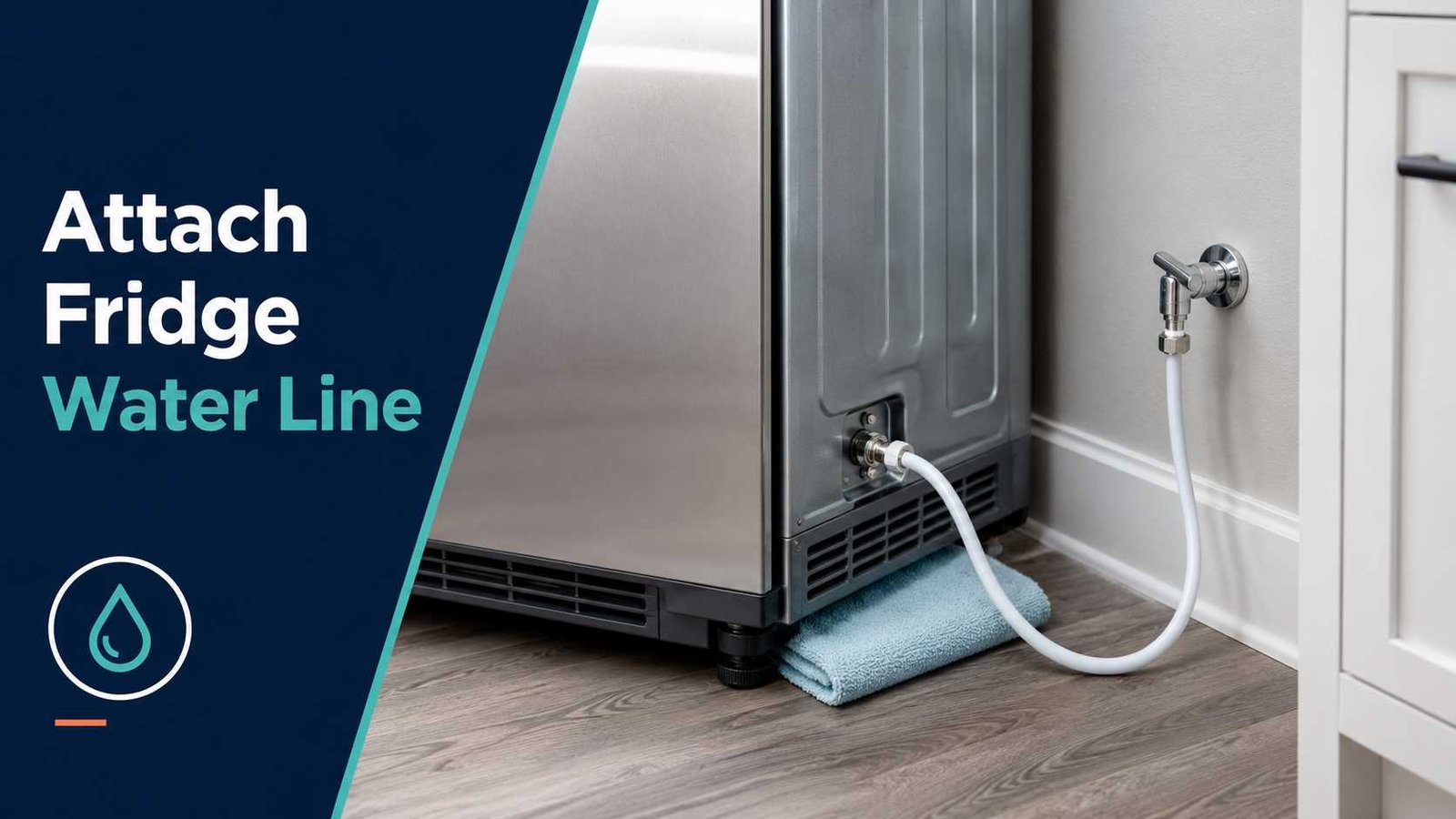
 If your refrigerator has a plumbed water dispenser or automatic ice maker, it normally needs a water supply connected to the inlet at the back of the appliance. On many North American refrigerators, this is commonly a 1/4-inch water line, but the tubing size and connector are not universal. Check your refrigerator’s installation manual before buying fittings.
For a refrigerator that already has an accessible cold-water shutoff nearby, attaching the line is usually straightforward: shut off the water, disconnect power, connect the correct tubing, restore the supply, and inspect every joint for leaks. If you must alter household plumbing, route a line through walls or floors, or install a new shutoff, a qualified plumber is the safer option. LG specifically recommends professional help when the home’s water supply must be modified.
Safety: Do not continue using a connection that is dripping or leaking. Shut off the water supply and correct the connection before pushing the refrigerator back into place.
Whirlpool, LG, and Samsung all stress that refrigerator-specific instructions should take priority because fittings and procedures can vary by model.
Do You Need to Connect Your Fridge to a Water Line?
Not every refrigerator needs plumbing.
A water connection is normally required when a plumbed refrigerator uses the household supply for an automatic ice maker or water dispenser. LG states that its plumbed ice and water features require a connection between the refrigerator and the home’s water supply.
However, some refrigerators use a refillable internal water tank rather than a mains connection. Samsung UK currently offers both plumbed and non-plumbed fridge freezers, including models that provide chilled water without being connected to household plumbing.
If your refrigerator has no automatic ice maker or plumbed dispenser, it may not need a water line at all.
If a refrigerator has an automatic ice maker but you intend to operate the appliance before connecting water, check its manual. LG, for example, instructs owners to leave the ice maker switched off until a water connection is installed.
Check the Refrigerator Before Buying a Water Line Kit
Avoid buying a generic kit until you know what your appliance actually requires.
Find the water inlet
Pull the refrigerator forward carefully and locate the water connection at the rear. On some models it is a threaded inlet. Others may have a short factory-installed tube, push-fit connector, external filter arrangement, or another model-specific design.
LG notes that the location and water-line size can vary and that an adapter or connector may be required when the line does not match the refrigerator connection.
Read the model installation manual
Look for sections called:
- Water connection
- Connecting the water supply
- Ice and water installation
- Installation requirements
- Plumbing requirements
Do not assume instructions for another refrigerator from the same brand are identical.
Samsung, for example, notes that selected RS27T and RS22T refrigerators have two water lines. Cross-connecting those lines can stop the ice and water functions from working correctly.
Confirm the tubing size
For many refrigerators sold in the United States and Canada, 1/4-inch outside-diameter tubing is common. Whirlpool specifies 1/4-inch tubing in its general refrigerator installation guidance, while LG and Samsung US also describe standard 1/4-inch arrangements.
That does not make 1/4 inch universal worldwide. Follow the specification for your exact refrigerator.
What You Need
For a basic installation where a suitable shutoff valve already exists, you may need:
- Manufacturer-approved refrigerator water tubing
- Correct compression nut, ferrule, adapter, or push-fit connector
- Adjustable wrench if your fitting requires one
- Clean bucket or container
- Dry towel
- Enough tubing to leave some movement behind the refrigerator
Whirlpool’s general installation procedure uses 1/4-inch copper tubing and compression hardware, while Whirlpool also sells compatible refrigerator kits using PEX tubing. Samsung US describes both copper and certain plastic arrangements but specifically says its plastic tubing option is not recommended. Compatibility should therefore be checked against the appliance rather than choosing tubing solely by price.
How to Attach a Water Line to a Fridge
1. Shut off the water supply
Close the shutoff valve supplying the refrigerator.
If there is no suitable accessible shutoff, do not improvise a connection to household pipework. Installing a new branch, valve, or concealed line moves the job beyond a simple refrigerator hookup.
Whirlpool begins its connection procedure by shutting off the water, and LG recommends calling a qualified plumber if the household water supply needs modification.
2. Unplug the refrigerator
Disconnect refrigerator power before working at the rear connection when directed by your appliance instructions.
Whirlpool, LG, and the Fisher & Paykel installation material reviewed all specify disconnecting or keeping the refrigerator disconnected from power during water connection work.
3. Inspect the tubing
Look along the entire accessible water line.
Do not reuse tubing that is:
- Split or cracked
- Flattened
- Sharply kinked
- Heavily discoloured
- Damaged around the fitting
- Too short to let the refrigerator move safely
Also check the shutoff valve for existing seepage. A leaking household valve should be repaired before connecting the refrigerator.
4. Flush a newly installed supply line
If you have installed new tubing, follow your manufacturer instructions for flushing it before completing the refrigerator connection.
Whirlpool directs users to place the open end in a bucket or sink and run water through until it is clear before attaching the refrigerator. LG gives similar instructions.
After flushing, shut the water off again before making the final connection.
5. Fit the correct connector
The exact procedure depends on the connection type.
A typical compression connection may use:
- A compression nut
- A ferrule or sleeve
- The water tube
- The refrigerator’s compression fitting
LG tells users of its applicable system to place the supplied compression nut and ferrule over the line, insert the tubing fully into the refrigerator connection, and tighten the nut until secure.
Samsung’s US instructions distinguish between copper tubing, which uses a ferrule, and its described plastic tubing arrangement, which uses a molded end.
If your refrigerator uses a push-fit hose connector instead, do not add compression components unless its manual calls for them. Fisher & Paykel’s instructions for one current refrigerator family show the hose being pushed fully into a series of supplied connectors rather than using the same compression setup described for some US models.
6. Do not overtighten the fitting
Tight enough is not the same as maximum force.
Whirlpool tells users not to overtighten the refrigerator water connection. Samsung goes further in its US instructions, warning that overtightening its compression nut can cause leakage.
If your manual gives a specific tightening method, use that method rather than relying on a generic rule.
7. Turn the water supply back on
Open the shutoff valve and watch the refrigerator connection closely.
Inspect:
- The household shutoff
- Any adapter
- Any filter connection
- Any coupler
- The refrigerator inlet
Whirlpool, LG, Samsung, and Fisher & Paykel all include a leak check after restoring the water supply.
8. Check for very small leaks
A fitting does not have to spray water to be leaking.
Dry the joint with a towel, wait briefly, then check again. If moisture returns, shut off the water before adjusting the connection.
Do not push the refrigerator into its final position while a joint is still wet.
9. Leave enough line behind the refrigerator
The line needs enough length for the refrigerator to be moved forward for cleaning, inspection, or service without pulling hard on the connection.
Arrange the excess line in a relaxed curve or service loop. Avoid sharp bends.
Before pushing the refrigerator back, watch the tubing so it does not become trapped, folded, or crushed.
10. Reconnect power and flush the dispenser
Once the plumbing is dry and secure, reconnect refrigerator power and complete the manufacturer’s flushing procedure.
There is no single flushing quantity that applies to every refrigerator.
For example:
- LG USA currently instructs users of the covered models to dispense at least 2 gallons after installation.
- Samsung US instructs users of its covered dispenser models to dispense 1 gallon before drinking the water.
- One current Fisher & Paykel installation guide calls for at least 8 litres through the dispenser on the models covered by that manual.
This variation is exactly why the model manual should determine the final flushing procedure.
How Do I Install a Refrigerator Water Line Kit?
A refrigerator water line kit typically provides some combination of tubing and connection fittings, but its contents vary.
The important question is whether you already have a suitable household shutoff.
If a shutoff already exists
The job usually involves:
- Confirming tubing compatibility
- Closing the shutoff
- Connecting the supply tube
- Flushing new tubing
- Connecting the refrigerator end
- Restoring water
- Checking for leaks
If no refrigerator water supply exists
You may need new household plumbing.
Whirlpool notes that installation becomes more complicated when the line has to travel long distances or pass through floors and walls. LG recommends a qualified plumber when the home’s supply needs modification.
For that situation, treat the refrigerator connection and the household plumbing installation as two separate jobs.
Can I Use an Existing Refrigerator Water Line?
Possibly.
Samsung states that an existing line from a previous refrigerator can be used, but compatibility and condition still matter.
Before reusing one, check:
- Correct diameter
- Correct end fitting
- No cracking or kinking
- No leaking joints
- Adequate length
- Compatibility with the new refrigerator manual
If an old line looks damaged or its fittings do not match the new appliance, replacement is preferable to forcing an incompatible connection.
Is It Easy to Replace a Refrigerator Water Line?
Replacing an accessible line between an existing shutoff and the refrigerator is usually much easier than installing an entirely new household water supply.
Whirlpool describes refrigerator water-line installation as potentially manageable for a homeowner depending on skill level, but recommends professional help when routing through walls or floors or when other complications arise.
A simple external replacement generally means:
- Shut water off
- Unplug the refrigerator
- Disconnect the old tube
- Fit the compatible replacement
- Restore the water
- Check for leaks
- Flush according to the manual
If the shutoff itself leaks or household pipework needs alteration, call a plumber.
Common Problems After Connecting the Water Line
Water leaks from the rear fitting
First shut off the supply.
Then check whether:
- The tube is fully inserted
- The ferrule or molded fitting is correct
- The nut is cross-threaded
- The connector was overtightened
- The tubing is damaged
- The wrong adapter was used
Samsung specifically warns that overtightening its compression connection can create a leak.
The dispenser has no water
Check the basic supply path first:
- Is the water shutoff fully open?
- Is the refrigerator line kinked?
- Is the filter installed correctly where required?
- Is the refrigerator actually a plumbed model?
Samsung UK advises confirming that a mains-connected refrigerator has its valve fully open, is supplied from cold potable water, and has a correctly secured connector.
Water flow is weak
Check for a partially closed valve, pinched tubing, or restricted filter.
Samsung UK notes that an old or clogged water filter can restrict flow to the ice maker.
Do not assume low flow is caused by the refrigerator valve until the external supply and filter have been checked.
Ice maker is not producing ice immediately
Do not assume installation failed simply because ice does not appear at once.
LG notes that ice production on the covered refrigerators may take up to 24 hours after setup. Timing varies, so follow the owner’s manual for the model rather than repeatedly disconnecting the supply.
The line kinks when the refrigerator is pushed back
Pull the refrigerator forward and rearrange the tubing into a broad curve.
Do not leave the refrigerator sitting against a pinched water line. A restricted line can reduce flow and may place unnecessary stress on the connection.
Regional and Model Differences Matter
United States and Canada
A 1/4-inch outside-diameter refrigerator supply is common in the Whirlpool, LG, and Samsung US installation information reviewed. Copper, PEX, and other approved configurations may be used depending on the appliance.
United Kingdom and Ireland
Check whether the refrigerator is plumbed or non-plumbed before installing anything. Samsung UK sells both types, and some non-plumbed refrigerators use an internal tank instead of a mains water connection.
Australia and New Zealand
Do not assume North American hardware matches AU/NZ models. Fisher & Paykel installation documents show model-specific hose, filter, adapter, and push-fit arrangements.
Local plumbing requirements and manufacturer instructions should take priority over generic online installation advice.
When Should You Call a Plumber?
Stop the DIY installation and consider professional help when:
- There is no existing suitable refrigerator shutoff
- Household pipework must be cut or altered
- The supply must be routed through walls or floors
- The existing valve leaks or is badly corroded
- You cannot identify the correct fitting
- The new refrigerator connection differs from the old one
- Water continues leaking after a correct reconnection
- Manufacturer instructions require professional installation
LG recommends a qualified plumber when modification of the home’s water supply is necessary, while Whirlpool recommends professional help for more complicated routing.
The goal is not simply to get water into the refrigerator. The connection needs to remain dry and secure after the appliance is moved back into place.
Frequently Asked Questions
How do I connect a water line to a fridge?
Turn off the cold-water supply, unplug the refrigerator when directed, connect the manufacturer-approved tubing between the shutoff and refrigerator inlet, restore the water, and inspect all connections for leaks. Flush the dispenser according to the model manual.
How do I install a refrigerator water line kit?
If an approved shutoff already exists, connect the correct tubing and fittings according to the refrigerator and kit instructions. If installing the kit requires modifying household plumbing or routing a new line through floors or walls, consider using a qualified plumber.
Do I need to connect my fridge to a water line?
Only if the appliance uses household water for features such as a plumbed dispenser or automatic ice maker. Some refrigerators have no water functions, while others use a refillable non-plumbed tank.
Is it easy to replace a refrigerator water line?
It can be relatively simple when you are replacing an accessible external tube connected to an existing shutoff. It becomes more difficult when household plumbing must be modified or the new line needs to pass through walls or floors.
What size water line does a refrigerator use?
Many North American refrigerators use a 1/4-inch outside-diameter supply line, but this is not universal. Verify the required tubing and fitting in your exact refrigerator’s installation manual.
How tight should the refrigerator water-line fitting be?
It should be secure without being overtightened. Whirlpool warns against overtightening, and Samsung says overtightening the compression nut on its covered connection can cause a leak.
Can I reuse the water line from my old refrigerator?
Sometimes. Samsung notes that an existing refrigerator supply may be reused, but you should first make sure it is undamaged and compatible with the new refrigerator’s connection requirements.
Why is my fridge not dispensing water after I connected the line?
Check whether the shutoff is fully open, the tubing is kinked, the filter is correctly installed, and the connections are secure. A restricted filter can also reduce water flow. If the external supply is correct and the refrigerator still does not dispense, consult the model-specific troubleshooting guide.

Daniel Brooks is a US-based appliance troubleshooting researcher with 12 years of experience studying washer, dryer, refrigerator, and dishwasher faults. He reviews manufacturer manuals and converts technical error codes into safe, practical guidance for homeowners.