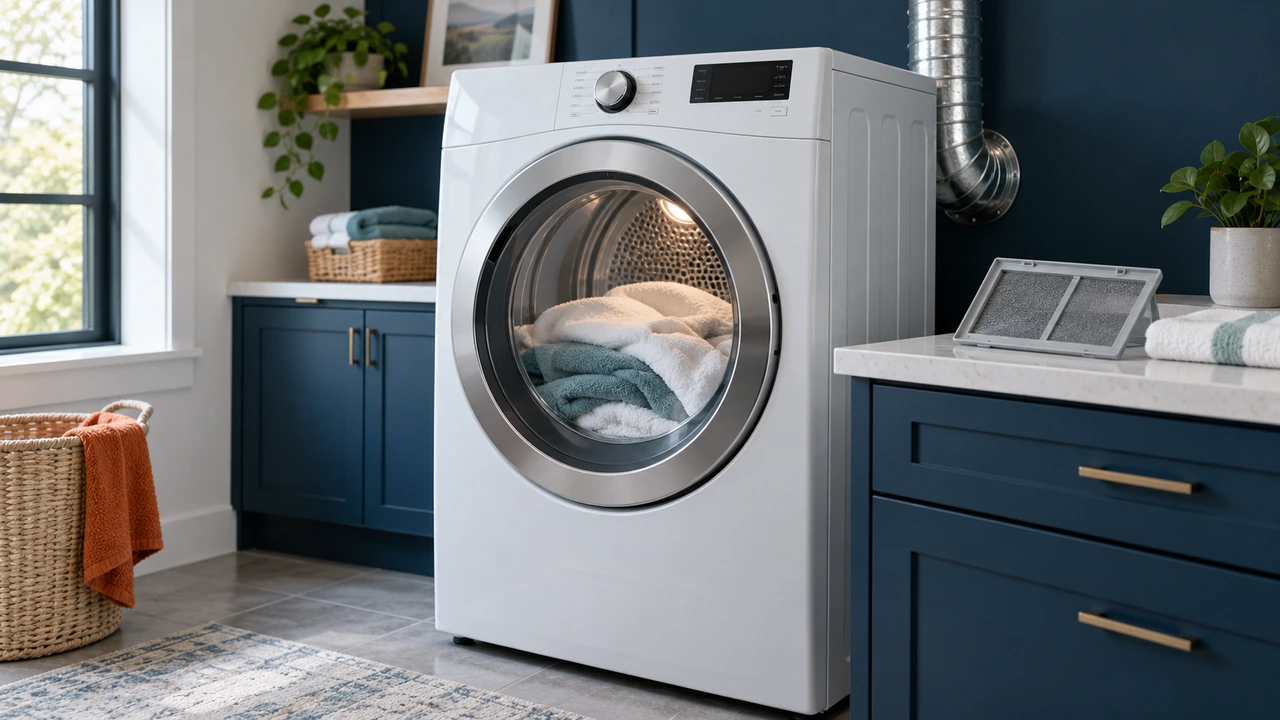
 If your GE dryer will not heat up but the drum still turns, start with the cycle selection and the supply that powers its heater. GE Appliances explains that many electric dryers can tumble when part of their 208/240-volt supply is missing, while a gas dryer may tumble with its gas supply turned off. A blocked exhaust can also make clothes stay damp even when the dryer produces heat.
Stop using the dryer if you notice smoke, a burning smell, scorch marks, a hot or damaged plug, or repeated breaker trips. If you smell gas, leave the area without operating switches or flames and contact your gas utility or emergency service from a safe location. Do not attempt to find or repair the leak yourself.
First decide: no heat at all or clothes taking too long to dry?
These symptoms point toward different checks. If the drum stays cold during an appropriate heated cycle, look at cycle settings, electrical or gas supply, and possible heating-system faults. If it becomes warm but laundry remains wet, check airflow, load size and the condition of the exhaust duct before ordering parts.
Choose a regular heated or timed-dry cycle permitted by your model’s manual, rather than Air Fluff, No Heat or the final cool-down portion of a programme. Give the dryer time to begin heating and stop it before cautiously checking for warmth. Heat-pump and other specialty models may behave differently; use their specific instructions instead of judging every design by a short test.
Five safe checks before calling for service
- Confirm a heated setting. Check both the cycle and temperature selections. A fluff or cool-down setting intentionally runs without added heat.
- Clean the lint filter. Remove lint and reseat the screen correctly. If residue blocks the mesh, wash it according to your manual and dry it completely before reinstalling.
- Inspect accessible ventilation. With the appliance off, look for a crushed flexible duct, a blocked outdoor hood or piles of lint around the outlet. Do not run a gas dryer with its exhaust disconnected.
- Check the load. A packed drum, bulky towels mixed with lightweight clothes or laundry that was poorly spun by the washer can lengthen drying times.
- Identify gas or electric heating. Check the appliance label or model documentation. The next step depends on how your dryer generates heat.
Why a GE electric dryer runs but does not heat
On many North American GE electric dryers, the heating system requires the full specified 208/240-volt circuit, while the drum motor may continue running with only partial voltage. GE explicitly advises checking the household breaker because a partially tripped breaker may not look tripped. The paired breaker may be reset once using its normal labeled procedure, provided there is no evidence of overheating or damage.
If the breaker trips again, stop resetting it and call a qualified electrician. Do not open a receptacle, remove the power-cord terminal-block cover or use a meter on live wiring. A defective cord, loose connection or incorrect voltage can be dangerous and cannot be diagnosed safely from drum movement alone.
Could the heating element be burned out?
Yes. A failed heating element is one possible cause after the electrical supply has been ruled out. Other model-dependent possibilities include a high-limit thermostat, thermal cutoff, sensor, relay, timer or control fault. These parts are not interchangeable across GE dryer families, and there is no reliable way to identify the bad part from the no-heat symptom alone.
A technician should use the complete model number and relevant service information before opening the cabinet or testing the heating circuit. Replacing the element without confirming the electrical supply may leave the real problem unresolved.
Why a GE gas dryer tumbles but stays cold
GE’s guidance for gas dryers begins with the heated-cycle setting, unobstructed airflow and the gas supply. A conventional North American gas dryer normally uses a dedicated 120-volt electrical outlet for the motor and controls, but it needs gas to make heat. If a newly installed dryer’s shutoff valve was left closed, the drum may turn without heating.
Check a shutoff valve only if it is readily accessible, clearly identified and safe to inspect, with no gas smell. Do not move the dryer to reach hidden pipework, loosen connections, try to light the burner manually or bypass a safety switch. If the gas supply is available and the dryer remains cold, have a qualified gas-appliance technician investigate the ignition and burner controls.
Can a blocked dryer vent cause little or no heat?
A restricted exhaust more commonly causes long drying times, excessive moisture and overheating rather than a simple, continuous loss of heat. GE’s Check Vent alert on equipped models indicates low airflow. A badly restricted duct can also contribute to safety-device operation or overheating-related failures.
With the dryer unplugged, inspect only accessible ducting and the exterior vent hood. Remove loose lint where it can be reached safely and make sure the outdoor flap is not stuck. If the run is inaccessible or packed with lint, arrange professional cleaning. GE recommends inspecting and cleaning exhaust ductwork at least annually, with more frequent attention when lint accumulates quickly.
Follow the installation instructions for duct material, diameter, length and bends. GE generally recommends a four-inch metal exhaust for suitable conventional models and warns against flexible white plastic ducting. Never operate a gas dryer without exhausting outdoors; combustion products can include carbon monoxide.
GE dryer symptoms and what they suggest
| What you notice | Possible explanation | Next safe step |
|---|---|---|
| Drum turns but stays cold | No-heat cycle, supply loss or heating-system fault | Select heated cycle; identify gas or electric model |
| Electric dryer spins but never heats | Partial 208/240-volt supply or internal heater fault | Check paired household breaker once; seek service |
| Gas dryer spins without heat | Gas supply off or burner-system fault | Inspect only a safely accessible known shutoff; call gas service |
| Drum gets warm but clothes stay wet | Blocked exhaust, overloaded drum or damp starting load | Clean filter and accessible exhaust; correct load size |
| Check Vent warning appears | Low exhaust airflow on models with that feature | Stop and inspect/clean the venting before further use |
| Burning odor or unusually hot cabinet | Potential overheating or electrical hazard | Stop use; arrange professional inspection |
Does a failed thermal fuse stop a GE dryer from heating?
It can, depending on the design and which protective component has opened. On some dryers, a thermal fuse stops the motor; on others, a thermal cutoff or thermostat interrupts heating. A drum that still turns is not enough to confirm or exclude every protective component.
Repeatedly replacing a thermal protection device without addressing blocked venting or another overheating cause is unsafe. Never bypass a fuse, thermostat or door switch to test the dryer. Model-specific inspection and replacement belong to a qualified technician.
Why does the GE dryer heat briefly and then go cold?
Normal thermostatic cycling turns heat on and off during drying, and a cool-down stage is intentional. But if clothes remain wet, the drying time rises sharply or the machine becomes abnormally hot, investigate the lint screen and vent first. Irregular heating can also result from a control, thermostat, electrical connection or gas ignition problem.
If a breaker repeatedly trips or an overheating warning returns, stop testing rather than repeatedly restarting the machine. Those patterns need professional diagnosis.
Should you reset a GE dryer that is not heating?
A restart may help after a temporary control interruption, but it will not repair a heater, restore a missing supply leg or remove a lint blockage. GE provides different operating instructions for different models; do not assume every GE dryer uses the same button sequence. Check the user manual before trying a model-specific reset, and do not use a reset to ignore a recurring safety fault.
When is professional repair the better option?
Arrange service when a correct heated cycle remains cold after the accessible checks, a vent warning continues after cleaning, or the dryer repeatedly overheats. Household power-supply faults should be handled by an electrician; ignition and gas-system problems require an appropriately qualified gas technician. Internal heater, thermostat and control diagnosis also requires suitable service expertise.
Before requesting an estimate, note the complete GE model number, whether the appliance is electric or gas, any displayed alert and whether it makes some heat or none. Ask for the diagnostic charge, parts and labor estimate, and whether the proposed repair addresses an underlying airflow issue.
The useful starting point is simple: confirm a heated cycle, distinguish cold tumbling from slow drying, check the appropriate supply and inspect accessible airflow. If those steps do not explain the problem, a model-specific diagnosis is more reliable than replacing parts by guesswork.

Daniel Brooks is a US-based appliance troubleshooting researcher with 12 years of experience studying washer, dryer, refrigerator, and dishwasher faults. He reviews manufacturer manuals and converts technical error codes into safe, practical guidance for homeowners.