If your Kenmore gas clothes dryer is tumbling but not heating, start with the cycle setting, the visible gas shutoff valve and the lint screen. An Air Only setting produces no heat, and a closed gas valve can leave the drum running while clothes stay cold. If the dryer heats at first and then stops, the problem may be different from one that never ignites. Do not assume either symptom identifies a failed part. 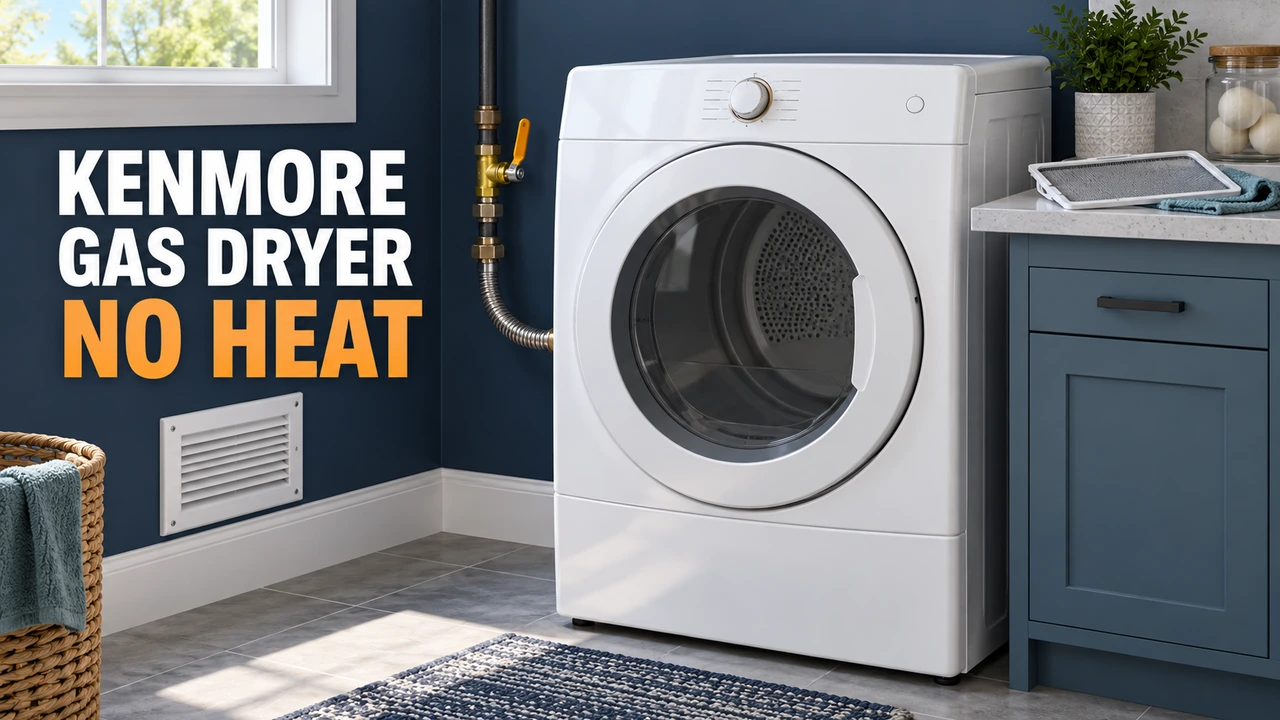
Gas safety comes first: If you smell gas, leave the area immediately. Do not use electrical switches, unplug equipment, operate a phone inside or attempt to find the leak. Call your gas supplier or emergency service from a safe location. For other warning signs such as smoke, scorching smells or repeated electrical trips, stop using the dryer and seek qualified service.
Which no-heat symptom matches your Kenmore dryer?
| What happens | Check first | Possible next diagnosis |
|---|---|---|
| Drum turns but clothes stay cold | Heated cycle and accessible gas shutoff | Ignition or heating safety circuit |
| Dryer heats once, then stops heating | Lint screen and exhaust airflow | Intermittent burner-control or valve-coil fault |
| Clothes are warm but take several cycles to dry | Vent restriction and load size | Airflow or temperature-control problem |
| Problem started after installation or moving | Installer’s gas supply and vent setup | Gas connection, fuel setup or airflow issue |
| Dryer does not turn on at all | Power, door closure and control settings | No-start fault, not necessarily a heating fault |
1. Make sure the cycle calls for heat
Check the controls for Air Only, Air Fluff, No Heat or an equivalent setting. Choose a normal heated programme suitable for the garments, following the owner’s guide. On models with automatic moisture sensing, a very small or nearly dry load may end sooner than expected; that alone does not prove the burner is defective.
If your Kenmore manual describes a safe way to confirm heating during a timed programme, follow it. Avoid repeated test cycles when heating is erratic, or if you notice abnormal heat, smell or noise.
2. Check the accessible gas shutoff without moving the dryer
A Kenmore gas dryer uses gas for heat and electricity for its motor, controls and ignition system. The drum may tumble even if the gas supply is off. If the manual shutoff valve is readily visible and you can positively identify it, check its position against the installation instructions. On common quarter-turn valves, a handle parallel to the pipe indicates open, while a perpendicular handle indicates closed.
Do not drag the dryer out, loosen the flexible connector, try to purge the gas line or turn an unidentified valve. If the dryer was recently installed, moved or converted between natural gas and propane, ask a qualified gas installer to verify the approved fuel configuration and connection. Kenmore-branded dryers span several manufacturers and model families; the correct instructions depend on the complete model number.
3. Clean the lint screen and assess the outdoor exhaust
Switch the dryer off and let it cool. Clear lint from the removable lint screen and reinstall it fully. Check the outside vent hood from a safe, accessible location for obvious lint accumulation, nesting material or a stuck flap. Look for any visible crushed duct without pulling on the appliance or gas line.
A blocked vent can cause slow drying and overheating. On some designs, thermal protection can interrupt heating after excessive temperatures. The vent must comply with the model’s specified material, routing and length. Never disconnect the exhaust to run a gas dryer indoors, and do not substitute plastic or unapproved foil ducting.
4. If the dryer heats once and then loses heat
This pattern is useful information for a technician. Sears’ Kenmore troubleshooting guidance identifies weak gas valve coils as one possible cause of heating that works initially and then fails. Restricted exhaust airflow or another temperature-related fault can produce overlapping symptoms, so valve coils should not be ordered based on timing alone.
Record whether the dryer stops heating only after it warms up, whether the cycle continues tumbling and whether drying time has recently increased. Do not open a burner inspection cover or watch the flame through a removed panel to diagnose it.
5. Why an igniter or flame sensor may be involved
Many Kenmore gas dryers use an electric igniter to begin burner ignition. The flame-sensing and gas-valve components work as part of a controlled ignition sequence. A defective igniter, sensor, valve coil or other control can prevent heat even while the motor operates. These parts are not interchangeable across every Kenmore model.
An igniter that does not light, an igniter that glows without a burner flame, and a burner that fails to relight may suggest different faults. Those observations require properly guarded, model-specific service procedures. Homeowners should not bypass safety controls, test live burner circuits, manually ignite the burner or replace gas-control parts without the appropriate qualifications.
6. Could the thermal fuse or thermostat stop the heat?
Kenmore gas dryers may use thermal fuses, thermal cutoffs, thermostats and other protective components. Their effect depends on the dryer design: one failed device may stop heating, while another may prevent the motor from operating. A tripped or open safety component is a reason to investigate overheating and airflow, not merely to install a new fuse.
Never bridge a thermal fuse, defeat a thermostat or fit an unapproved replacement. A qualified technician should inspect the appropriate circuit using the exact model’s documentation and correct the underlying cause before returning the dryer to service.
7. Find the correct Kenmore model before ordering anything
Look for the full model number on the appliance rating label, commonly near the door opening or another location specified in the manual. Do not use the Kenmore name alone to select a burner, igniter or valve-coil kit. Different Kenmore lines use different designs, parts and installation instructions. The number prefix can help identify a product family, but the entire model number is needed to confirm compatibility.
Also confirm that the appliance is a gas dryer. Online results for a generic ‘Kenmore dryer not heating’ search frequently describe electric heating elements and 240-volt supply faults; those are not a diagnosis for a gas burner’s failure to heat.
When should you stop troubleshooting?
- Gas smell: Leave immediately and contact the gas emergency service from outside the affected area.
- Smoke, scorching or electrical trips: Stop use and arrange qualified inspection.
- No heat after settings and accessible checks: Arrange diagnosis of the ignition, gas-valve and thermal-protection systems.
- Recently moved or newly installed dryer: Have the installer verify supply and venting without improvising gas-line work.
- Persistent long drying times: Have the complete exhaust route and heating performance evaluated.
Before booking service, note the exact model number, selected cycle, whether the drum turns, whether heat is absent throughout or disappears after startup, and whether an exterior vent restriction is visible. That description gives a repairer more useful evidence than a guess about a particular coil or igniter.
Keep the dryer heating safely
Clean the lint screen as directed, prevent heavy lint buildup at the exterior vent, avoid overloading and maintain the approved exhaust installation. If a no-heat fault returns, do not repeatedly restart the dryer or assume a reset will repair a failed component. For a Kenmore gas dryer, the sensible boundary is clear: check settings and accessible airflow or supply conditions yourself; leave the burner and internal safety circuit to a qualified professional.
Daniel Brooks is a US-based appliance troubleshooting researcher with 12 years of experience studying washer, dryer, refrigerator, and dishwasher faults. He reviews manufacturer manuals and converts technical error codes into safe, practical guidance for homeowners.