
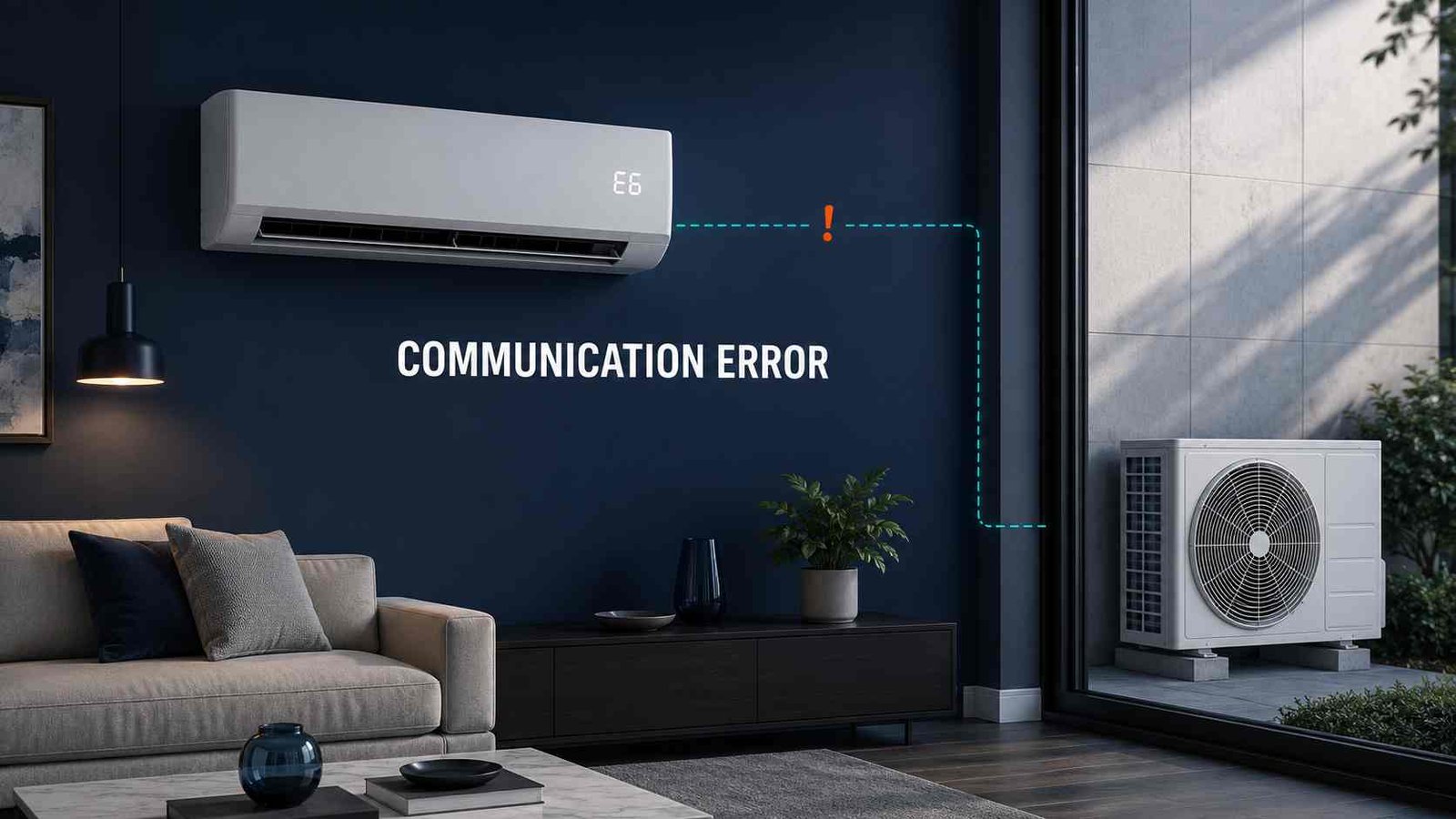
 The Gree Air Conditioner E6 Error Code usually indicates a communication failure between the indoor and outdoor units of a Gree split or mini-split system. The units are receiving power or attempting to operate, but control information is not passing correctly between them.
Start by turning the air conditioner off and disconnecting power at the correct breaker or isolator for 10 minutes. Restore power and test the system once. If E6 returns, the underlying wiring, power, controller, or control-board problem still needs diagnosis.
Do not continue using the air conditioner if you notice a burning smell, smoke, repeated breaker trips, melted wiring, buzzing, or water entering an electrical area. Switch off the power and arrange professional service.
Gree E6
| Item | Details |
|---|---|
| Error code | E6 |
| Common meaning | Communication failure within the system |
| Usually affects | Gree split, mini-split, multi-zone and selected U-Match systems |
| Main communication path | Indoor unit to outdoor unit |
| Most common reported cause | Incorrect interconnecting wire, a splice or a wiring fault |
| Safe first action | Switch power off for 10 minutes, then restart once |
| Can the system still run? | It may run partially, but normal heating or cooling is usually interrupted |
| Repair difficulty | Moderate to advanced |
| Homeowner repair recommended? | Only external observations and one power reset |
| Professional help needed? | Yes, if E6 returns after the reset |
Gree’s official FAQ defines E6 as a communication failure within the system. Its current technical guidance says incorrect wire or a splice in the interconnecting cable is more common than control-board failure.
What Does E6 Mean on a Gree Air Conditioner?
On researched Gree mini-split systems, E6 means that the indoor and outdoor units are not communicating properly.
A split air conditioner does not operate as two independent appliances. The indoor unit, outdoor unit, sensors and control electronics continuously exchange operating information. When those signals are missing, interrupted or invalid, the system may stop the compressor and display E6.
The fault does not automatically prove that the outdoor PCB has failed. Gree specifically advises technicians to investigate the complete wiring path before replacing a control board.
Confirm the code for your exact model
The communication-fault meaning is well documented for Gree residential mini-splits, multi-zone equipment, Vireo Gen3 systems and selected U-Match models.
However, Gree sells different air-conditioning products in different countries. Owners of portable, window, packaged or specialised commercial units should check the manual for the exact indoor and outdoor model numbers before ordering parts or accepting a diagnosis.
What Happens When a Gree AC Displays E6?
The exact behaviour depends on the system and operating mode.
On one documented Gree multi-zone system:
- During cooling, the compressor stops while the indoor fan may continue running.
- During heating, the complete system stops.
This explains why a homeowner may still feel air coming from the indoor unit even though the room is no longer cooling. Fan operation alone does not confirm that the compressor or outdoor unit is working.
Other possible symptoms include:
- The outdoor unit does not start
- The air conditioner runs briefly and then stops
- One indoor head displays E6
- Every indoor head displays E6
- E6 appears immediately after startup
- E6 appears several minutes after startup
- The code returns after a power outage or recent installation work
Most Common Causes of the Gree E6 Error
1. Incorrect interconnecting cable or a splice
Gree’s current technical guide identifies a wrong cable or a splice in the wiring run as the leading cause of E6 service calls.
The problem may not be visible at the indoor or outdoor terminals. A technician may need to inspect the complete cable route between the units rather than checking only the two ends.
Cable specifications are model and region dependent. Gree’s North American technical material refers to particular cable requirements for many mini-splits, but those specifications must not be applied automatically to every Gree model worldwide.
2. Loose, crossed or damaged wiring
Communication can fail when:
- Terminal positions do not match between the units
- A connection has loosened
- A conductor is broken
- The cable has poor continuity
- A termination is badly crimped
- A connection is corroded or heat-damaged
A visual check from outside the closed electrical compartments may reveal obvious cable damage. Removing terminal covers or handling conductors should be left to a qualified technician.
3. The outdoor unit has lost power
The indoor display can remain active even when the outdoor section has no usable power.
Possible reasons include:
- A tripped outdoor breaker
- An open isolator or disconnect
- A failed fuse
- A supply problem
- A loose power connection
- A fault inside the outdoor electrical section
Official multi-zone diagnostic instructions tell technicians to check both the indoor-to-outdoor connections and power to the outdoor unit when investigating E6.
4. Incorrectly connected accessory
A condensate pump, float switch or other accessory can interrupt the communication circuit if it has been installed incorrectly.
This cause deserves particular attention when E6 began:
- Immediately after a condensate pump was installed
- After drainage work
- After an accessory or safety switch was replaced
- After an installer modified the wiring
Gree’s technical guidance specifically tells technicians to inspect connected accessories during E6 diagnosis.
5. Wired-controller problem on selected U-Match systems
E6 is not limited to indoor-to-outdoor communication on every model.
Gree New Zealand’s U-Match R32 service documentation states that E6 may be reported when communication is lost between:
- The outdoor and indoor units
- The indoor unit and wired controller
On those systems, possible causes include loose or broken communication wiring, an incorrect controller address, an incorrect number of connected controllers, or a faulty controller. The manual reports E6 after communication has been absent continuously for 120 seconds.
These details should not be applied to a wall-mounted mini-split unless its own service documentation confirms the same control arrangement.
6. Indoor or outdoor control-board fault
An indoor PCB or outdoor PCB can cause E6, but board replacement should come after the wiring, power supply, accessories and connections have been tested.
Replacing a board based only on the displayed code can be expensive and may leave the real wiring fault unresolved. Gree’s technical guidance repeatedly warns that E6 does not automatically mean the outdoor main board is defective.
7. Model mismatch or incorrect system configuration
Selected Gree service literature lists mismatched indoor and outdoor equipment or improper voltage among possible causes of communication failure.
This possibility is most relevant when:
- The fault began immediately after installation
- One unit was recently replaced
- A control board was replaced
- The system has never operated correctly
- The indoor and outdoor model numbers do not form an approved combination
This is a technician-level installation check, not a homeowner adjustment.
How to Reset the Gree E6 Error Code Safely
A power reset can clear a temporary communication disturbance, but it cannot repair incorrect wiring or a failed component.
Safe power-cycle procedure
- Turn the air conditioner off with the remote control.
- Locate the breaker, disconnect or isolator that supplies the complete system.
- Switch the power off.
- Leave the system disconnected for 10 minutes.
- Restore power.
- Wait for the unit to initialise.
- Select cooling or heating and test the system once.
- Record how long it takes for E6 to return.
Gree’s FAQ recommends turning the breaker off for 10 minutes to clear an error code. Its Vireo Gen3 owner’s manual advises restarting the unit and contacting a qualified HVAC technician if the problem remains.
Safety warning: Do not repeatedly reset a breaker that trips again. A recurring trip may indicate an electrical fault. Leave the system off and arrange professional inspection.
What the Reset Result Means
E6 does not return
The problem may have been a temporary interruption following a power fluctuation or control lockup.
Continue to observe the system. If E6 returns later, record what the system was doing and arrange service.
E6 returns immediately
Gree’s 2026 technical guide says that an E6 appearing at startup points technicians toward the indoor side first.
This is a diagnostic clue, not proof that the indoor board has failed. Indoor wiring, the indoor controller, connected components and the PCB still require proper testing.
E6 returns after three to four minutes
Gree advises technicians to focus first on the outdoor side when the code appears approximately three to four minutes after startup.
Again, the timing does not confirm which part is defective. It only helps decide where diagnosis should begin.
E6 keeps returning after every reset
The communication problem has not been corrected. Gree states that E6 will not remain cleared until the underlying fault is resolved.
Do not continue power-cycling the system in the hope that damaged wiring or a faulty board will recover.
Safe Homeowner Checks
You can collect useful information without opening electrical compartments.
1. Record both model numbers
Find the model label on:
- The indoor unit
- The outdoor unit
Photograph both labels. Do not rely only on a remote-control number or a sales receipt.
2. Confirm how many zones are affected
For a multi-zone system, check every indoor head.
Write down whether:
- Only one indoor unit shows E6
- Several units show E6
- Every indoor unit shows E6
This distinction helps the technician narrow the fault.
3. Observe the outdoor unit
From a safe position, note whether the outdoor unit:
- Starts normally
- Makes no sound
- Starts and then stops
- Has a visibly open isolator
- Shows obvious external damage
Do not remove its electrical cover.
4. Check for recent events
Tell the service technician if E6 appeared after:
- A power cut
- A thunderstorm
- New installation
- Control-board replacement
- Condensate-pump work
- Electrical work
- Moving or extending the system cable
- Renovation near the cable route
5. Look for immediate danger signs
Switch off the system if you notice:
- Burning or melting smells
- Smoke
- Crackling or arcing
- Repeated breaker trips
- Water near electrical parts
- Blackened cable insulation
- A damaged outdoor electrical enclosure
Checks Homeowners Should Not Attempt
Do not:
- Open indoor or outdoor electrical compartments
- Remove wires from numbered terminals
- Test live AC or DC voltage
- Test a communication bus
- Bypass a float switch or condensate safety
- Move wires to different terminals
- Replace an indoor or outdoor PCB
- Test capacitors or inverter components
- Work on the unit while energised
- Assume a wiring layout from another Gree model
Gree’s detailed E6 procedure includes live measurements, wire isolation and service-tool testing. That information is intended for trained HVAC personnel, not routine homeowner troubleshooting.
One Indoor Unit Shows E6 Versus All Indoor Units
Only one indoor unit is affected
On a multi-zone system, one affected head may direct attention toward:
- That indoor unit’s branch wiring
- Its terminal connections
- Its indoor PCB
- Its communication circuit
- Its controller, where fitted
Gree’s multi-zone service documentation provides a specific diagnostic path for communication failure affecting only some indoor units.
Every indoor unit is affected
When all indoor units lose communication, the shared side of the system becomes more important.
A technician may prioritise:
- Outdoor-unit power
- Shared communication wiring
- Outdoor board connections
- Outdoor filter or control boards on applicable models
- Main indoor-to-outdoor communication faults
Gree provides a separate diagnostic path for E6 affecting all indoor units.
This pattern helps organise testing, but it does not identify a failed part by itself.
What a Technician Should Check
A qualified HVAC technician should use the service manual for the exact indoor and outdoor model combination.
A sensible diagnosis normally includes:
- Confirming that E6 has the same meaning on the exact model.
- Checking the incoming power supply.
- Confirming that the outdoor unit is properly powered.
- Comparing indoor and outdoor terminal connections with the wiring diagram.
- Inspecting the entire interconnecting cable run.
- Checking for joins, splices, breaks or incorrect cable.
- Inspecting accessory wiring such as condensate pumps and float switches.
- Checking communication signals with the correct instruments.
- Using a compatible Gree service tool where available.
- Isolating the indoor unit, outdoor unit and cable before condemning a PCB.
- Confirming system compatibility after any unit or board replacement.
Gree’s current procedure allows technicians to simulate the indoor and outdoor units separately with a compatible service tool. When both sections pass independently, the interconnecting wiring becomes the likely fault area.
Parts That May Be Involved
| Part or area | Why it may cause E6 | Replacement should occur when |
|---|---|---|
| Interconnecting cable | Communication signal is interrupted or distorted | Testing confirms incorrect, broken or unsuitable cable |
| Terminal connection | Loose or crossed conductors prevent communication | The connection is damaged or cannot be secured correctly |
| Condensate-pump wiring | Incorrect accessory wiring interrupts the control path | The installation does not match the model diagram |
| Wired controller | Selected U-Match units can lose controller communication | Wiring and address settings are correct but the controller fails testing |
| Indoor PCB | Indoor unit cannot send or receive the required signal | Wiring and connected components pass model-specific tests |
| Outdoor PCB | Outdoor unit cannot communicate with the indoor unit | Power, cable and indoor-side checks are satisfactory |
| Model-specific filter or interface board | Communication or power is interrupted on selected systems | The exact service procedure identifies the board as defective |
Do not order a board using only the E6 code. Use the complete model number and obtain a confirmed diagnosis first.
Can You Continue Using a Gree AC With E6?
Normal operation should not be expected while E6 is active.
Although an indoor fan may continue running on some models, heating or cooling may have stopped. Repeated attempts to operate the unit will not repair the communication fault.
Leave the system off and request service when:
- E6 returns after the 10-minute reset
- The breaker trips
- The outdoor unit does not start
- All zones have stopped
- The problem followed wiring or installation work
- There is visible electrical damage
- You smell burning
- The system behaves unpredictably
Regional and Model Differences
The core homeowner advice is similar across the US, Canada, the UK, Ireland, Australia and New Zealand: restart once, avoid internal electrical work and use the exact model documentation.
Terminology varies:
- US and Canada: breaker, disconnect, mini-split
- UK and Ireland: circuit breaker, isolator, split air conditioner
- Australia and New Zealand: circuit breaker, isolating switch, split-system air conditioner
Wire type, terminal layout, controller configuration, supply voltage and permitted electrical work can differ significantly. Do not apply North American wiring specifications to a UK, Irish, Australian or New Zealand model unless the relevant manual confirms them.
Frequently Asked Questions
What does E6 mean on a Gree air conditioner?
On researched Gree split and mini-split systems, E6 means a communication failure within the system, commonly between the indoor and outdoor units.
How do I clear the Gree E6 error code?
Turn the unit off and disconnect power at the correct breaker or isolator for 10 minutes. Restore power and test it once. If E6 returns, professional diagnosis is needed.
Does E6 mean the outdoor control board is bad?
Not necessarily. Gree says incorrect wire or a splice is more common than component failure and advises checking the wiring path before replacing the outdoor main board.
Can a power outage cause E6?
A power interruption can leave controls needing a restart, which is why a power cycle is a reasonable first check. If E6 returns, a persistent communication, power or component fault must be investigated.
Why is the indoor fan running when E6 is displayed?
On selected Gree systems in cooling mode, the compressor stops while the indoor fan continues. The fan may move air, but the system is not providing normal cooling.
What does it mean when E6 appears immediately?
Gree’s current technical guidance says an immediate E6 points technicians toward the indoor side first. It does not prove that the indoor PCB requires replacement.
What does it mean when E6 appears after three or four minutes?
A delayed E6 points technicians toward the outdoor side first, according to Gree’s technical guidance. Wiring and power still need to be checked before replacing components.
Can I fix E6 by reconnecting the wires myself?
Homeowners should not open electrical covers or move terminal wiring. Mini-split communication circuits may be combined with mains-voltage wiring and inverter electronics. Have a qualified HVAC or electrical professional perform internal checks.

Emily Carter is an Australian home-appliance safety editor with 9 years of experience researching washers, air conditioners, refrigerators, and coffee machines. She checks troubleshooting steps for accuracy, regional model differences, and homeowner safety before publication.