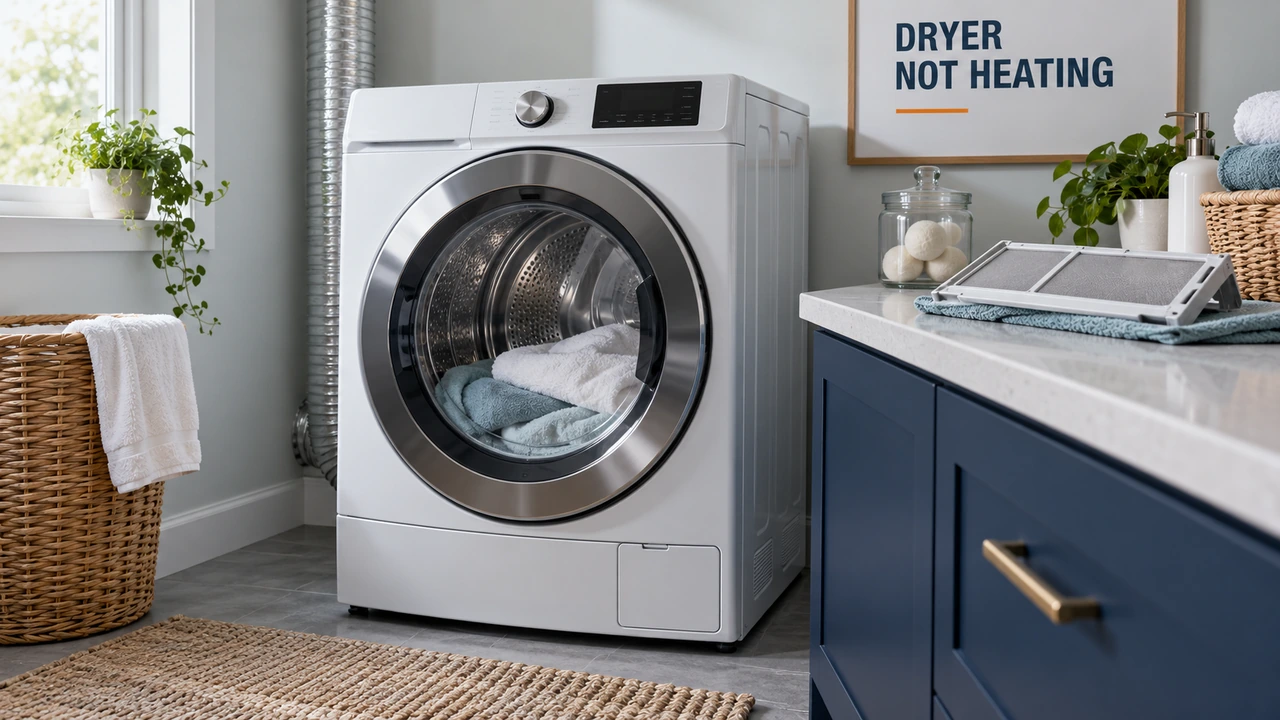
 If your dryer will not heat up but the drum still turns, check the cycle setting and household power supply before assuming the heating element has failed. On a gas dryer, an interrupted gas supply is another possibility. If clothes are taking too long to dry rather than staying completely cold, a clogged lint filter or restricted exhaust vent deserves attention first.
Stop using the dryer if you notice a burning smell, smoke, scorch marks, an unusually hot cabinet or a damaged power cord. If you smell gas, leave the area, avoid switches and flames, and contact your gas utility or emergency service from outside. Do not attempt to locate a gas leak yourself.
First, find out whether the dryer makes any heat
There is a difference between a dryer that never warms up and one that heats but cannot remove moisture efficiently. After cleaning the lint screen and confirming the vent is not visibly obstructed, select a normal heated timed cycle, not Air Fluff, Air Only or a cool-down setting. Follow your model’s operating instructions; some manufacturers recommend checking after about five minutes with an empty drum. Stop the cycle before opening the door.
If the drum and air remain cold, focus on the heat source, power supply and controls. If there is some warmth but wet clothes remain after a full cycle, focus on airflow, load size and moisture-sensing settings. Do not repeatedly run a dryer that has poor exhaust airflow.
Six checks you can make without opening the dryer
- Confirm the selected cycle. Air Only, Fluff and the final cool-down portion of a cycle are designed to operate without added heat. Try a heated timed cycle that your owner’s manual permits.
- Clean and reseat the lint filter. Remove lint before every load. If the screen has residue from fabric-care products, clean it according to the manual and let it dry fully before reinstalling it.
- Look at the external exhaust path. With the dryer off, check for a crushed or sharply kinked accessible vent hose and obvious lint at the outside termination. The exterior flap should be able to open freely. Have inaccessible or heavily clogged ductwork professionally cleaned.
- Check the load. An overloaded drum or clothes that entered the dryer excessively wet may cause long drying times, even when the heater works. Separate heavy items and verify the washing machine spun the load normally.
- Check the household breaker. On many North American electric dryers, the motor can run even when one side of the 208/240-volt supply is lost. If you can safely identify the dedicated dryer breaker, follow its labeled reset instructions once. If it trips again, leave it off and call an electrician.
- Check the gas shutoff position only if you have a gas dryer. If the readily accessible valve and your manual clearly identify the open position, verify that the valve is open. Do not move the dryer, disconnect pipes or manipulate an unfamiliar valve.
Why an electric dryer can run but not heat
Many full-size North American electric dryers require a 208- or 240-volt supply for heating, even though the drum motor may run with only part of that supply available. That is why a dryer can tumble normally after a breaker or fuse problem yet produce no heat. Do not test a live outlet or remove the dryer’s terminal-block cover yourself. A qualified electrician can establish whether the specified voltage reaches the appliance safely.
If the supply checks out, a technician may investigate the heating element, high-limit thermostat, temperature sensor, thermal cutoff, wiring and controls. Which components can stop heat depends on the exact design. A heating element is not confirmed faulty merely because the drum is cold.
Why a gas dryer can tumble without heating
A gas dryer usually uses electricity for its motor and controls, but gas provides the heat. The drum may therefore turn when the gas valve is closed or the gas service is interrupted. A qualified technician may also need to inspect the igniter, burner-related sensors, valve coils or control system.
Do not remove burner covers, attempt to light the burner manually, bypass flame-safety devices or loosen a gas connection. If the supply is known to be available and the dryer still produces no heat, arrange gas-appliance service.
Could a clogged dryer vent cause the problem?
Yes, but distinguish poor drying from no heat at all. Blocked exhaust airflow commonly leaves clothes damp despite some heat. Serious overheating can also cause protective devices to interrupt heating, depending on the dryer. A vent restriction by itself does not establish that a thermal fuse has blown.
Inspect only the visible, accessible venting. If the duct is crushed, blocked, excessively long or fitted with unsuitable material, have it corrected in accordance with the installation instructions and local requirements. Never operate a vented dryer with its exhaust intentionally directed into a living space. Ventless heat-pump and condenser dryers use different moisture-removal arrangements; follow their filter and heat-exchanger care instructions instead.
Common symptoms and what to check next
| Symptom | Likely direction | Next action |
|---|---|---|
| Drum turns, clothes stay completely cold | Wrong cycle, missing electrical supply or heating fault | Check heated setting and applicable breaker; seek service if unchanged |
| Some heat, but clothes remain damp | Restricted airflow, large load or sensing problem | Clean lint screen, inspect accessible vent and try a suitable load |
| Electric dryer stopped heating after a power issue | Tripped supply breaker or electrical fault | Check labeled breaker once; call an electrician if it trips again |
| Gas dryer tumbles but stays cold | Gas shutoff or burner-system issue | Verify only an accessible known valve position; arrange gas service |
| Heat returns briefly, then disappears | Overheating protection, airflow or control fault | Stop repeated testing and request a diagnosis |
| Burning odor or unusually hot exterior | Potential fire or electrical hazard | Stop use immediately; have the appliance inspected |
Is a blown thermal fuse the reason?
A thermal fuse or thermal cutoff can interrupt dryer operation or heating when an over-temperature condition occurs, but its effect varies by model. Some dryers will not run at all after a particular fuse opens. A technician must identify the correct component and investigate the underlying cause, especially blocked airflow, before replacing a failed protective device.
Never bypass a thermal fuse, thermostat or door switch to see whether the heat comes back. Protective parts must be replaced only with the correct model-compatible specification.
What if the dryer heats for a few minutes and then goes cold?
First rule out normal cycling: dryers regulate heat during operation, and a cool-down stage at the end is intentional. If drying performance has clearly deteriorated or heating stops abnormally early, inspect accessible airflow paths and stop use if you suspect overheating. An intermittent heating element, temperature-control component or gas burner fault can require professional testing. The pattern alone cannot identify a particular part.
Does resetting the dryer help?
It may restore operation after a temporary control interruption, but a reset cannot repair damaged wiring, a failed heating component or a blocked vent. Use a reset sequence only if the manufacturer provides one for your model. Avoid repeated breaker resets or random button combinations, and never use a reset to dismiss a recurring safety-related fault.
When to repair the dryer rather than replace it
After the simple checks, record the model number, the selected heated cycle, whether the drum turns, whether the air warms at all, and whether drying times changed gradually or suddenly. These details help a repairer distinguish a supply issue from an airflow, control or heating-system fault.
Ask for an estimate that includes diagnosis, parts and labor. Compare it with the dryer’s condition, age, parts availability and replacement cost; there is no reliable universal repair-cost threshold. For gas-system work, live electrical testing, damaged cords, recurring breaker trips or internal disassembly, use appropriately qualified professionals.
The quickest safe approach is to establish whether the dryer produces any heat, confirm you selected a heated cycle, check the lint screen and accessible exhaust, then check the correct power or gas supply. If those checks do not explain it, stop guessing at parts and arrange a model-specific diagnosis.

Daniel Brooks is a US-based appliance troubleshooting researcher with 12 years of experience studying washer, dryer, refrigerator, and dishwasher faults. He reviews manufacturer manuals and converts technical error codes into safe, practical guidance for homeowners.