
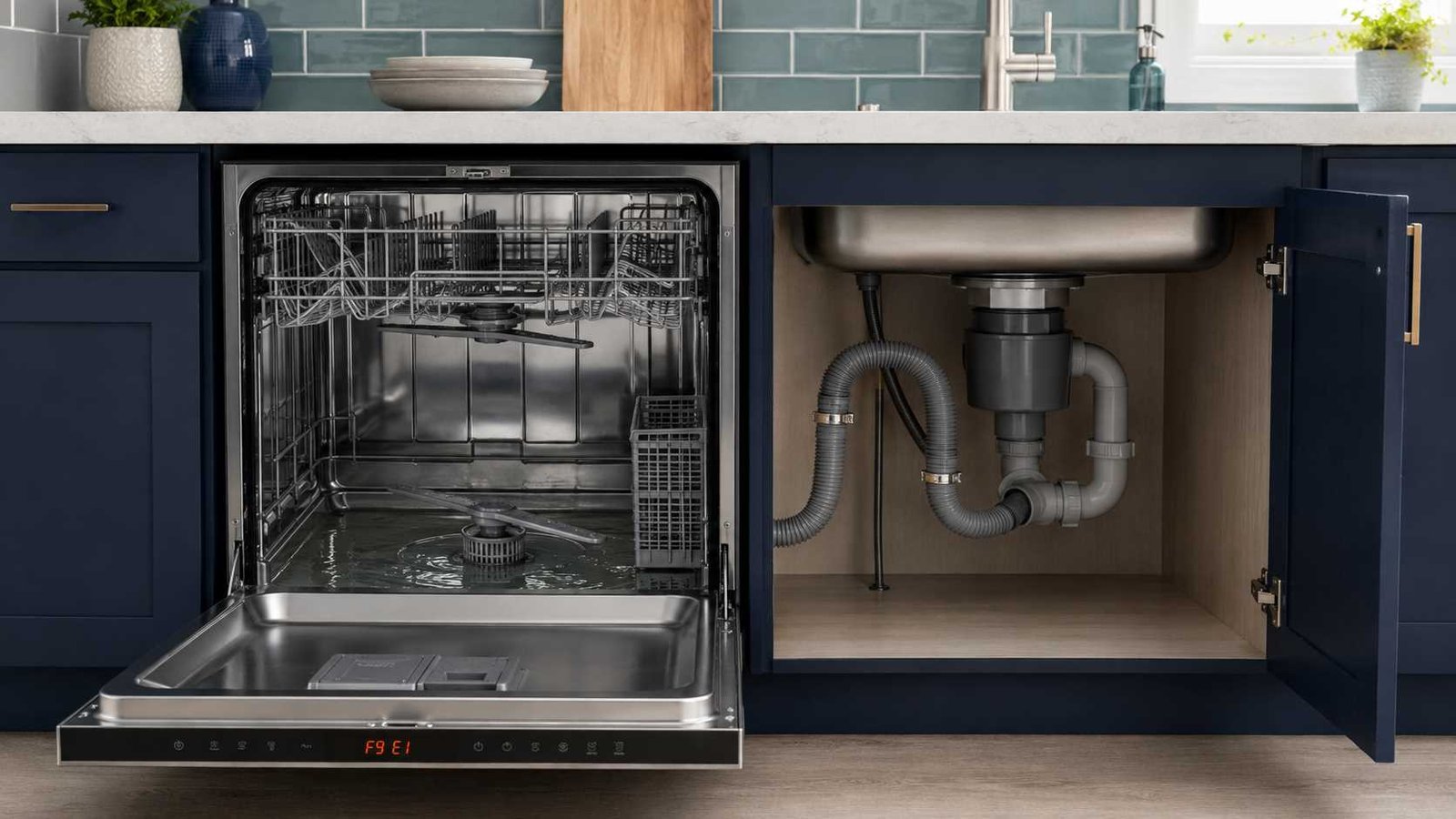
 The Whirlpool Dishwasher F9 E1 error usually means the machine is taking too long to drain or cannot drain the water from its tub. Start by disconnecting power and checking the removable filter, visible drain hose, sink connection, garbage disposer, and countertop air gap where fitted.
Do not keep starting new wash cycles while dirty water remains inside. Stop using the dishwasher immediately if it is leaking, producing a burning smell, making unusual electrical noises, or tripping the circuit breaker.
There is one important exception: some older Whirlpool dishwasher platforms use 9-1 for a diverter-position fault, not a drain fault. Confirm the complete model number before ordering a pump or other replacement part.
Whirlpool F9 E1 Quick Answer
| Item | Details |
|---|---|
| Error code | F9 E1, F9E1, E1 F9, or nine flashes followed by one flash |
| Current meaning | Long drain or dishwasher not draining |
| Possible older meaning | Diverter cannot find its correct position |
| Most common checks | Filter, drain hose, sink drain, disposer connection and air gap |
| Safe first action | Disconnect power and inspect the filter and visible drain route |
| Official reset | Disconnect power for 30 seconds |
| Repair difficulty | Basic external checks are usually simple; internal diagnosis requires service |
| Can it still be used? | Avoid using it until it drains correctly |
| Service is needed when | The code returns after accessible blockages and installation issues are ruled out |
Whirlpool’s current Product Help documentation lists F9E1 as Long Drain, while its newer service platform describes it as Draining: Product Not Draining.
What Does F9 E1 Mean on a Whirlpool Dishwasher?
On current North American Whirlpool dishwashers, F9 E1 means the control has detected that the appliance is not draining as expected.
The control may detect this when water remains in the machine for too long. The code tells you that a drainage problem exists, but it does not identify one confirmed failed part.
Common explanations include:
- A dirty or incorrectly installed filter
- A kinked or pinched drain hose
- Food debris in the sink drain or garbage disposer
- An unopened disposer knockout plug after installation
- A blocked countertop air gap
- Excessive detergent foam
- An internal restriction
- A drain-system component that requires professional testing
Whirlpool specifically directs owners to check the filter, drain hose, disposer connection and air gap before arranging service.
Confirm Your Dishwasher Model First
Whirlpool has used different fault-code systems across dishwasher generations. That matters because F9 E1 does not have one universal meaning on every Whirlpool-built dishwasher.
| Dishwasher platform | Meaning of F9E1 or 9-1 |
|---|---|
| Current documented platform | Product not draining or long drain |
| Selected older platform | Diverter cannot find its position |
A newer Whirlpool technical sheet separates these faults clearly:
- F9E1: Product not draining
- F9E2: Drain motor electrical problem
- F10E4 or FAE4: Diverter cannot find its positions
However, an older official Whirlpool technical sheet assigns:
- 8-1: Slow drain
- 9-1: Diverter cannot find position
This is why replacing a drain pump solely because the display says F9E1 can lead to an unnecessary repair.
Where to Find the Model Number
Open the dishwasher door and inspect the tub frame. Whirlpool says the model-number label on a built-in dishwasher is commonly found on the left side of the tub frame. Use the complete number, including its final letters or revision digits, when searching for the manual.
How Whirlpool Dishwashers Display the Code
A dishwasher with a digital screen may show:
- F9E1
- F9 E1
- F9 followed by E1
- E1 followed by F9
Models without a full display may communicate the fault through a flashing Clean light or another indicator.
For a flashing-light code:
- Count the first group of flashes.
- Wait for the short pause.
- Count the second group.
- Wait for the longer pause before the pattern repeats.
Nine flashes, a short pause and one flash correspond to F9E1 on control systems using Whirlpool’s two-part flashing format. Exact code systems still vary by model.
Common Symptoms of an F9 E1 Error
The code may appear with one or more of these symptoms:
- Water remains in the bottom of the tub
- The wash cycle stops before completion
- The dishwasher repeatedly tries to drain
- A humming sound comes from underneath the machine
- Dirty water remains around the filter
- The code returns soon after a reset
- The Clean light flashes nine times, pauses and then flashes once
- The dishwasher fails to move into the drying stage
The symptoms alone cannot confirm whether the problem is an external blockage, a pump issue or a different model-specific fault.
Common Causes of Whirlpool Dishwasher F9 E1
1. Dirty Dishwasher Filter
Food particles, labels, seeds, fragments of packaging and other debris can restrict water movement through the filter area.
Whirlpool removable filtration systems commonly contain an upper filter assembly and a lower filter. On applicable models, the upper assembly keeps larger objects out of the pump while the lower filter reduces food recirculation.
2. Kinked or Pinched Drain Hose
The hose running from the dishwasher to the sink may be:
- Crushed behind the machine
- Folded beneath the sink
- Pinched against cabinetry
- Restricted by debris
- Routed incorrectly after installation
Whirlpool lists a kinked, pinched or clogged hose as a direct F9E1 troubleshooting check.
3. Blocked Garbage Disposer or Sink Drain
Where the dishwasher drains through a garbage disposer, food buildup in the disposer or household drain can prevent the dishwasher from emptying.
A slow kitchen sink can therefore indicate that the restriction is in the household plumbing rather than inside the dishwasher.
4. Garbage Disposer Knockout Plug Still Installed
A new disposer has a sealed dishwasher inlet. The installer must remove its knockout plug before connecting the dishwasher hose.
If F9 E1 appeared after a new disposer was installed, this should be one of the first checks. Whirlpool specifically identifies the knockout plug as a possible cause.
5. Blocked Countertop Air Gap
Some North American installations have a small air-gap fitting beside the faucet. Food residue can collect inside it and restrict drainage.
Air-gap designs differ, so follow the air-gap manufacturer’s cleaning instructions rather than forcing parts apart.
6. Excessive Suds
Hand dishwashing liquid should never be used in an automatic dishwasher. It can create a large quantity of foam, interfere with water movement and contribute to poor drainage or leaking.
Too much automatic-dishwasher detergent can also produce excessive foam under some conditions. Whirlpool advises switching the dishwasher off and allowing visible suds to dissipate.
7. Internal Drain-System Problem
When the filter, hose and household drain are clear, the fault may involve:
- Debris deeper in the drain path
- A restricted check valve
- A mechanically obstructed drain pump
- A deteriorated drain pump
- A loose or damaged electrical connection
- An electronic control problem
These possibilities require model-specific diagnosis. F9E1 alone does not prove that the pump motor has electrically failed.
How to Fix Whirlpool Dishwasher F9 E1 Safely
1. Record the Code and Model Number
Photograph the display or write down the flashing sequence before disconnecting power.
Then locate the complete model number on the tub frame. This prevents confusion between current drain-code platforms and older diverter-code platforms.
2. Disconnect the Dishwasher from Power
Unplug the dishwasher if its plug is safely accessible. For a hardwired appliance, switch off the correct dishwasher circuit at the electrical panel.
Do not remove the lower service panel, handle wiring or perform electrical measurements. Whirlpool’s service sheet states that diagnostic voltage measurements are for authorized technicians and that power must be disconnected before servicing.
3. Remove and Clean the Filter
The exact design varies, so check the owner’s manual first.
On many Whirlpool removable-filter models:
- Remove the lower rack.
- Turn the upper filter assembly about one-quarter turn counterclockwise.
- Lift out the upper filter.
- Remove the lower filter if the design allows it.
- Rinse both parts under running water.
- Use a soft brush for stubborn deposits.
- Reinstall the lower filter.
- Refit and lock the upper assembly.
Do not use wire brushes, scouring pads or other abrasive tools because they can damage the filter.
4. Inspect the Visible Filter Area
With power disconnected and the filters removed, look for accessible debris around the filter opening.
Remove only objects that can be reached safely without dismantling the pump, sump or other internal parts. Be cautious of broken glass, bones and sharp food-container fragments.
Reinstall the filters correctly before operating the dishwasher.
5. Check the Drain Hose
Inspect the accessible hose from the dishwasher toward the sink cabinet.
Look for:
- Sharp bends
- Flattened sections
- Pinching against stored items
- A hose trapped behind the appliance
- Visible buildup near the sink connection
Straighten a simple kink without pulling the dishwasher out or disturbing electrical and water connections.
Stop if accessing the hose would require appliance removal or disassembly.
6. Check the Sink and Garbage Disposer
Run water into the kitchen sink and confirm that it drains normally.
Where a garbage disposer is fitted:
- Make sure it is switched off before inspecting the connection.
- Check whether the sink or disposer is blocked.
- Run the disposer normally if it is safe and appropriate to do so.
- Confirm that the knockout plug was removed if the disposer was recently installed.
Do not insert your hand or tools into a disposer.
7. Check the Air Gap
If an air gap is installed beside the faucet, inspect it for an obvious blockage using its manufacturer’s instructions.
Water flowing from the air gap onto the countertop during drainage often indicates a restriction in the air-gap or downstream hose.
8. Deal With Excessive Foam
If the tub contains a large quantity of bubbles:
- Stop the cycle
- Leave the dishwasher unused until the foam settles
- Remove obvious foam only by methods permitted in the owner’s manual
- Use automatic-dishwasher detergent for the next cycle
- Measure detergent according to the product instructions and water conditions
Do not add more cleaning chemicals to counteract the foam.
9. Restore Power and Test the Dishwasher
Once the filters are installed and the visible drain route is clear, restore power.
Run the machine according to the model’s manual and watch the first complete drain. Stop the test if water leaks, backs up into the sink, escapes through the air gap or the code returns.
How to Reset Whirlpool Dishwasher F9 E1
Whirlpool’s official control reset is a 30-second power cycle:
- Disconnect the dishwasher from electricity.
- Wait at least 30 seconds.
- Restore power.
- Start the dishwasher again.
A reset can clear a temporary control condition. It cannot remove food debris, straighten a hose, open a disposer connection or repair a defective component.
If F9 E1 returns, do not repeatedly reset the appliance. Continue with the drainage checks or arrange service.
F9 E1 but the Filter and Hose Are Clear
When the obvious checks do not find a blockage, consider these next possibilities.
The Household Drain Is Restricted
The dishwasher may be working but pumping into a slow or partially blocked sink drain. Watch whether the sink backs up while the dishwasher attempts to empty.
A plumbing restriction should be corrected before replacing dishwasher parts.
The Drain Pump Is Mechanically Restricted
A small object can reach an internal pump or valve even when the removable filter appears clean.
Accessing the pump normally involves removing covers or working beneath the dishwasher. That is beyond a basic homeowner check.
The Pump Has an Intermittent Problem
A pump may hum, work occasionally or stop when hot. A technician may need to inspect it under the correct model-specific procedure.
The code itself does not confirm pump failure.
The Wiring or Control Has a Fault
Loose connections, damaged wiring or control-board problems can prevent normal drainage. These require electrical diagnosis with the appliance opened and should be handled by a qualified service professional.
The Code Has a Different Meaning on Your Model
If the model belongs to an older Whirlpool platform, 9-1 may identify a diverter-position problem rather than long drainage.
Check the model-specific technical information before authorizing drain-pump replacement.
Whirlpool F9E1 Versus F9E2
| Code | Current Whirlpool description | What it tells you |
|---|---|---|
| F9E1 | Product not draining | The dishwasher has a drainage problem |
| F9E2 | Drain motor electrical problem | The control has detected a drain-motor-related fault |
Both codes may still lead Whirlpool to recommend checking the disposer, drain connection and hose first. However, their official descriptions are different. F9E1 does not automatically mean that the drain motor is electrically defective.
Can F9 E1 Mean a Diverter Problem?
Yes, but only on selected older control platforms.
The diverter directs wash water toward different spray zones. An older Whirlpool technical sheet describes 9-1 as Diverter: Can’t Find Position and lists possible causes such as:
- A loose or corroded diverter connection
- A sensor or motor circuit fault
- Mechanical binding
- Moisture or contamination around the sensor
- A control-circuit problem
These are technician-level checks involving diagnostics, electrical measurements and access beneath the dishwasher.
On the newer documented platform, the equivalent diverter-position fault is F10E4 or FAE4 rather than F9E1.
Parts a Technician May Inspect
The components depend on which code platform the dishwasher uses.
| Current F9E1 drain platform | Older 9-1 diverter platform |
|---|---|
| Filter assembly | Diverter motor |
| Drain hose | Diverter position sensor |
| Internal drain path | Diverter shaft or disc |
| Check valve | Diverter seal |
| Drain pump | Diverter wiring |
| Pump wiring | Electronic control |
| Electronic control | Sump-related components |
Do not order parts until the model number and fault definition have been confirmed.
Is It Safe to Use the Dishwasher With F9 E1?
Avoid running normal wash cycles until the dishwasher drains correctly.
Continued operation may:
- Leave dirty water around dishes
- Cause unpleasant odours
- Push water into a restricted sink drain
- Increase the chance of an overflow or leak
- Place repeated strain on the drain system
Disconnect power and stop troubleshooting immediately if you notice:
- Water underneath the appliance
- A burning or hot-electrical smell
- Sparking
- A circuit breaker that trips
- Damaged wiring
- Smoke
- Water reaching electrical outlets or cables
Regional and Installation Differences
The current Whirlpool Product Help definition is aimed mainly at United States and Canadian dishwasher platforms.
North American kitchens may use a garbage disposer and countertop air gap. These fittings are less common in some other countries, where the dishwasher may connect directly to a sink trap.
Whirlpool Australia sells different regional dishwasher model families, so Australian and New Zealand owners should use the manual supplied for their exact appliance rather than assuming the North American F9E1 definition applies. The same caution applies to UK and Irish models.
When to Call a Dishwasher Technician
Arrange professional service when:
- F9 E1 returns after the filter and accessible hose are cleared
- The drain pump hums but no water leaves the tub
- The dishwasher remains full after repeated safe checks
- The appliance leaks from underneath
- The circuit breaker trips
- There is a burning smell or electrical noise
- The pump, wiring or control requires testing
- Appliance removal is necessary to reach the drain hose
- The model’s documentation identifies 9-1 as a diverter fault
- You cannot verify which fault-code platform the model uses
Whirlpool’s technical documents classify live voltage testing and internal service diagnosis as technician work.
Reducing the Chance of Another Drain Error
- Remove large food scraps before loading dishes.
- Clean a removable filter regularly.
- Reinstall both filter sections correctly.
- Use only automatic-dishwasher detergent.
- Avoid excessive detergent.
- Keep items under the sink away from the drain hose.
- Clear the garbage disposer before starting the dishwasher.
- Check the drain connection after sink or disposer work.
- Do not operate the dishwasher without its filter fitted.
Frequently Asked Questions
How do I clear the F9 E1 code on a Whirlpool dishwasher?
Correct the drainage problem first. Clean the filter, inspect the drain hose, check the sink or disposer, clear the air gap where fitted and allow excessive suds to disappear. Then disconnect power for 30 seconds and restore it.
Can I reset F9 E1 without unplugging the dishwasher?
A hardwired dishwasher can be reset by switching off its dedicated circuit breaker for 30 seconds. Make sure you identify the correct breaker.
Does F9 E1 always mean the drain pump is bad?
No. Current Whirlpool guidance first points to the filter, drain hose, disposer and air gap. The newer fault list uses a separate F9E2 description for a drain motor electrical problem.
Why does F9 E1 return after I cleaned the filter?
The remaining cause may be a kinked hose, blocked sink drain, disposer problem, unopened knockout plug, air-gap blockage, excessive foam or an internal drain-system fault.
What if F9 E1 appeared after installing a garbage disposer?
Check whether the dishwasher-inlet knockout plug was removed. The hose can be connected correctly but remain completely blocked if the plug is still in place.
Can dish soap cause Whirlpool F9 E1?
Excessive suds can interfere with normal dishwasher performance and drainage. Use only detergent made for automatic dishwashers and allow visible foam to dissipate before testing the machine again.
Why is my Whirlpool dishwasher flashing nine times and then once?
On models using a two-part flashing code, the first group represents the F number and the second represents the E number. Nine flashes followed by one flash indicate F9E1. Exact meanings still need to be checked against the model documentation.
Can F9 E1 be a diverter error?
It can on selected older Whirlpool dishwasher platforms. An older official technical sheet assigns 9-1 to a diverter that cannot find its position, while a newer platform assigns F9E1 to a drainage problem.

Daniel Brooks is a US-based appliance troubleshooting researcher with 12 years of experience studying washer, dryer, refrigerator, and dishwasher faults. He reviews manufacturer manuals and converts technical error codes into safe, practical guidance for homeowners.