
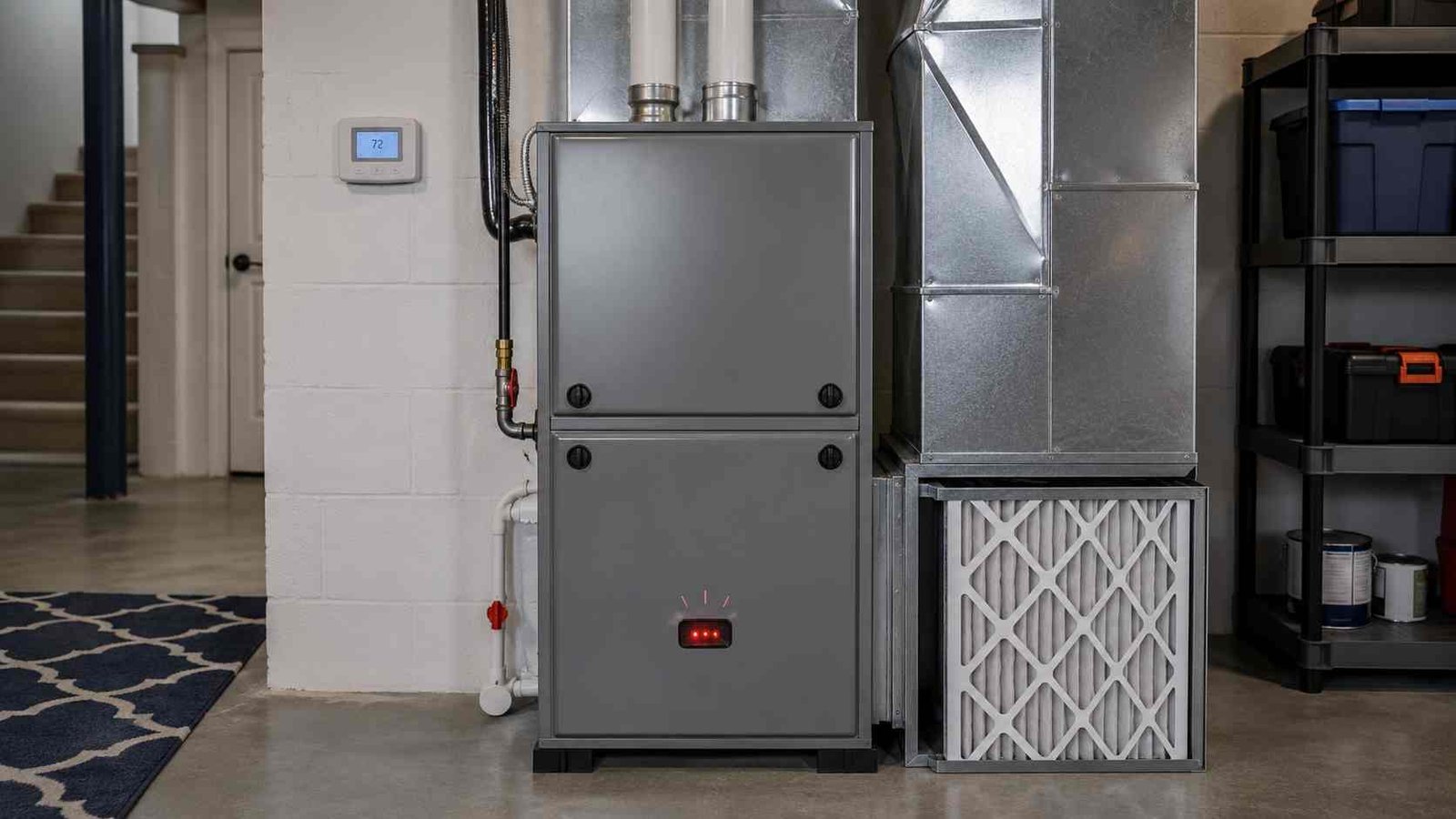
 A Trane furnace red light flashing usually means the control board has detected a fault or stored a recent fault code. The exact meaning depends on the number of flashes, the pause between them and the furnace’s model or control-board generation.
Start by watching the light through the furnace’s sight window with all access panels closed. Count one complete repeating sequence and write it down. Then check the thermostat, furnace filter, vents and power supply.
Do not open a running furnace, bypass a safety switch or attempt gas, combustion or live-electrical testing. Leave the home immediately if you smell gas or a carbon-monoxide alarm sounds. Trane states that red blinking generally signals a problem and recommends recording the pattern for an HVAC technician.
| Item | Details |
|---|---|
| Brand | Trane |
| Appliance | Residential gas furnace |
| Indicator | Flashing or solid red diagnostic LED |
| General meaning | A model-specific operating fault, lockout or stored error |
| Safe first check | Record the pattern, then inspect the thermostat and air filter |
| Can the furnace still run? | It may continue operating with some intermittent faults, but repeated red flashes should not be ignored |
| Reset guidance | Follow the exact owner’s manual; do not repeatedly cycle power |
| Repair difficulty | Basic external checks are easy; internal diagnosis requires an HVAC professional |
| Immediate danger signs | Gas smell, CO alarm, smoke, scorching, delayed ignition or repeated breaker trips |
What Does a Flashing Red Light on a Trane Furnace Mean?
A flashing red LED is the furnace control board’s way of reporting a condition it has detected. The pattern may point toward:
- An ignition lockout
- A pressure or venting fault
- An open temperature-limit circuit
- Weak or unexpected flame sensing
- An inducer problem
- A gas-valve circuit fault
- A grounding, polarity or voltage problem
- An internal control-board fault
The light alone does not prove that a particular component has failed. For example, a pressure-related code can be caused by the pressure switch, blocked venting, an inducer problem or another condition that prevents correct draft operation.
Trane also uses different diagnostic systems across its furnace generations. Some controls use numbered LED flashes, while others display codes containing letters and numbers. The diagnostic legend on your furnace or its model-specific manual takes priority over any general chart online.
Before You Count the Flashes
Watch a complete repeating sequence
Do not count every flash continuously. Look for a pattern such as:
Flash, flash, flash, pause, repeat
That would normally be recorded as three flashes.
Also note whether the indicator is:
- Flashing slowly
- Flashing rapidly
- Flashing in numbered groups
- Continuously illuminated
- Alternating with another LED
- Accompanied by an alphanumeric display
A phone video can help you review a fast or irregular sequence without standing near the furnace for a long time.
Keep the furnace panels closed
Use the viewing window where fitted. Trane advises against removing the front panel while the furnace is running. Many furnaces have a blower-door switch that shuts down the furnace when the panel is removed, which can change the light pattern or interrupt the stored fault.
Never press, tape or hold this switch closed.
Find the furnace model
Use the model number from your paperwork, warranty registration or an accessible equipment label. Model families such as XR80, XV80, XR95, S8 and S9 do not necessarily share one diagnostic chart.
When arranging service, provide:
- Full model number
- Serial number when available
- LED colour
- Number of flashes
- Length of the pause
- Whether the furnace starts
- Whether the igniter or burners activate
- Whether the blower delivers warm or cold air
Common Trane Furnace Red-Light Flash Codes
The following table comes from an official 2023 Trane integrated furnace control guide. It applies to the control documented in that guide and must not be treated as a universal chart for every Trane furnace. Your furnace label or manual overrides it.
| Red-light pattern | Meaning on the documented Trane control | What the homeowner should do |
|---|---|---|
| 2 flashes | System lockout because retries or recycles were exceeded | Check the filter and thermostat, then arrange service if the code remains |
| 3 flashes | Draft-pressure error involving possible venting, pressure-switch or inducer problems | Check only for an obvious outdoor vent obstruction; internal diagnosis is required |
| 4 flashes | Open temperature-limit switch | Turn the furnace off, inspect the filter and open vents; service is required if it returns |
| 5 flashes | Flame detected when no flame should be present | Stop resetting the furnace and call an HVAC professional |
| 6 flashes | Reversed power, igniter-control fault, poor grounding or low system voltage | Electrical diagnosis is required |
| 7 flashes | Gas-valve circuit error | Do not attempt gas-valve testing; arrange professional service |
| 8 flashes | Low flame-sense signal | Flame-sensor, burner or grounding checks require a technician |
| 9 flashes | Open inducer-limit switch | Arrange service for inducer and venting diagnosis |
| 10 flashes | Inducer communication error | Professional control and inducer-system diagnosis is required |
| Solid red | Internal gas-valve-related error or low thermostat voltage on this control | Call for service |
| Solid red and solid green | Continuous reset caused by a blown fuse or internal error | Turn the furnace off and arrange service |
On this particular Trane control, slow and fast green flashes indicate normal status. Slow green means no call for heat, while fast green means there is a call for heat. This is another reason not to assume that a slow or fast red light is normal.
Safe Checks You Can Perform
Complete only external checks that do not involve burners, gas fittings, wiring or safety controls.
1. Check the thermostat
Confirm that:
- The thermostat is set to Heat
- The set temperature is above the room temperature
- The fan is set to Auto, not On
- Battery-powered thermostats have working batteries
- The display is operating normally
Setting the fan to On can make the blower circulate room-temperature air even when the burners are not heating. Trane recommends checking the operating mode, setpoint and thermostat batteries before assuming the furnace itself has failed.
2. Inspect the air filter
Turn the furnace off before removing the filter.
Replace the filter when it is visibly clogged with dust. Confirm that:
- It is the correct size
- It is fully inserted
- The airflow arrow points in the correct direction
- No packaging remains on a new filter
A dirty filter restricts airflow and may cause overheating, ignition trouble or a limit-switch shutdown. Never operate the furnace without a filter.
A clean filter does not rule out a four-flash limit fault. Restricted ductwork, blower trouble or a faulty safety circuit may still require professional testing.
3. Open supply and return vents
Make sure supply registers are open and not covered by furniture, rugs or curtains. Return-air grilles must also remain clear.
Closing too many registers can reduce airflow through the furnace. If a limit-related code returns with a clean filter and open vents, stop resetting the system and arrange service.
4. Check the furnace power switch
The furnace normally has a nearby service switch that resembles a wall-light switch. Confirm it has not been turned off accidentally.
Check the electrical panel for a furnace or heating-system breaker. Do not repeatedly reset a breaker. A breaker that trips again may indicate an electrical fault requiring professional diagnosis. Trane recommends service when furnace power protection continues to operate.
5. Make sure the access panel is correctly installed
A loose blower door may fail to press the door-safety switch, preventing normal operation.
Turn the furnace off before touching the panel. Seat it correctly without opening internal covers or bypassing the switch.
6. Look for an obvious outdoor vent obstruction
From a safe, ground-level position, look for:
- Snow covering a vent opening
- Leaves or light debris around the termination
- Ice buildup
- An object placed directly in front of the vent
Do not insert tools into the vent or dismantle vent piping. CPSC advises keeping snow clear of fuel-burning appliance vents because blocked exhaust can allow carbon monoxide to accumulate indoors.
How to Reset a Trane Furnace Safely
There is no single reset procedure for every Trane furnace.
Trane advises consulting the owner’s manual because the permitted reset method can vary. Some model documentation may specify a particular power-cycling sequence, but that sequence should not be copied to a different furnace.
Use this approach:
- Record the complete fault pattern. A reset may erase or replace useful diagnostic information.
- Turn the thermostat to Off.
- Replace a visibly dirty filter and open blocked vents.
- Follow the reset method stated in the exact furnace manual.
- Restore normal thermostat settings and observe one heating attempt.
- Stop if the code returns.
Do not repeatedly cycle the service switch or breaker. A reset clears the control state; it does not repair blocked venting, failed ignition, overheating, weak flame sensing or an electrical fault.
Trane’s hard-lockout guidance says changing the filter is generally the only homeowner repair attempt recommended for a confirmed hard lockout. Further investigation should be left to an HVAC professional.
Why the Red Light Returns After Resetting
A returning code means the furnace detected the same condition again or found another fault during the next heating cycle.
Common possibilities include:
Ignition did not complete
The control may have attempted ignition several times without proving a stable flame. Possible technician-level causes include the igniter, flame sensor, burner condition, fuel pressure or gas-valve operation.
The furnace overheated again
A clogged filter can cause overheating, but so can a blower problem, restricted ductwork or another airflow issue. The furnace may shut off the burners while allowing the blower to run so that internal temperatures can fall.
The pressure sequence failed
A three-flash fault on the documented Trane control can involve the vent system, pressure switch or inducer. Replacing the pressure switch without testing the complete draft system may not solve the cause.
An electrical fault remains
Grounding, polarity, low voltage, wiring or control-board problems cannot be corrected by repeated resets. These require suitable instruments and trained diagnosis.
Why the Furnace Blows Cold Air While the Red Light Flashes
Cold air does not always mean the blower itself has failed.
The blower may run while the burners remain off because:
- The thermostat fan is set to On
- The furnace is cooling itself after overheating
- Ignition failed
- The high-limit safety circuit opened
- The furnace entered lockout
- A high-efficiency model detected a condensate or venting problem
Trane notes that a dirty filter can cause the furnace to overheat and shut down its heating operation. A limit-related problem can also leave the blower circulating cool air while fuel remains off.
Set the thermostat fan to Auto and inspect the filter. If the blower continues running with grouped red flashes or the burners repeatedly start and stop, arrange service.
Possible Parts and Systems a Technician May Check
A fault code identifies a circuit or failed operating condition, not always a failed part.
| Area checked | Why it may be involved |
|---|---|
| Igniter | The furnace cannot start the flame successfully |
| Flame sensor | The control does not receive a reliable flame signal |
| Pressure switch | The expected draft-pressure change is not detected |
| Draft inducer | The furnace cannot establish or communicate correct combustion airflow |
| Vent system | Exhaust or intake airflow is restricted |
| High-limit switch | The furnace overheated or the limit circuit is open |
| Blower system | Airflow may be insufficient to control furnace temperature |
| Gas valve and fuel supply | The burner is not receiving or controlling fuel correctly |
| Control board | The board may detect an internal fault or fail to control the sequence |
| Electrical supply and grounding | Incorrect polarity, weak voltage or poor grounding may disrupt operation |
Do not clean a flame sensor, test a gas valve, jump a pressure switch or measure live furnace voltage unless you are properly trained and authorised to perform that work. Trane warns that internal furnace repair involves electrical, hazardous-gas and explosion risks.
Stop Using the Furnace Immediately When
Turn off the furnace only if you can do so without entering an unsafe area, then seek professional or emergency help when:
- A carbon-monoxide alarm sounds
- You smell or hear leaking gas
- Smoke or an electrical burning smell appears
- The furnace makes a boom or delayed-ignition sound
- Flames appear outside their normal enclosed area
- Soot or scorching appears near the furnace or vent
- The breaker repeatedly trips
- The furnace has been exposed to flooding
- A five-flash or gas-valve-related code repeatedly returns
- Anyone develops headache, nausea, dizziness or unusual fatigue near furnace operation
When a CO alarm sounds, move everyone outside, call emergency services and do not re-enter until responders give permission. Do not operate a fuel-burning appliance identified as the possible CO source until trained personnel have serviced it.
If you smell or hear leaking gas, leave immediately. Do not operate lights, phones or other electronics until you are outside. Contact emergency services or the gas supplier from a safe location.
When to Call an HVAC Technician
Arrange professional diagnosis when:
- The red pattern returns after one manual-approved reset
- The furnace has no heat during freezing weather
- Two or more grouped flashes repeat
- The light remains solid red
- The furnace starts but shuts down before heating the home
- Burners ignite briefly and then go out
- The blower runs continuously with cold air
- A clean filter and open vents do not resolve the fault
- The breaker or fuse operates again
- The display shows an unfamiliar letter-and-number code
- The fault involves ignition, draft, flame, gas, limits or electrical power
- You cannot find a model-specific code chart
Tell the service company the exact flash pattern and symptoms. Trane notes that this information can help the company send an appropriately prepared technician.
Frequently Asked Questions
Is a flashing red light normal on a Trane furnace?
Usually, a repeating red light indicates a fault or stored diagnostic condition. However, indicator behaviour varies by model. Consult the furnace’s diagnostic label or manual rather than judging the light by colour alone.
What does a continuous red light mean?
A solid or continuously illuminated red LED can have a model-specific meaning. On one official Trane control, solid red indicates an internal gas-valve-related error or low thermostat voltage. Other controls may define it differently. Do not apply that meaning without confirming your model.
What does two red flashes mean on a Trane furnace?
On the documented Trane integrated furnace control, two flashes mean the system exceeded its allowed retries or recycles and entered lockout. Check the filter, record the symptoms and arrange service if the pattern remains. Other models may use a different definition.
What does three red flashes mean?
Three flashes on the documented control indicate a draft-pressure error. Possible areas include venting, the pressure switch and the inducer. These are technician-level checks. You may look for obvious snow or debris outside, but do not dismantle the vent or bypass the pressure switch.
Can a dirty filter make the red light flash?
Yes. A severely restricted filter can contribute to overheating, poor airflow, ignition trouble or lockout. Replace a dirty filter with the correct size, but seek service if the code returns after replacement.
Can I keep using the furnace while the red light flashes?
Do not assume it is safe merely because heat is still being produced. Record the pattern and verify its meaning in the model manual. Stop using the furnace immediately if there is a gas smell, CO alarm, smoke, scorching, unusual combustion noise or repeated shutdown.
Why does the light return after I reset the furnace?
The reset cleared the control state but did not correct the original condition. Ignition failure, overheating, restricted venting, weak flame sensing or an electrical fault may still be present.
Should I remove the furnace door to read the light?
Not while the furnace is running. Use the sight window when available. Removing the door may operate a safety switch, stop the furnace and alter the diagnostic sequence. Never bypass the door switch.
Daniel Brooks is a US-based appliance troubleshooting researcher with 12 years of experience studying washer, dryer, refrigerator, and dishwasher faults. He reviews manufacturer manuals and converts technical error codes into safe, practical guidance for homeowners.