
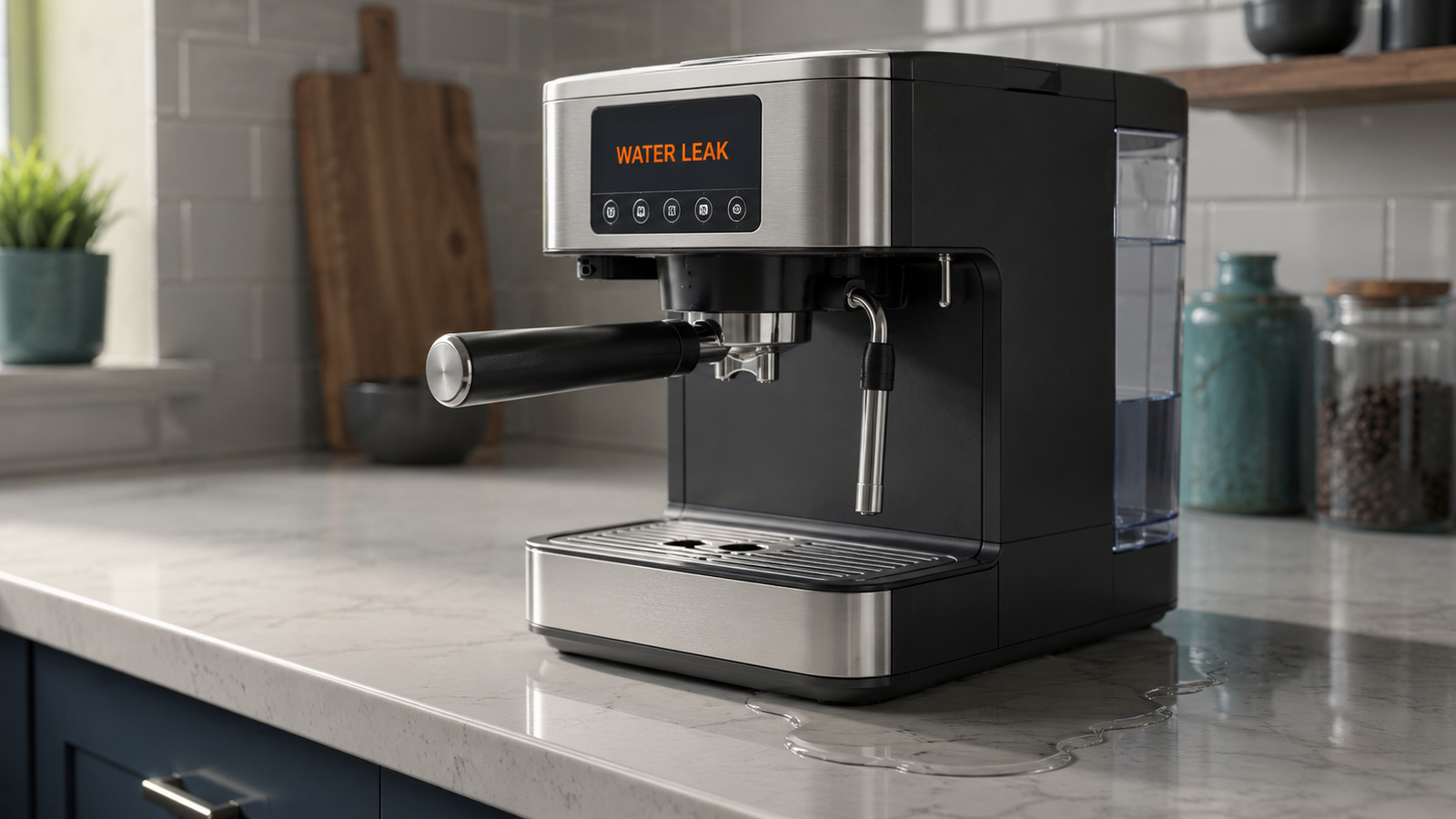
 An espresso machine leaking underneath usually has one of three explanations: an overflowing drip tray, a water tank that is not seated correctly, or water escaping from inside the machine. A small amount of water in the drip tray can be normal because many machines automatically rinse or release pressure into the tray. Water spreading across the counter, however, needs attention.
Start by switching the machine off, checking that the plug and socket are dry, and emptying the drip tray. Then inspect and reinstall the water tank. Do not open the casing or continue using the machine if water is entering the electrical base, reaching the power cord, appearing while the machine is idle, or returning after the external checks.
| Item | Details |
|---|---|
| Problem | Water appears beneath or behind the espresso machine |
| Most likely causes | Full drip tray, incorrectly fitted water tank, overfilled tank, accidental spill or internal leak |
| Safe first check | Switch off the machine, dry the counter, empty the tray and reseat the tank |
| Repair difficulty | Easy for tray or tank problems; professional diagnosis for an internal leak |
| Can you keep using it? | Only after confirming it was an external spill or tray overflow and all electrical areas are dry |
| Professional help needed | When water continues from the base, appears while idle, reaches electrical parts or is accompanied by steam, heat, smells or tripped power |
Why Is Water Appearing Under the Espresso Machine?
Water underneath the machine does not always mean an internal component has failed. Espresso machines intentionally move water through internal circuits for brewing, rinsing, heating, cooling and releasing pressure.
On many fully automatic machines, rinse water drains directly into the drip tray during startup and shutdown. Some semi-automatic machines also discharge water into the tray when changing between espresso and steam functions. De’Longhi describes water in the tray as normal on selected models because of internal water-circuit operation, while Philips and Saeco explain that automatic rinsing can make the tray fill faster than expected.
The situation becomes more concerning when water:
- Spreads beyond the drip tray
- Appears from the centre or rear of the base
- Continues while the machine is switched off
- Returns immediately after the counter is dried
- Causes the reservoir to empty unexpectedly
- Reaches the plug, cord, socket or controls
- Appears with steam coming from the rear
First Identify the Liquid
The colour and position of the liquid can help narrow down its source.
| What you see | Possible explanation | Recommended action |
|---|---|---|
| Clear water beside the tank | Tank not seated, overfilled or damaged | Remove, inspect and reinstall the tank |
| Clear water under the centre of the base | External spill or possible internal leak | Dry the area and observe where water first appears |
| Brown water near the tray | Full tray or residual brew-group rinse water | Empty, clean and correctly reinstall the tray |
| Coffee around the portafilter | Grounds on the basket rim, overfilled basket or loose portafilter | Clean and refit the brewing parts |
| Water near the steam wand | Steam control not closed, milk residue or removable seal problem | Clean only as directed in the manual |
| Water while the machine is idle | Tank connection or possible internal fault | Stop using the machine and arrange support |
| Steam from the rear or base | Possible internal pressure or water-circuit problem | Switch off and contact the manufacturer |
Clear Water
Clear water near the back or side of the machine commonly points to the removable reservoir. Philips says clear water beneath or beside selected machines is most likely caused by the tank not being pushed fully into position. Its Barista Brew guidance also warns that an overfilled or incompletely inserted tank can leak at the rear or underneath.
De’Longhi gives similar model-specific advice for the Dedica EC680: the tank must be positioned correctly and fitted tightly at the bottom connection.
Brown or Coffee-Coloured Water
Brown water does not necessarily mean the brewing unit is leaking internally. Saeco explains that a full drip tray may spill while being removed. A small amount of residual brew-group rinse water can also fall onto the surface after the tray has been pulled forward.
Clean the area and monitor it before assuming an internal failure.
Coffee Around the Portafilter
Coffee or water escaping around the portafilter is normally a separate problem from water coming through the base.
Philips advises checking that the portafilter is firmly locked into the brewing position, the upper edge of the filter basket is clean, the basket is installed correctly and it has not been overfilled with coffee. Frigidaire also recommends removing grounds from the filter-cup edge when liquid escapes outside the filter cup.
Note When the Leak Happens
The timing of the leak is often more useful than the final location of the puddle.
Immediately After Filling the Tank
Check for:
- Water above the MAX line
- Water spilled while carrying or fitting the tank
- A tank that has not dropped fully into position
- Cracks around the tank body or lower outlet
- Debris around the tank connection
- Water released briefly from the tank valve during removal
A few drops released while handling the tank may not indicate a continuing fault. Dry the machine and counter before testing again.
Only During Brewing
A leak that appears only while making espresso may be coming from:
- An incorrectly locked portafilter
- Coffee grounds trapped on the basket rim
- An overfilled filter basket
- The drip tray overflowing
- A fault inside the pressurised water circuit
Perform only the visible checks described in the machine’s instructions. Do not remove the base or access internal hoses while testing a brewing leak.
After Steaming Milk
Check that the steam control is fully closed and clean the removable frother parts according to the manual. De’Longhi advises checking for milk residue and confirming that visible removable O-rings are present and intact on relevant traditional frother assemblies.
A few drops from a cooling steam wand may be normal. Continuous leakage, leakage from the base, or steam coming from the rear requires further attention.
During Startup or Shutdown
Automatic machines often rinse when they start or shut down. The rinse water normally enters the drip tray, even when a cup is placed under the coffee spouts. This can make the tray contain more water than expected.
While the Machine Is Idle
A machine that leaks while it is not brewing, rinsing or steaming should not be treated as normal drainage. Switch it off, disconnect it when safe, empty the tank and arrange manufacturer or authorised service support.
Safe Step-by-Step Troubleshooting
1. Switch Off the Machine
Stop the current brewing or steaming operation. Allow hot parts to cool before handling the tray, tank or portafilter.
Look at the plug, cord and socket without touching any wet electrical area. When water has reached the electrical connection, do not reconnect the appliance until it has been assessed as safe.
Electrical Safety First advises unplugging water-affected or damaged electrical appliances and avoiding their use until they have been professionally assessed. It also recommends unplugging appliances that show overheating, crackling, burn marks, blown fuses or tripped circuit breakers.
2. Dry the Counter Completely
Remove cups and accessories, then wipe away all water around the machine. Drying the surface makes it easier to identify where fresh water first appears.
Do not tilt a full or hot machine. Water inside the tray or reservoir can move into other parts and make the source harder to identify.
3. Empty and Inspect the Drip Tray
Pull the tray out slowly and keep it level.
Check for:
- Water close to the tray rim
- A raised full-tray indicator
- Coffee grounds preventing proper installation
- A tray insert that is out of position
- Cracks or damage
- Water left in the tray recess
Wash and dry the removable parts as permitted by the manual, then reinstall them fully.
Frigidaire lists excess water in the drip tray as a primary cause of leakage from the bottom. KitchenAid and Nespresso also place emptying and correctly installing the tray among their first troubleshooting steps.
4. Inspect the Water Tank
Remove the tank only after switching off the machine.
Check that:
- It was not filled above the MAX mark
- Its body has no visible crack
- The bottom connection is clean
- The tank is not distorted
- The lid is fitted properly
- Any manufacturer-approved filter is installed correctly
- The tank can sit squarely in its mounting area
Do not press, dismantle or manually operate the tank valve unless the manual specifically directs you to do so.
5. Reinstall the Tank Firmly
Push or lower the reservoir into its normal operating position. The correct movement varies by machine, so consult the model manual rather than forcing it.
KitchenAid recommends checking both the tank position and the tank for cracks or damage. Nespresso likewise advises confirming that the tank is correctly attached because water can escape between the bottom of the tank and the machine when it is misaligned.
6. Check the Visible Brewing Area
For a portafilter machine:
- Remove the portafilter after it has cooled and pressure has been released.
- Clean loose grounds from the basket and portafilter rim.
- Confirm that the basket is correctly inserted.
- Avoid filling above the manufacturer’s recommended dose.
- Refit and lock the portafilter in the normal brewing position.
Stop if the handle cannot be locked normally. Excess force can damage the holder or brewing assembly.
7. Perform a Controlled Observation
Only reconnect and test the machine when:
- The plug and socket have remained completely dry
- No water has entered the electrical base
- The leak was likely caused by a tray spill, tank spill or incorrect fitting
- The machine shows no signs of electrical damage
Place the machine on a dry surface and observe it without lifting or tilting it.
Note whether water first appears:
- Beside the tank
- Around the tray
- Around the portafilter
- Near the steam wand
- From the centre of the base
- From the rear ventilation area
Stop the test immediately if water emerges from the housing.
Is Water in the Drip Tray Normal?
Yes, water in the drip tray can be normal.
Many espresso machines use the tray to collect water from:
- Automatic startup rinsing
- Shutdown rinsing
- Pressure release
- Temperature changes
- Internal circuit flushing
- Residual water from brewing
- Steam-mode purging
The amount considered normal varies by model. Do not compare a capsule machine, a manual portafilter machine and a fully automatic bean-to-cup machine by the same standard.
Saeco states that rinse water can make the tray fill quicker without indicating a leak. However, its guidance says support should be contacted if the tray becomes full after only about two drinks or fills with water overnight. This is a model-family warning sign, not a universal measurement for every espresso machine.
Will Resetting the Machine Stop the Leak?
A reset does not repair a loose tank, overflowing tray, cracked reservoir, damaged connection or internal water leak.
Nespresso troubleshooting may include unplugging the machine, emptying the tray, removing the water beneath it and reconnecting it. That process can help distinguish a temporary spill from a continuing leak, but it does not repair a physical defect.
Do not repeatedly reset or restart a machine that continues releasing water from its base.
Can Descaling Fix the Leak?
Descaling may help only when the model’s instructions connect poor water flow or leakage at the brewing area with mineral buildup.
For example, De’Longhi notes that leakage around the filter holder on selected machines can be associated with limescale and recommends following the approved descaling process before seeking technical assistance. That advice concerns a specific leakage location and should not be applied automatically to water coming from underneath the machine.
Descaling cannot repair:
- A cracked reservoir
- A damaged drip tray
- A loose tank connection
- A split internal water line
- A failed internal seal
- A damaged valve or heating connection
Never run a descaling cycle when water is already entering the electrical base.
What If the Tank and Drip Tray Are Fine?
When the tray is correctly fitted, the tank is undamaged and fully seated, and water still emerges from the housing, stop troubleshooting.
Philips directs users to support when clear water continues from underneath after the tank has been correctly installed. Frigidaire recommends authorised repair when cleaning the drip tray does not resolve bottom leakage. KitchenAid advises contacting customer service when water leaks under the unit or steam exits the rear.
Before contacting support:
- Record the brand and exact model number.
- Note whether the leak occurs during brewing, steaming, rinsing or idle periods.
- Photograph the first wet area after drying the counter.
- Note the colour and approximate amount of liquid.
- Check the purchase date and warranty documents.
- Record any warning lights, error messages, unusual sounds or smells.
- Avoid further testing if the leak is clearly internal.
Possible Parts Involved
The external checks may involve user-removable components such as:
- Water tank
- Water-tank lid
- Drip tray
- Drip-tray insert
- Capsule container
- Grounds container
- Portafilter
- Filter basket
- Removable steam or milk-system parts
A continuing under-base leak may require a technician to inspect internal seals, water connections, valves or other water-circuit components. These are possible inspection areas, not a diagnosis.
The puddle’s location alone cannot identify which internal part has failed. Manufacturers generally direct persistent under-machine leakage to service rather than providing internal repair procedures for homeowners.
Differences Between Espresso Machine Types
Semi-Automatic Portafilter Machines
Check the portafilter, basket rim, coffee dose, drip tray, rear water tank and steam controls. Leakage around the group head may be visible before water reaches the base.
Fully Automatic Bean-to-Cup Machines
Expect some automatic rinse water in the tray. Pay attention to clear water beside the reservoir, brown rinse water near the tray, rapid tray filling or water appearing overnight.
Capsule Espresso Machines
Check the water tank, drip tray and capsule container. On some models, a poorly positioned capsule or dirty capsule area may direct liquid outside its intended route. Follow the exact model’s machine-assistance instructions.
When to Stop Troubleshooting
Switch off the machine and arrange professional assistance when:
- Water reaches the power cord, plug, socket or controls
- The circuit breaker or protective outlet trips
- You notice burning, crackling, unusual heat or an electrical smell
- Steam comes from the rear or base
- Water continues from inside the housing
- The reservoir empties while the machine is idle
- The leak returns after correctly fitting the tray and tank
- The casing, tank or tray is visibly damaged
- The machine is new and may qualify for return or warranty service
Do not remove the bottom cover, test live voltage, bypass a safety device or open pressurised water and heating components.
Can You Keep Using a Leaking Espresso Machine?
Continue using the machine only when you have clearly identified the water as an external filling spill or an overflowing drip tray, corrected the cause and confirmed that all electrical areas stayed dry.
Do not continue using it when the source is unknown or appears to be inside the base. A small leak can spread internally before enough water becomes visible on the counter.
Frequently Asked Questions
Why does my espresso machine leak underneath only when brewing?
The drip tray may be overflowing, or water may be escaping around the portafilter and running beneath the machine. Clean the basket rim, avoid overfilling it and lock the portafilter correctly. Stop using the machine if water comes directly through the base.
Why is clear water leaking behind my espresso machine?
The rear water tank may be overfilled, incorrectly seated or damaged. Remove it, inspect it and reinstall it fully. Philips, De’Longhi, KitchenAid and Nespresso all include correct tank positioning among their leak checks.
Why does my espresso machine leak while switched off?
A leak while idle is not typical rinse drainage. Empty the tank, leave the machine disconnected and contact the manufacturer or an authorised repair provider.
Is brown water beneath a fully automatic coffee machine normal?
A small amount can come from an overfilled tray or residual brew-group rinse water after the tray is removed. Clean and dry the area. Continued or excessive leakage still needs investigation.
Why does the drip tray fill even when I place a cup under the spouts?
Automatic machines may release rinse and pressure-relief water internally rather than through the coffee spouts. Some water in the tray is therefore expected.
Can I seal the leak myself?
Do not apply glue, silicone or sealant to the tank connection, base or internal water circuit. It may hide the source, contaminate the water path or interfere with warranty service. Replace only approved user-removable parts identified for the exact model.
Should I descale a machine that is leaking underneath?
Not automatically. Descale only when the model instructions recommend it for the observed symptom and the machine is electrically safe. Descaling will not repair a cracked tank or internal physical leak.
Is a leaking espresso machine dangerous?
It can be when water reaches electrical components or when hot water and steam escape unexpectedly. Disconnect the machine when safe and seek professional help if the leak is internal or affects the electrical area.

Emily Carter is an Australian home-appliance safety editor with 9 years of experience researching washers, air conditioners, refrigerators, and coffee machines. She checks troubleshooting steps for accuracy, regional model differences, and homeowner safety before publication.